Nearly 300 Million Older People Are Reshaping the Home
China's market for home appliances designed for older people is expected to exceed 100 billion yuan, about US$14 billion, in 2025 and reach 1 trillion yuan by 2030, according to market consultancy All View Cloud. Behind those projections is a population of nearly 300 million people aged 60 and above, representing more than 21% of the country.
Contents
- Nearly 300 Million Older People Are Reshaping the Home
- How Large Could the Silver Economy Become?
- Older Shoppers Are Spending More on Themselves
- Haier Brings Rehabilitation and Voice Controls Home
- Hisense Turns the Television Into a Service Hub
- Changhong Connects Appliances, Health Devices and Alerts
- AI Adds Assistance and Emotional Companionship
- Robotic Pets and Care Robots Find New Roles
- Government Support Links Consumption With Care
- DeepSeek and Connected Homes Extend the Technology
- Usability and Unequal Access Remain Central Problems
- Key Points
Haier Group is developing rehabilitation robots and bathrooms with voice controls. Hisense Group is turning televisions into platforms for exercise, shopping, video calls and health services. Sichuan Changhong Electronic Holding Group is connecting appliances, medical devices and security systems so that older residents can receive medication reminders and caregivers can receive emergency alerts.
As of August 22, 2025, these developments reflect a growing effort by businesses and policymakers to support an aging population at home. For someone who has difficulty moving, a shower that responds to a spoken instruction can make washing easier. For someone living alone, a television that connects to family or a healthcare service can become much more than an entertainment screen.
China's longer life expectancy and declining birth rates are making it one of the world's oldest societies. The shift is changing healthcare needs, consumer markets and everyday life. The products and services built around those needs form what is commonly called the silver economy.
Government policies seek to stimulate consumption, improve services for older people and build a comprehensive support system by 2029. Appliance manufacturers are responding with artificial intelligence, or AI, alongside connected devices designed to make daily routines safer, healthier and more comfortable. Their commercial opportunity depends on whether older customers can afford, understand and comfortably use what they build.
How Large Could the Silver Economy Become?
China's silver economy is projected to grow from 7 trillion yuan in 2024 to 30 trillion yuan by 2035, when it could account for 9% of gross domestic product, the measure of the country's economic output. That would make the sector more than four times its 2024 size, based on the figures behind the projection.
Home appliances are one part of that wider market. All View Cloud's forecast puts appliances designed for older people above 100 billion yuan in 2025 and at 1 trillion yuan in 2030. The business extends beyond selling a replacement television or washing machine: companies are adding health functions, assistance with daily tasks and connections to care services.
China's older population is projected to increase by more than 10 million people annually over the next decade. That growth adds to demand for goods and services, while greater familiarity with technology and stronger financial resources are expected to raise expectations for quality, convenience and personalization.
The main dates combine market forecasts with a government service target:
- 2024: The silver economy's estimated starting value for the growth projection is 7 trillion yuan.
- 2025: All View Cloud expects the market for appliances designed for older people to exceed 100 billion yuan, about US$14 billion.
- 2029: Government guidelines aim to establish a comprehensive services system for older people.
- 2030: The market for appliances designed for older people is projected to reach 1 trillion yuan.
- 2035: The silver economy is projected to reach 30 trillion yuan and could represent 9% of China's GDP.
Older Shoppers Are Spending More on Themselves
Chinese seniors are increasingly willing to spend on health, wellness and lifestyle products. Older generations were once known for their frugality, but rising incomes and improved pension systems have enabled many people to seek goods and services of higher quality.
Millions of older people are also using digital platforms for shopping and payments as adoption of electronic commerce grows. Family members still influence purchases, yet seniors are becoming more independent in choosing products that improve their quality of life and support active aging.
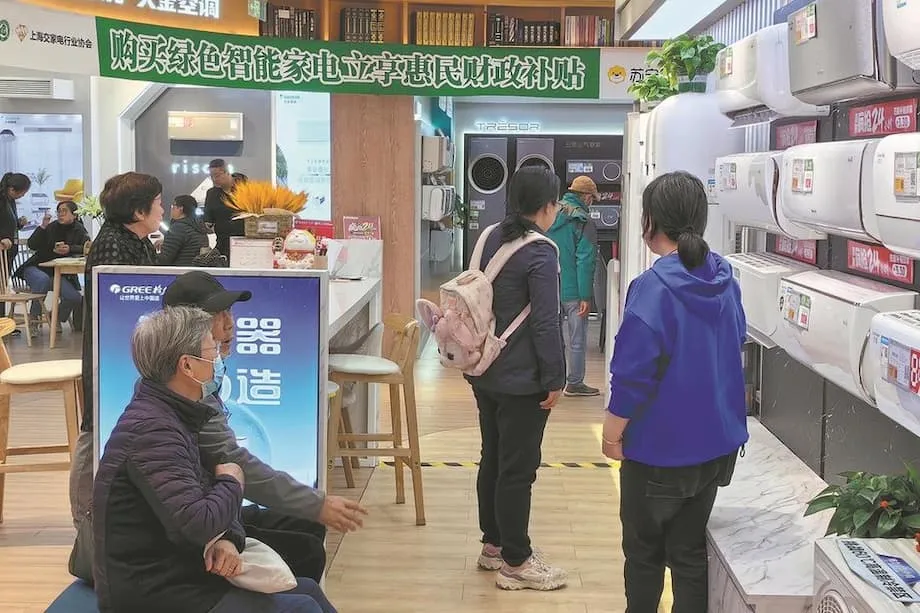
Urban areas have particularly strong demand for appliances that are easy to use and designed around health and daily living. Many older residents in cities have higher disposable incomes and are more open to new technologies. For manufacturers, that creates a market for products that combine familiar household functions with newer forms of assistance.
Older customers living alone or with limited mobility have practical reasons to seek such equipment. An appliance can help them complete a routine without another person's assistance. As their expectations grow, ease of use, reliability and the ability to tailor a product to individual needs become central parts of the purchase.
Haier Brings Rehabilitation and Voice Controls Home
Haier Group, one of China's largest appliance manufacturers, has developed rehabilitation robots that use AI to provide plans based on an older user's physical condition. The robots can monitor progress, adjust exercises and give feedback as the person uses them.
Personalization means that the same exercise routine need not be used for everyone. The system can respond to a person's condition and progress, making rehabilitation more accessible for seniors who have difficulty visiting clinics regularly. Haier's approach brings guided exercise and monitoring into the home.
Haier has also introduced toilets, showers and entire bathroom systems for older people with mobility challenges. Constant temperature control and voice recognition allow users to adjust settings with less physical effort. A spoken instruction can take the place of reaching for or manipulating a control.
Bathrooms combine several everyday needs: comfort, temperature control and the ability to move safely. Haier's products are intended to reduce accident risks while making ordinary routines easier for people whose movement is limited. The rehabilitation and bathroom products address different parts of the same goal, helping older residents manage more of daily life independently.
Hisense Turns the Television Into a Service Hub
Hisense Group has launched televisions equipped with medical-grade vision protection and tailored to older people's viewing habits. The televisions also offer activities beyond watching programmes, including games, exercise, online shopping and video conversations with family and friends.
Hisense is collaborating with hospitals to develop healthcare management platforms that bring health monitoring and telemedicine services into the television interface. Telemedicine allows a person to access healthcare services remotely, rather than relying entirely on a visit in person.
The television becomes a shared route to entertainment, social contact and health services. An older resident can use the same screen to exercise, speak with relatives or access a healthcare platform. That combination aims to help people stay connected and support mental well-being, especially when contact with others is limited.
Hisense's work also shows how manufacturers are expanding the purpose of established household products. A television is becoming an interactive platform for daily living, with hospital collaboration connecting the appliance business to healthcare management.
Changhong Connects Appliances, Health Devices and Alerts
Sichuan Changhong Electronic Holding Group has developed a smart eldercare system linking home appliances, medical devices and security systems. Its televisions equipped with AI can remind older people to take medication, monitor vital signs and alert caregivers during emergencies.
Vital signs are measurements of basic bodily functions used in health monitoring. Connecting that information with reminders and alerts allows the system to address several care needs through a network of devices, rather than leaving each appliance to operate separately.
Changhong's approach is intended to help older residents live independently while giving families greater peace of mind. The television can deliver a routine reminder, while the wider system can bring an urgent situation to a caregiver's attention.
Haier, Hisense and Changhong are pursuing different uses, but their products share a direction: household appliances are becoming connected systems that support several parts of senior living. Rehabilitation, bathing, medication, social contact and security are increasingly being brought into the same home environment.
AI Adds Assistance and Emotional Companionship
Artificial intelligence supports voice interaction, personalized assistance and health monitoring across these products. In practical terms, it helps a device respond to what someone says or adapt its assistance to that person's needs. Those functions can make appliances more accessible to older users.
Many seniors live alone, making loneliness and social isolation growing concerns. Smart speakers, televisions and robotic pets can offer conversation, reminders and entertainment. Their role is expanding from carrying out instructions to providing a form of emotional companionship for people with limited contact with family or friends.
Liang Zhenpeng, an independent consumer electronics analyst, described that change in the relationship between older users and their devices:
household appliances are becoming emotional companions for the elderly, creating a safer, more comfortable, and smarter home environment.
Liang also said manufacturers should focus on older people's basic needs while balancing the introduction of new technology with helping customers learn to use it:
With the help of AI, senior-friendly home appliances are creating a safer, more comfortable and smarter home environment for silver-haired residents," said Liang Zhenpeng. "These products should cater to the fundamental needs of the elderly, while home appliance makers need to further expand application scenarios, striking a balance between technological iteration and user education.
His comments connect two parts of the market: companies are adding capabilities, while customers need products they can understand and use. For an older resident, the value of voice controls or an automated reminder lies in how easily it fits into daily routines.
Robotic Pets and Care Robots Find New Roles
Robotic dogs and cats have become popular among Chinese seniors. These AI pets can interact physically and develop personalities based on their owners, providing companionship without the responsibilities involved in caring for a living animal.
Older people who have lost a spouse or whose children live far away may find comfort and emotional support in those interactions. The appeal combines responsiveness with convenience: the device can offer company without requiring the same care as a live pet.
More advanced care robots are also entering nursing homes and private residences. They can remind seniors to take medication, assist with daily tasks and call for help in emergencies. These functions bring companionship and practical assistance closer together.
Companion robots have been predicted to become common in Chinese households within a few years, potentially creating an industry worth a trillion yuan. That is a forecast for the robot business, alongside the separate projection that appliances designed for older people could reach 1 trillion yuan by 2030.
Government Support Links Consumption With Care
Chinese policymakers have made stronger domestic demand a central part of economic strategy, with improving living standards for older people among their priorities. Measures include special treasury bonds to support programmes for trading in consumer goods, higher pension benefits and increased spending on healthcare and social security.
Trade-in programmes encourage consumers to replace existing goods with newer products. Subsidies and other incentives for new, smart appliances can make those purchases more affordable for seniors, while supporting demand for manufacturers.
Government guidelines also call for a comprehensive services system for older people by 2029. Companies are being encouraged to develop and promote advanced products and services suited to seniors' needs. The policy effort combines household purchasing support with a broader expansion of care services.
Pensions, health spending and appliance subsidies affect different parts of an older person's budget. Together, they support the government's effort to improve living standards while encouraging consumption. Manufacturers, meanwhile, have a reason to develop products that match the needs of a growing customer group.
DeepSeek and Connected Homes Extend the Technology
China's advances in AI, 5G, the Internet of Things and cloud computing are supporting innovation in eldercare. The Internet of Things connects devices so they can share information, while cloud computing provides computing services over a network. These technologies help separate household products work together.
Chinese companies are competing in their domestic market and collaborating with international partners to bring newer technologies into products. Homegrown AI models, including DeepSeek, are being adopted across industries, with home appliances among the areas of practical application.
Midea has launched air conditioners incorporating DeepSeek that can respond to spoken expressions and adjust settings automatically. Other brands are integrating AI into vacuum cleaners, refrigerators and security systems. The direction is moving from intelligence within one appliance to connected systems across a home.
For older residents, that could bring several routines into a coordinated system: controlling the indoor environment, managing appliances and receiving assistance through connected services. More advanced nursing and housekeeping robots, home modifications using smart technology and closer connections with healthcare services are among the future developments anticipated as the market expands.
Usability and Unequal Access Remain Central Problems
Many older people have limited experience with smart devices or find complex interfaces difficult to navigate. This digital divide can make an appliance hard to use even when its functions are designed to help. User education and support after purchase are therefore part of making the technology useful.
Zhang Subing, chief expert at the China Electronics Standardization Institute, called for better technology, design and support, with particular attention to AI and health functions in the devices people use:
More efforts should be made to strengthen technological innovation, improve product design and enhance after-sales support for the elderly, with a key focus on embedding AI and health-oriented functions into intelligent terminal devices.
Standardized design and safety features are also needed to make products accessible and reliable for older users. Manufacturers must serve people with different physical abilities, levels of experience and care needs, making continued product development and customer support important parts of the market.
Older residents in urban areas and eastern provinces tend to have higher disposable incomes and better access to advanced products. Seniors in rural or less developed areas can face greater barriers to adoption. Targeted policies and inclusive design are needed to narrow that gap, so that the expansion of the silver economy reaches people beyond its most affluent customers.
Key Points
- Nearly 300 million people in China are aged 60 or above, representing more than 21% of the population.
- All View Cloud projects that appliances designed for older people will exceed 100 billion yuan in 2025 and reach 1 trillion yuan by 2030.
- Haier, Hisense and Changhong are developing rehabilitation tools, accessible bathrooms, interactive televisions and connected care systems.
- AI devices and robots offer reminders, assistance and companionship, including support for seniors living alone.
- Government measures include appliance incentives, pension increases and a target for comprehensive services by 2029.
- The silver economy is projected to grow from 7 trillion yuan in 2024 to 30 trillion yuan in 2035, potentially reaching 9% of GDP.
- Ease of use, safety, customer support and access in rural and less developed areas remain central challenges.