A Factory Revolution That Travels Beyond China
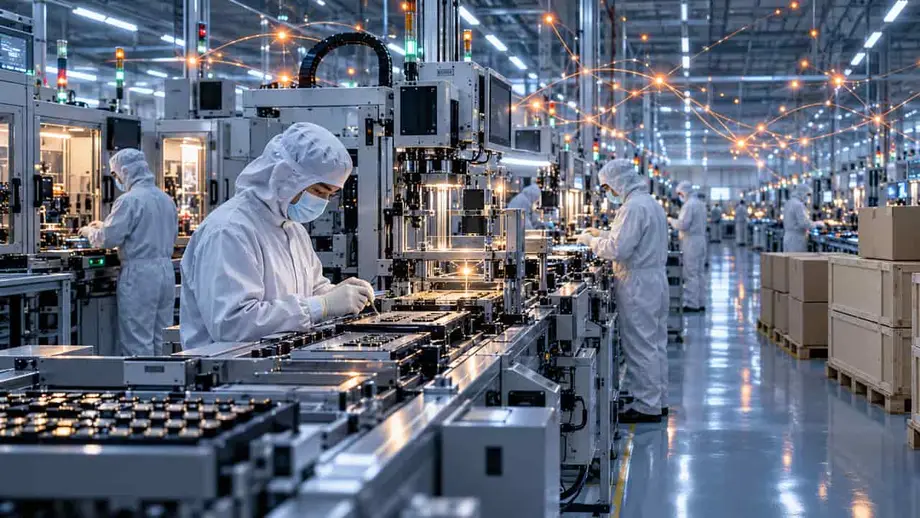
China had more than 30,000 smart factories by early 2025, including over 1,200 classified as advanced level and 230 rated at the excellence level. Xiaomi's factory in Beijing can assemble 10 million smartphones a year with minimal human intervention. Those figures point to a change in what China brings to the world economy: alongside its goods, it is spreading a way of producing them.
Contents
- A Factory Revolution That Travels Beyond China
- What Changes Inside an Intelligent Factory?
- Why AI Is Becoming Industrial Infrastructure
- Fashion Shows How Speed Becomes a Competitive Advantage
- Electric Vehicles Extend the Model Into Heavy Industry
- Government Goals Meet Business Experimentation
- DeepSeek and the Push for AI Self-Reliance
- A Timeline of Growth and Technology Restrictions
- Trade Controls Meet a Model That Can Spread
- Why the Manufacturing Contest Reaches Beyond China
- Waste, Workers and the Next Stage of Production
- The Bottom Line
For decades, China's manufacturing rise rested on inexpensive labor, enormous scale and the ability to mobilize resources quickly. Its factories supplied everything from toys to smartphones. Artificial intelligence, robotics and digital platforms are now changing that formula, helping manufacturers coordinate machines, shorten production cycles and respond faster to customers.
As of August 4, 2025, the central issue is how this combination could reshape competition beyond China's borders. A production model that keeps lowering costs can put pressure on prices elsewhere, challenge rival manufacturers and change the tasks workers perform. Its effects reach trade balances, industrial investment and employment.
U.S. Treasury Secretary Scott Bessent has expressed Washington's concern about China's reliance on exports to restore economic strength:
The Chinese cannot be allowed to export their way back to prosperity,
Bessent's warning reflects concerns about excess production capacity, government subsidies and dumping, meaning exports sold at prices considered unfairly low. China's manufacturing transformation adds another dimension to that dispute. Foreign competitors face both Chinese products and an increasingly integrated system for designing, making and delivering them.
The emerging model combines state industrial goals with business experimentation and the use of AI across the physical economy. Its influence is visible in smartphones, ultra-fast fashion, electric vehicles and batteries, although environmental costs, working conditions and technology restrictions remain substantial challenges.
What Changes Inside an Intelligent Factory?
Xiaomi's factory in Beijing illustrates the move toward production with little human intervention, often described as a lights-out factory. AI coordinates machines across the assembly process, helping optimize production, reduce waste and improve efficiency. Its annual capacity of 10 million smartphones shows how automation can operate at industrial scale.
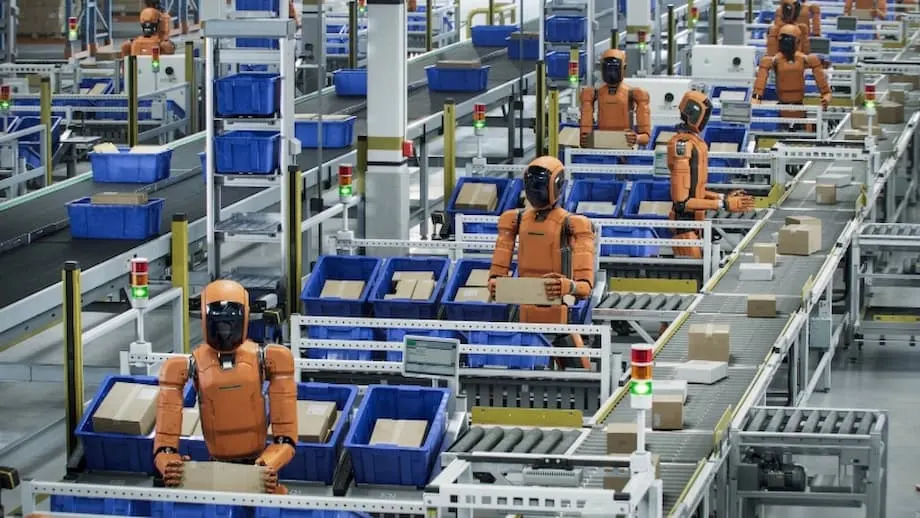
China's wider factory network increasingly connects sensors, machines and software that analyzes production data. Sensors collect information about what equipment is doing. AI uses that information to guide robotic arms, warehouse fleets and autonomous production lines, allowing adjustments while work is underway.
Manufacturers can use these systems to manage energy consumption, predict when equipment needs maintenance and fine-tune production. Predictive maintenance means identifying signs of a possible fault before a machine breaks down. Rapid customization allows a factory to change what it makes as orders or customer preferences change.
The difference lies in how widely these capabilities connect. A robot handling one task provides automation at a single point. A network linking production, inventory and logistics lets changes in one part of the operation influence the others. China's approach increasingly brings AI, robotics and digital platforms into multiple layers of its industrial base.
The smart factory totals recorded in early 2025 far exceed comparable efforts in most other countries. Sometimes described as Made in China 2.0, this approach combines government direction, entrepreneurial agility and technical capability in a model shaped by China's own industrial conditions.
Why AI Is Becoming Industrial Infrastructure
China's AI+ approach treats artificial intelligence as a capability that can spread across industries, rather than remain confined to software products or chatbots. In manufacturing, it becomes part of the infrastructure that helps businesses organize their work.
Open-source models from developers such as DeepSeek help extend access to advanced AI tools beyond major cities and large companies. Manufacturers and entrepreneurs can use these tools as part of efforts to improve production and develop new services. Wider access lowers the barrier to experimentation.
Engineers can also connect software changes more closely to physical results. Data from production feeds back into design and operating decisions, supporting short-cycle innovation: making a change, observing its effects and applying improvements quickly across a larger operation.
Factories that learn from production data can become more adaptable when demand changes and more resilient when operating conditions shift. The commercial advantage comes from the combined effects of faster learning, less waste and tighter coordination, rather than from any single machine or AI model.
Fashion Shows How Speed Becomes a Competitive Advantage
Shein and Temu demonstrate how China's manufacturing networks and digital commerce infrastructure can support ultra-fast fashion. AI helps anticipate trends, while production organized around current demand and cross-border e-commerce connects suppliers with customers abroad.
Traditional fast fashion works around seasonal collections. Ultra-fast fashion companies release thousands of new styles each week and respond rapidly to changing preferences. Just-in-time production means arranging manufacturing around demand instead of relying mainly on large quantities made far in advance.
Shein's online revenue rose from $2.5 billion in 2019 to $48 billion in 2024. Using those figures, its 2024 revenue was 19.2 times the 2019 level. The increase illustrates the scale a business can reach when digital selling and flexible production grow together.
The Shein Effect is being studied and copied by retailers worldwide. Competitors are examining how to match its speed and prices, bringing China's approach to supply chain management into decisions made far beyond its factories.
The same production system creates difficult questions about sustainability, labor practices and regulatory compliance. Releasing more styles more quickly places greater importance on how clothes are made, how workers are treated and what happens to products after consumers discard them.
Electric Vehicles Extend the Model Into Heavy Industry
China's new energy vehicle market accounts for more than half of passenger vehicle sales. Projections cited in 2025 anticipate electric vehicles overtaking vehicles powered by internal combustion engines during the year. The change puts vehicles using newer energy technologies at the center of China's automotive competition.
BYD and Xiaomi are using AI to shorten development cycles, reduce costs and bring vehicles to market faster. Applying production data and software throughout development allows manufacturers to connect decisions about design, components and assembly more closely.
Chinese automakers are also building software ecosystems around their vehicles. Subscriptions, services based on data and connections with other platforms can generate recurring revenue after the initial vehicle purchase. Competition therefore extends beyond the price of a car to the services associated with it.
China's strength reaches further up the supply chain. It controls 75% of global lithium-ion battery production and 70% of cathode capacity. A cathode is a key battery component, so those shares give China a substantial position in both finished batteries and the materials needed to make them.
CATL's battery-swap stations and sodium-ion battery technology are among the innovations intended to make electric vehicles more accessible. Battery swapping replaces a depleted battery with a charged one. Sodium-ion technology offers another route to storing electricity. Government incentives and policy support reinforce the industry's manufacturing and commercial development.
Government Goals Meet Business Experimentation
Made in China 2025, dual circulation and the 14th Five-Year Plan for Ecological and Environmental Protection help set the broad direction for industrial development. Their role sits alongside competition among local governments, state enterprises and private businesses to turn national goals into operating results.
China's approach differs from Western economies where private companies generally lead innovation and governments take a more hands-off role. Chinese industrial development relies on closer coordination between the state and business, while leaving room for firms and local authorities to experiment.
Local governments and state enterprises compete against key performance indicators, which are measures used to judge progress toward policy goals. This creates decentralized efforts within a broader national strategy. Progress in batteries, for example, can benefit electric vehicles and electronics.
Engineers move between design and production, and close collaboration between suppliers and manufacturers helps companies revise products quickly. Government direction, entrepreneurial activity and readiness for rapid technological change combine with these practical relationships.
Other countries seeking to reproduce the results face the task of building connections among businesses, technical workers and public institutions. Buying automated equipment is one part of the process. Coordinating it with suppliers, design teams and industrial goals is another.
DeepSeek and the Push for AI Self-Reliance
U.S.-led restrictions on advanced chips and manufacturing equipment have increased China's focus on an independent AI ecosystem. Huawei and Baidu are developing their own AI chips and software frameworks, while startups including DeepSeek are working on efficient model development.
DeepSeek released its R1 large language model in early 2025. A large language model, or LLM, is an AI system designed to process and generate language. R1 was presented as achieving performance close to models such as OpenAI's GPT-4 while using far fewer training resources and costing a fraction as much.
DeepSeek's progress brought greater attention to the possibility of achieving strong AI performance without continually increasing computing resources at the same rate. That shift matters for manufacturers whose ability to adopt AI depends on its cost and accessibility.
Cheaper, efficient models can support adoption in enterprises, public sector platforms and edge computing. Edge computing means running software near the machines or devices that generate data. It brings AI closer to physical operations rather than keeping every task in a distant computing center.
China's push for self-reliance both responds to technology restrictions and supports its broader production model. Domestic AI tools can spread through industrial networks, while demand from those networks gives developers reasons to improve the tools.
A Timeline of Growth and Technology Restrictions
China's manufacturing transition brings together developments that unfolded over several years. Fashion sales, environmental pressures and restrictions on technology each show a different part of the change.
- 2019: Shein's online revenue stood at $2.5 billion.
- 2020: China generated approximately 22 million tonnes of textile waste, with a recycling rate of only 20%.
- 2022: U.S.-led export controls targeting advanced chips and manufacturing equipment were introduced and strengthened in subsequent years.
- 2024: Shein's online revenue reached $48 billion.
- Early 2025: DeepSeek released R1, while China's smart factory network exceeded 30,000 facilities.
- 2025: Projections anticipated electric vehicles overtaking vehicles powered by internal combustion engines in China's passenger market.
By August 4, 2025, these developments had brought manufacturing efficiency, trade policy and access to AI into the same debate. Businesses were pursuing lower costs and faster production while governments were trying to influence which technologies could cross borders.
Trade Controls Meet a Model That Can Spread
Washington and other Western capitals are concerned that China's productivity gains, subsidies and excess capacity are distorting trade and weakening domestic industries. The policy response includes export controls, trade penalties and efforts to restrict access to strategically important technologies.
Restrictions introduced in 2022 and expanded afterward have created obstacles for Chinese companies. They have also encouraged domestic innovation and efforts toward self-sufficiency. SMIC, Huawei and other businesses are advancing chip design and manufacturing while facing continuing challenges in performance and global market access.
U.S. policy has moved from confidence toward greater uncertainty about its ability to control the worldwide spread of AI. China's rapid development and open-source approach complicate that effort because models can travel across borders differently from physical chips or factory equipment.
Open releases such as DeepSeek's also bring data sovereignty and ethical governance into the debate. Data sovereignty concerns who controls data and the rules governing its use. U.S. policymakers worry that widely accessible AI could support surveillance and cyber warfare by adversaries.
Critics of strict controls argue that restrictions can hurt American semiconductor companies and slow innovation. Both countries are imposing controls and trade penalties, including restrictions involving critical minerals. The contest concerns national security and economic power as well as technological capability.
Why the Manufacturing Contest Reaches Beyond China
East Asia, led by China and South Korea, is pulling ahead in the adoption of AI in manufacturing. Strong coordination between governments and businesses, strategies organized around industrial goals and societal support for rapid technological change help drive that progress.
Western countries and economies across the Global South seeking to bring manufacturing back home face competition from increasingly connected production systems. Building local factory capacity becomes more demanding when rivals can use AI and robotics to improve design, prototyping, logistics and service after a sale.
More cautious approaches to technology and greater attention to privacy in the West contrast with East Asia's manufacturing strategies. Where digitalization and AI adoption lag, companies may struggle to match the speed and flexibility of more integrated competitors.
China's advances could set new standards for manufacturing quality, sustainability and production managed through software. The boundary between technology businesses and industrial businesses is becoming less distinct as software influences more of the product's journey from design to customer support.
Countries competing with this model face choices about investment, industrial policy and the organization of work. The comparison is increasingly about how production is coordinated, alongside familiar measures such as wages, factory size and the prices of exported goods.
Waste, Workers and the Next Stage of Production
China generated approximately 22 million tonnes of textile waste in 2020 and recycled only 20%. Those figures expose an environmental challenge associated with the rapid production and consumption of clothing. Greater manufacturing efficiency can coexist with substantial waste.
The government is promoting sustainability through the Circular Economy Promotion Law and extended producer responsibility. Extended producer responsibility places obligations on producers for what happens to products beyond their initial sale. Balancing profitability with environmental responsibility remains unfinished work.
Shein faces criticism over supply chain practices and working conditions. Regulatory scrutiny is increasing within China and internationally as policymakers seek fair competition and protection for workers. Faster production makes the conditions under which suppliers meet demand a central part of the business model's wider effects.
China's next manufacturing phase is expected to involve closer integration, modular production and greater coordination through digital systems. Industrial clusters may develop into computational zones where physical production and digital operations function together. Modular production organizes work into parts that can be adjusted or combined as needs change.
The prospective phase sometimes called Made in China 2035 is expected to focus on design quality, sustainability and closer connections between software and hardware. No implementation timetable for that prospective phase is given. It describes a possible direction for development rather than a scheduled next step.
International cooperation on governance, standards and ethical rules will be needed as AI spreads through industry. For businesses, investors and policymakers, China's changing model brings a concrete challenge: competing on price and scale now also requires attention to innovation, industrial coordination and the future tasks of workers.
The Bottom Line
- China's emerging export is a production model connecting AI, automation, digital platforms and government industrial goals.
- By early 2025, China had more than 30,000 smart factories, including over 1,200 at the advanced level and 230 at the excellence level.
- Xiaomi's Beijing factory can assemble 10 million smartphones annually with minimal human intervention.
- Shein's online revenue rose from $2.5 billion in 2019 to $48 billion in 2024, illustrating the reach of flexible production and digital commerce.
- China controls 75% of global lithium-ion battery production and 70% of cathode capacity, supporting its electric vehicle industry.
- DeepSeek's R1 release in early 2025 strengthened attention to efficient AI development as China pursued technology self-reliance.
- Export controls, trade competition, textile waste and labor concerns remain central challenges as China's manufacturing approach spreads.