Animated Idols Make a Real Chart Breakthrough
The Saja Boys exist inside a Netflix film, but their music is competing with some of K-pop's biggest stars. As of July 5, 2025, "Your Idol," a song by the fictional boy band in KPop Demon Hunters, has reached No. 2 on Spotify's US chart, above the No. 3 peak achieved by BTS's Grammy-nominated "Dynamite" in 2020.
Contents
- Animated Idols Make a Real Chart Breakthrough
- Two Rival Groups With More Than Music at Stake
- How the Soundtrack Built Momentum
- What the BTS and Blackpink Comparisons Mean
- The Real Artists Behind Huntr/x and the Saja Boys
- Writing Songs for the Story and the Charts
- Fans Carry the Music Beyond Netflix
- BTS Joins the Moment as Real Groups Prepare Their Returns
- Merchandise, Awards and the Value of an Original Story
- Key Points
Huntr/x, the animated girl group at the heart of the same film, has made its own breakthrough. Its anthem "Golden" debuted at No. 3 on the US Spotify chart, matching Blackpink's best position for a girl group. Together, the two fictional acts have turned a movie soundtrack into a competitor for established recording artists.
The wider album has also made a strong start. The soundtrack debuted at No. 8 on the Billboard 200, the highest soundtrack debut of 2025, and reached No. 1 on Billboard's Soundtracks chart. Those rankings measure different parts of its success: the Spotify positions concern individual songs on that service, while the Billboard results concern the soundtrack album.
Released on June 20, KPop Demon Hunters accumulated more than 33 million Netflix views within its first two weeks. It topped the service's charts in 33 countries, including the United States, South Korea, Brazil and France, while its Rotten Tomatoes score stood at 97%.
The result is an unusual entertainment success built around two linked experiences. Viewers meet the characters through an animated adventure, then continue listening to their songs outside the film. Real singers, songwriters and producers supply the performances that make those imaginary groups sound like credible pop acts.
Two Rival Groups With More Than Music at Stake
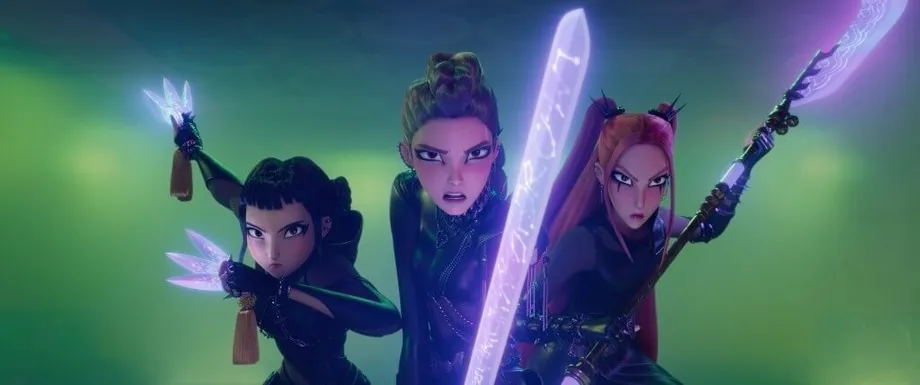
Sony Pictures Animation produced KPop Demon Hunters, which was directed by Maggie Kang and Chris Appelhans. The story follows Rumi, Mira and Zoey, the three members of Huntr/x, as they balance their lives as K-pop performers with a secret responsibility: hunting demons.
Huntr/x's music has a practical purpose within that fantasy world. It is a magical force that protects the group's fans and the wider world from supernatural threats. Their performances therefore carry the action as well as providing the film's musical spectacle.
The Saja Boys are their rivals, a boy band whose polished appearance conceals a dangerous identity. They are demons in disguise, sent by the demon king Gwi-ma to steal the souls of Huntr/x's fans. The competition for an audience becomes part of the struggle between the two groups.
The film combines fantasy action, the theatrical presentation of K-pop and themes about growing up. Its mixture of anime influences and musical theater storytelling has drawn praise from critics and fans. The songs help explain who the characters are, what they want and why their rivalry matters.
How the Soundtrack Built Momentum
The soundtrack's 12 songs generated 13.3 million official on-demand US streams in their first four days. By the end of the second week, that figure had risen to 42.8 million, with "Golden" and "Your Idol" leading the listening.
The later figure is more than three times the earlier one, although the two figures cover different listening periods. In simple terms, the album moved from attracting an initial audience to drawing a much larger volume of plays as the film spread.
The key developments unfolded quickly:
- June 20: KPop Demon Hunters was released on Netflix.
- First four days: The soundtrack's 12 songs earned 13.3 million official on-demand US streams.
- First two weeks: The film passed 33 million Netflix views, while the soundtrack's reported US streams reached 42.8 million by the end of the second week.
- July 1: BTS's first livestream after completing military service brought another moment of attention when RM sang along to "Soda Pop."
- By July 5: The soundtrack had debuted at No. 8 on the Billboard 200 and reached No. 1 on Billboard's Soundtracks chart.
What the BTS and Blackpink Comparisons Mean
The Saja Boys' No. 2 position for "Your Idol" puts the fictional group one chart place above the No. 3 peak that BTS reached with "Dynamite" on US Spotify in 2020. Huntr/x's No. 3 debut for "Golden" places it alongside Blackpink's best US Spotify result for a girl group.
The distinction between the two achievements matters to understanding the story. The Saja Boys moved beyond the cited BTS peak, while Huntr/x matched the cited Blackpink peak. Both comparisons concern positions on Spotify's US chart, where the film's characters have reached the level of major real performers.
The soundtrack has also reached the top of a different ranking, Billboard's Soundtracks chart, while entering the broader Billboard 200 at No. 8. Its success therefore stretches across individual song listening and interest in the album as a whole.
Fictional K-pop groups have not previously outperformed their real counterparts on this scale. The striking feature is that listeners are choosing the music beyond the screen, giving songs attached to animated characters a place in everyday pop listening.
The Real Artists Behind Huntr/x and the Saja Boys
Ejae, Audrey Nuna and Rei Ami provide Huntr/x's singing voices. The Saja Boys' vocal performers are Andrew Choi, Neckwav, Kevin Woo, Danny Chung and samUIL Lee. Their work gives the animated bands the individual voices listeners hear on the soundtrack.
Many of the performers have backgrounds as K-pop idols or songwriters. That experience helps connect the fictional groups to the sound and performance traditions of the real industry. The characters may be invented, but the vocal work comes from artists with their own musical skills and careers.
The songwriting and production team includes Teddy Park, whose work includes Blackpink and Taeyang; Lindgren, associated with BTS and Dua Lipa; Jenna Andrews, who has worked with BTS; and Stephen Kirk. Their involvement brought established pop production experience to a project that also had to serve an animated story.
Real K-pop group TWICE contributed as well, recording versions of the film's diss track "Takedown" and "Strategy." A diss track is a song used to challenge or attack a rival, making it a natural fit for a story about competing groups.
Writing Songs for the Story and the Charts
Ian Eisendrath, the executive music producer known for his work on The Greatest Showman, worked with the K-pop production team to make songs that could function both inside the film and outside it. That meant treating each track as a piece of storytelling and as music someone might choose to play on its own.
The process included "temping" songs into storyboards. In practice, this meant placing temporary music alongside the planned scenes so the team could judge how the songs worked with the action. Eisendrath and the songwriters then worked closely on tracks that advanced the narrative while retaining independent pop appeal.
Eisendrath described the storytelling requirement as central to the project:
Our goal from day one was to have the songs double-function as songs that forward or comment on the action story, because I do not believe you can take up screen time and not have it do something for the story.
"Golden," "Your Idol," "How It's Done" and "Soda Pop" carry that approach into the finished film. They provide memorable hooks while developing characters and moving events forward. The team's ambition was to create tracks that could "live inside the movie and stand alone on the pop charts."
The participation of established K-pop artists also mattered to Eisendrath. Reflecting on the confidence that their involvement gave him, the executive music producer said:
We've created this fictional group, and then to have the real thing authenticate it gave me faith in what we were doing—that they were interested, that they were willing. You never know when you dive into these things that are narrative, if they're going to land in the music space outside.
The chart results show that the soundtrack has found an audience beyond its immediate role in the movie. For listeners who already enjoy K-pop, it offers familiar musical energy; for newcomers, the characters and story provide an accessible introduction.
Fans Carry the Music Beyond Netflix
TikTok challenges, fan art and choreography videos have helped keep the soundtrack circulating. A viewer can discover a song in the film, encounter a dance clip afterward and return to the track on Spotify. Each activity gives the others another opportunity to attract attention.
Huntr/x and the Saja Boys have inspired fan activity that resembles the communities surrounding real K-pop groups. TikTok is filled with dance covers and fancams, videos focused on particular performers or characters. Reddit and K-pop forums host opinions, discussions and cosplay tributes, while fan art circulates on Instagram and Twitter.
The fictional groups have attracted fanbases described as rivalling those of established acts, with millions of social media mentions alongside artwork and merchandise sales. Their appeal rests partly on the way the film gives listeners personalities and conflicts to follow alongside the music.
One Reddit user described the film as an accessible starting point for people unfamiliar with the genre:
This is the perfect intro to K-pop for anyone who's been curious but didn't know where to start.
That response captures a practical benefit of the film's format. A newcomer can meet the groups, understand their rivalry and hear their songs within one story, then explore the music independently.
BTS Joins the Moment as Real Groups Prepare Their Returns
BTS appeared to welcome the animated bands' success. During the group's first livestream after completing military service, RM, its frontman, sang along to the Saja Boys' "Soda Pop." The moment connected the fictional group with one of the real acts against which its chart performance was being compared.
Netflix US marked the interaction by changing its biography to read, "BTS noticed Saja Boys 7.01.25." Director Maggie Kang has also called for a collaboration between BTS and the Saja Boys, extending the playful connection between the film and the real music industry.
Much of the K-pop community has embraced the fictional groups rather than turning the chart comparisons into fan conflict. The enthusiasm has made room for both the animated acts and the artists whose achievements provide the comparisons.
Blackpink, meanwhile, is preparing for its first world tour made up entirely of stadium shows. BTS is set to return with a new album and tour in 2026. Those plans give fans real performances to anticipate alongside their interest in Huntr/x and the Saja Boys.
Merchandise, Awards and the Value of an Original Story
Netflix's online shop recorded a 400% increase in new customers after the film's release, with band T-shirts and plush toys becoming top sellers. The response shows how interest in the characters has extended beyond watching the film and streaming its songs to buying items connected with the fictional groups.
The business appeal comes from the links between the different activities. Netflix viewing introduces the story, Spotify allows repeated listening, and social platforms keep songs and characters in circulation. Merchandise gives fans another way to express their attachment to the bands.
"Golden" has also been submitted for Best Original Song at the upcoming Oscars, a first for a Netflix animated musical. Awards consideration adds another possible outlet for music that began as part of an animated adventure.
Talk of sequels is already circulating, although no sequel release date has been given. The film's immediate achievements remain concrete: a large Netflix audience, a soundtrack in the Billboard 200's top 10, leading positions on US Spotify and demand for products tied to its characters.
The success arrives at a time when original animated features have struggled at the box office. Co-director Chris Appelhans has argued that audiences want fresh stories and bold creative choices, describing the conventional view of what animated films can be as "narrower than it should be."
KPop Demon Hunters brings those ambitions together through a specific combination of fantasy, character development and pop music. Its international Netflix reach and US listening figures show a story travelling across national and language boundaries, with the songs giving audiences a reason to remain involved after the film ends.
For the people making the music, the breakthrough is also a demonstration of their work outside its original setting. Songs written to explain a character or intensify a rivalry are now being chosen alongside releases by the artists who helped define contemporary K-pop.
Key Points
- KPop Demon Hunters was released on June 20 and attracted more than 33 million Netflix views in its first two weeks.
- The Saja Boys' "Your Idol" reached No. 2 on US Spotify, above the No. 3 peak of BTS's "Dynamite" in 2020.
- Huntr/x's "Golden" debuted at No. 3 on US Spotify, matching Blackpink's best position for a girl group.
- The soundtrack debuted at No. 8 on the Billboard 200 and reached No. 1 on Billboard's Soundtracks chart.
- Real singers, experienced K-pop producers and contributions from TWICE helped give the fictional acts their musical identity.
- Fan videos, artwork, merchandise and RM's "Soda Pop" moment have carried interest beyond the film.
- "Golden" has been submitted for Best Original Song at the upcoming Oscars, while sequel discussions have yet to produce a release date.