Visitor Numbers Rise, With Recovery Still Below Earlier Highs
Cambodia's Angkor Archaeological Park welcomed 567,673 international tourists between January and June 2025, an increase of 8.76% from the same period in 2024, according to Angkor Enterprise, the public administrative body overseeing ticket sales. Revenue reached $26.3 million, up 8% from a year earlier.
Contents
- Visitor Numbers Rise, With Recovery Still Below Earlier Highs
- What Is Helping More Tourists Reach Angkor?
- How Entry Procedures Are Changing
- Who Is Visiting the Temples?
- What Visitors Pay and Where Revenue Comes From
- How Far Has the Recovery Come?
- What the Coming High Season Could Bring
- Why Angkor Matters to Cambodia's Economy
- Protecting the Place Visitors Come to See
- Key Points
The figures show renewed demand for the ancient Khmer temples in Siem Reap province after the severe disruption caused by COVID-19. They also reveal how much ground remains to be recovered: in the first half of 2018, Angkor received 1,356,961 international visitors and earned $61.47 million from ticket sales.
Measured against that earlier period, visitor numbers in the first six months of 2025 were about 42% of the 2018 total, while ticket revenue was about 43%. Angkor is attracting more visitors than a year ago, but its recovery still has a considerable distance to go.
As of July 4, 2025, government agencies, tourism businesses and industry associations were looking toward the coming high season for further growth. Their efforts include easier ticket purchases, changes to immigration procedures, transport improvements and international promotional campaigns.
For Siem Reap, the recovery reaches beyond the temple entrances. Hotels, restaurants, guides, tour operators and artisans benefit when more visitors arrive and spend money locally. The task is to sustain those gains while protecting the monuments and their surroundings, which are central to Angkor's appeal.
What Is Helping More Tourists Reach Angkor?
Angkor Enterprise introduced automated ticket kiosks, mobile apps and online purchasing platforms in early 2025. Independent travelers and tour operators can use these systems to arrange admission more easily, reducing queues and simplifying entry.
Cambodia has also improved airport capacity and road networks, while contactless payment systems have made transactions easier. Multilingual support and tools designed for smartphones help international guests navigate services during their visits.
Chhay Sivlin, president of the Cambodia Association of Travel Agents, attributed the growth to cooperation between public bodies and businesses involved in tourism promotion:
This growth is a good sign and results in a strong partnership between the government, various ministries, and the private sector, all working to boost tourism promotion.
Government and tourism authorities have increased international marketing, including preparations for Visit Cambodia Year 2026. The Cambodia-China Tourism Year 2025 is another campaign intended to attract visitors from a specific market.
How Entry Procedures Are Changing
Cambodia's electronic Visitor Pass, known as the v-Pass, began rolling out in mid-2025, replacing traditional entry stamps and QR stickers. Travelers can complete immigration procedures in advance through the Cambodia e-Arrival platform or mobile app, helping reduce waiting times at airports and land borders.
The immigration changes and Angkor's ticketing changes address different stages of a trip. The v-Pass concerns entry into Cambodia, while the kiosks, apps and online ticket platforms make it easier to buy admission to the archaeological park.
The developments span several stages of the recovery and the government's tourism plans:
- 2020-2023: International arrivals suffered a near-total collapse during the pandemic years.
- Late 2023: Tourism began a gradual recovery, which accelerated through 2024 and 2025.
- Early 2025: Angkor Enterprise introduced automated kiosks, mobile apps and online ticket purchasing platforms.
- January-June 2025: Angkor recorded 567,673 international visitors and $26.3 million in ticket revenue.
- Mid-2025: Cambodia began rolling out the electronic Visitor Pass.
- 2026: Visit Cambodia Year is planned as a further international promotional campaign.
Who Is Visiting the Temples?
The United States, United Kingdom and France were Angkor's three leading international visitor markets in the first half of 2025, followed by China, Japan, South Korea and Canada. Most international visitors came from distant markets, despite Cambodia's proximity to Thailand and Vietnam and the steady flow of regional travelers.
Chinese arrivals reached 47,571 in the first six months, an increase of 25%. That growth was faster than the park's 8.76% increase in international visitors as a whole. Chinese tourists represented about 8.4% of Angkor's international visitors during the period.
The increase coincided with the Cambodia-China Tourism Year and improved direct flight connections. Thong Mengdavid, a lecturer at the Institute for International Studies and Public Policy of the Royal University of Phnom Penh, described how cooperation and travel arrangements could encourage further visits:
With 2025 being named the Cambodia-China Tourism Year, we can anticipate a notable surge in Chinese tourist arrivals to the Angkor Archaeological Park. This increase will likely be driven by enhanced bilateral cooperation, promotional campaigns, and greater accessibility through direct flights and group tour packages.
The closure of the Cambodia-Thailand border earlier in 2025 had a minimal effect on Angkor's ticket sales, according to tourism experts. They pointed to the composition of the park's visitors: Thai nationals do not account for the majority of admissions.
What Visitors Pay and Where Revenue Comes From
Angkor Enterprise offers three main admission options for international visitors, allowing travelers to choose between a short visit and more time exploring the temples:
- A pass for one day costs $37.
- A pass for three days costs $62.
- A pass for seven days costs $72.
The different prices accommodate both travelers making a brief stop and those planning a more detailed exploration. Self-service ticket vending machines at key locations are part of the modernized purchasing system that provides access to the park's 91 ancient temples.
Angkor Enterprise also manages ticket sales for other heritage attractions and tourism locations. Revenue in the first half of 2025 included:
- Koh Ker Temple: $181,140.
- Beng Mealea Temple: $81,990.
- Phnom Kbal Spean: $3,220.
- Chong Kneas Port: $1,216,716.
Those four revenue streams together amounted to $1,483,066. Chong Kneas Port accounted for the largest amount among them, while Angkor's $26.3 million in ticket sales remained the main source of revenue in this group.
The additional attractions broaden the range of places tourists can visit beyond Angkor's principal temples. Their earnings also give Cambodia's tourism sector more than one source of income, even while Angkor remains its leading cultural draw.
How Far Has the Recovery Come?
Angkor's first half results in 2025 combined an increase in visitors with a similar rise in revenue. Admissions grew 8.76%, while ticket income rose 8%, indicating that both measures were moving upward at a broadly similar pace.
The comparison with the first half of 2018 is more demanding. The 567,673 international visitors recorded in 2025 were 789,288 fewer than the 1,356,961 received in that earlier period. Ticket earnings of $26.3 million were $35.17 million below the $61.47 million earned then.
The pandemic years brought a near-total collapse in international arrivals, followed by a gradual recovery beginning in late 2023 and gathering pace through 2024 and 2025. For businesses that depend on tourists, the current gains represent progress after several difficult years.
Khiev Thy, president of the Angkor Tour Guide Association, expressed optimism about the coming season while acknowledging the scale of the earlier disruption:
Even though AE's revenue increased only slightly in the first half of this year, it is still a positive sign after the near-total collapse of tourism during the Covid-19 pandemic. We are optimistic that in the upcoming high season, Cambodia will see many more international tourists.
What the Coming High Season Could Bring
Tourism officials and industry stakeholders expect further growth during the second half of 2025, supported by improving international flight availability and the approach of the high season. The seasonal rebound is expected to help businesses after the quieter months.
Visitor numbers typically dip during the low season from May to August. The anticipated recovery begins in late August, with the high season continuing through early April. This pattern matters for guides, accommodation providers and other businesses whose income changes with the flow of tourists.
Global political tensions, changes in economic conditions and public health concerns remain risks to international travel demand. Tourism businesses have cautioned that continued growth depends partly on stable conditions outside Cambodia.
The government and private sector are responding with stronger international promotion, investment in staff training and new tourism products built around Cambodia's cultural and natural attractions beyond Angkor. These efforts aim to attract more visitors and give them more reasons to explore the country.
Why Angkor Matters to Cambodia's Economy
Cambodia welcomed 6.7 million international tourists in 2024. Tourism generated nearly $3.64 billion in revenue and contributed approximately 9.4% of national gross domestic product, the measure of the value of goods and services produced in the economy.
The Ministry of Tourism forecasts around 7.5 million international arrivals in 2025 and more than $5 billion in economic impact. The arrivals forecast is 800,000 higher than the 2024 figure, equivalent to growth of about 12%.
Angkor is both a source of tourism income and a useful measure of how the sector is recovering. Its first half performance reflects renewed interest in Cambodia's heritage attractions, alongside efforts to improve travel, visitor services and international promotion.
Local hotels and restaurants gain customers when more travelers come to Siem Reap. Tour operators, guides and artisans also benefit from spending connected to temple visits. These activities support jobs and community development, while tourism income contributes to preserving the cultural heritage that draws people to the area.
Protecting the Place Visitors Come to See
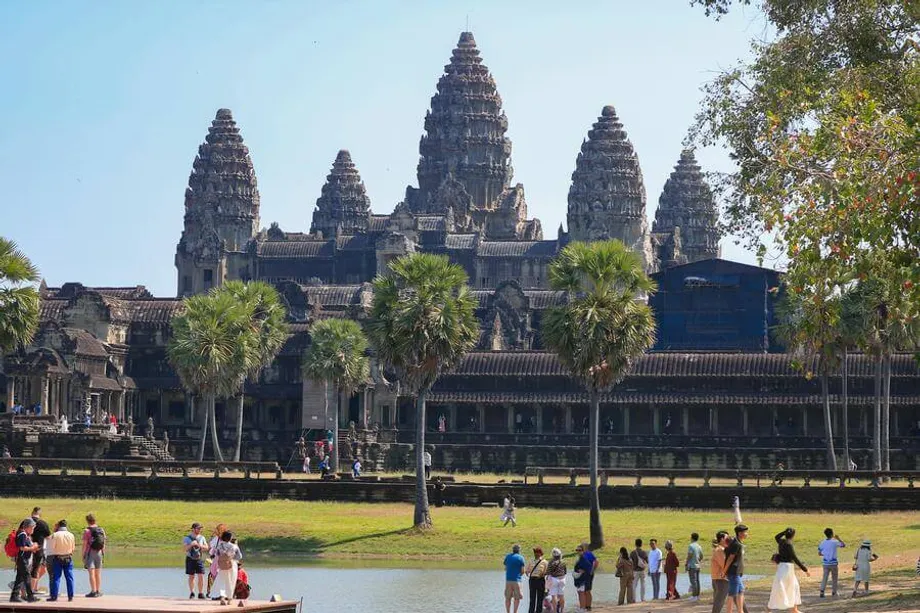
Angkor Archaeological Park covers 401 square kilometers in Siem Reap province. Its 91 temples were built between the ninth and 13th centuries, with Angkor Wat among its most internationally recognized monuments.
Angkor was inscribed as a UNESCO World Heritage Site in 1992. Its combination of history, spirituality and monumental architecture has drawn millions of people seeking to experience the craftsmanship and religious traditions of the Khmer Empire.
Rising visitor numbers bring a practical responsibility: managing pressure on fragile monuments and the surrounding environment. Sustainable tourism and responsible visitor management are necessary to preserve the site for future generations while allowing people to experience it today.
Guided heritage walks, sunrise tours, cultural performances and culinary experiences give travelers different ways to spend their time in and around Angkor. Digital services, contactless payments and multilingual assistance make those visits easier for people arriving from different countries.
Cambodia's preparations for Visit Cambodia Year 2026 place Angkor's recovery within a wider effort to attract international travelers. As of July 4, 2025, the park's results showed growth from the previous year, a substantial gap from its earlier highs and a tourism industry looking to the coming high season for its next gains.
Key Points
- Angkor received 567,673 international tourists from January to June 2025, up 8.76% from a year earlier.
- Ticket revenue reached $26.3 million, an increase of 8%.
- Visitor numbers were about 42% of the 1,356,961 recorded in the first half of 2018.
- The United States, United Kingdom and France were the leading international visitor markets.
- Chinese arrivals rose 25% to 47,571 during Cambodia-China Tourism Year 2025.
- Admission passes cost $37 for one day, $62 for three days and $72 for seven days.
- Digital ticketing, immigration changes, transport improvements and promotional campaigns are supporting the recovery.
- Cambodia forecasts around 7.5 million international arrivals in 2025, while Angkor prepares for the coming high season and continued conservation needs.