A 150-Second Flash Reveals a Hidden Stellar Explosion
A fleeting X-ray flash lasting just 150 seconds has connected a dying star 4 billion light-years away to a potentially hidden population of cosmic explosions. China's Einstein Probe satellite detected the event, named EP240414a, which astronomers later linked to the rare supernova SN 2024gsa.
Contents
- A 150-Second Flash Reveals a Hidden Stellar Explosion
- What Makes EP240414a Different?
- From Launch to the Supernova Connection
- How Einstein Probe Watches So Much Sky
- The Optics Behind the Wide View
- Why a Weak Jet Matters
- A Wider Search for Brief Cosmic Events
- How International Cooperation Supports the Mission
- Key Points
The discovery, published in Nature Astronomy in June 2025, marks the first observation of a fast X-ray transient directly associated with a supernova. These brief flashes, known as FXRTs, last from seconds to minutes. Their short lives and faint signals make them difficult for telescopes to catch.
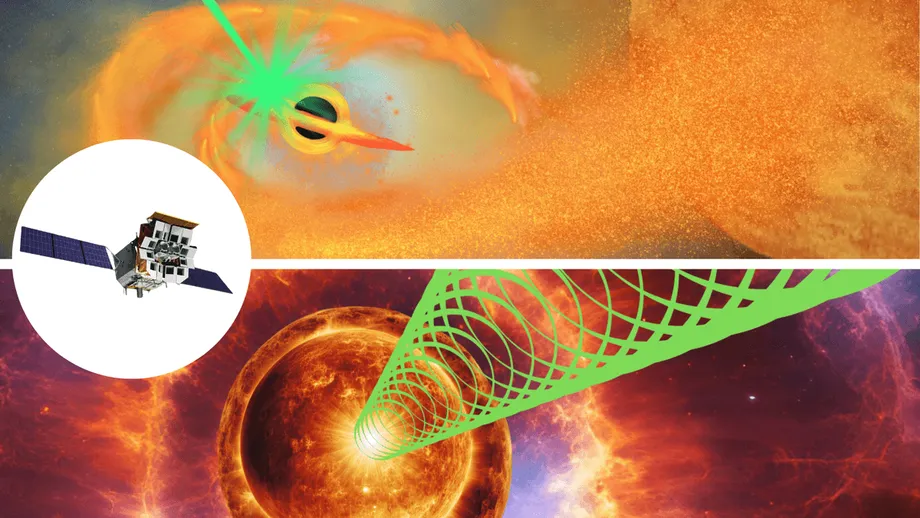
EP240414a also carried evidence of a weak relativistic jet, an outflow of matter moving at nearly the speed of light. Its jet was slower and less energetic than those associated with typical gamma-ray bursts, or GRBs, placing the event between familiar kinds of stellar explosions.
Astronomers see the finding as evidence that massive stars may die in a wider variety of ways than existing categories suggest. Ordinary supernovae and powerful gamma-ray bursts represent very different outcomes. EP240414a offers a way to examine the territory between them, where a star launches a jet without producing a typical powerful burst of gamma rays.
The observation also demonstrates why Einstein Probe was built to watch large areas of the X-ray sky. A telescope needs both sensitivity and a wide view to catch a faint event that disappears in less than three minutes. The discovery challenges established theories of stellar collapse and gives researchers a new opportunity to investigate how these explosions develop.
What Makes EP240414a Different?
Observations in optical light and radio waves confirmed the connection between EP240414a and SN 2024gsa. Following the event at several wavelengths allowed astronomers to connect the initial X-ray flash with the supernova and investigate the material moving away from the explosion.
EP240414a combined a soft X-ray spectrum, rapid changes and a weak jet. A spectrum describes how light is distributed across different energies; a soft X-ray spectrum is weighted toward lower X-ray energies. Together, these features set the event apart from both long-duration gamma-ray bursts and gamma-ray bursts with low luminosity.
The proposed explanation involves the collapse of a Wolf-Rayet star, a massive star that has lost its outer layers. In this interpretation, the star had insufficient angular momentum, or rotational motion, to power a full gamma-ray burst. It could still produce a weaker jet and a detectable X-ray flash.
He Gao, a professor at Beijing Normal University and lead author of the study, described why such events have been difficult to find:
These fast X-ray transients are like cosmic fireworks—bright and fleeting, making them extremely challenging to detect. They resemble 'gentler versions' of gamma-ray bursts and might be far more common than we thought. Past missions simply missed them due to limited X-ray monitoring capabilities.
The finding suggests that faint, fast transients could be a common feature of stellar death that earlier observations missed. How numerous this population is has not yet been established.
From Launch to the Supernova Connection
Einstein Probe began its mission in January 2024. Within its first months of operation, the satellite detected dozens of transient events involving white dwarfs, neutron stars, black holes and gamma-ray bursts. EP240414a became a particularly useful example because observations connected its brief X-ray signal with a supernova.
The main stages of the mission and discovery are:
- January 2024: Einstein Probe launched to survey the sky for changing and short-lived X-ray sources.
- During its first months of operation: The mission detected dozens of transient events across several kinds of astronomical objects.
- Detection and follow-up of EP240414a: A 150-second X-ray flare was linked through optical and radio observations to SN 2024gsa, 4 billion light-years away.
- June 2025: The findings appeared in Nature Astronomy.
The sequence shows why finding an initial flash is only part of the work. Observations after the alert supplied the connection to the supernova and helped researchers identify the event's unusual combination of properties.
How Einstein Probe Watches So Much Sky
The Chinese Academy of Sciences launched Einstein Probe in collaboration with the European Space Agency, the Max Planck Institute for Extraterrestrial Physics in Germany and the French space agency CNES. The spacecraft combines a broad survey instrument with a more sensitive telescope for investigating discoveries.
Its Wide-field X-ray Telescope, known as WXT, has twelve modules. Together, they can monitor nearly one-eleventh of the entire sky in a single glance. That coverage gives the satellite a better chance of seeing an unpredictable flash while it is happening.
When WXT identifies a new X-ray source, the spacecraft can quickly turn toward it with its Follow-up X-ray Telescope, or FXT. The second instrument allows more detailed observations of how the source changes after the initial detection.
The satellite orbits Earth every 96 minutes at an altitude of about 600 kilometers. Its observing pattern allows it to scan the entire night sky every few hours. Advanced detectors, including innovative CMOS sensors, support the sensitivity and rapid response needed to study faint sources that previous missions missed.
Weimin Yuan, Einstein Probe's principal investigator, described what EP240414a demonstrates about the mission:
EP240414a showcases Einstein Probe's ability to uncover new cosmic phenomena. We anticipate many more discoveries about the extreme universe in the future.
The Optics Behind the Wide View
Einstein Probe uses lobster-eye X-ray optics, a design inspired by the way lobsters see. Instead of relying on refraction, the bending of light, the system uses reflection to gather X-rays across a wide field of view.
Arrays of tiny square channels reflect incoming X-rays onto a detector. This arrangement lets WXT watch a large area of sky at once. Traditional telescopes using lenses or mirrors generally focus on narrower fields, making it harder to catch brief events that can appear in unpredictable places.
FXT supplies the complementary capability: sensitive observations with high resolution after a source has been found. It is modeled after the successful eROSITA X-ray telescope. The two instruments divide the task between finding a short flash and examining it closely.
That combination supports time-domain astronomy, the study of how objects in the universe change with time. For EP240414a, the useful information included both the brief appearance of the X-ray signal and the evolution of the event afterward.
Erik Kuulkers, ESA's Einstein Probe Project Scientist, described the spacecraft's early performance:
As soon as we opened the eyes of Einstein Probe to the sky, it found interesting new phenomena. That's pretty good and should mean that there are a lot more interesting discoveries to come.
Why a Weak Jet Matters
A massive star can end its life when its core collapses, triggering a supernova explosion. In some cases, the collapse also launches a jet of material at relativistic speeds, meaning speeds close to that of light. Such jets can produce gamma-ray bursts.
A jet's strength and its ability to escape the star help shape what astronomers observe. Some jets lack enough power to break through the surrounding stellar material or to produce detectable gamma rays. EP240414a points to a weak jet that nevertheless succeeded in escaping.
The finding supports a picture in which jet activity spans a range of stellar explosions. At one end are ordinary supernovae without jets. At the other are powerful gamma-ray bursts with strong jets. An event such as EP240414a occupies the middle, allowing researchers to investigate a less familiar outcome of stellar collapse.
Early X-ray observations help scientists study how a jet interacts with material around the star. They can also investigate the structure of the original star and the processes that determine whether a jet succeeds or fails. Stellar rotation is part of this investigation because rotational motion is linked to the proposed explanation for EP240414a's weaker outflow.
Xiaofeng Wang, a professor at Tsinghua University and co-corresponding author of the study, described the significance of the supernova connection:
This marks Einstein Probe's first discovery of an X-ray transient linked to a supernova, opening a new era in time-domain high-energy astrophysics. These findings were made possible through close international collaboration.
Connecting a fast X-ray transient with a supernova gives astronomers a way to examine the explosion from its early high-energy signal through the later observations. It also broadens the range of evidence available for testing ideas about how jets form and how massive stars die.
A Wider Search for Brief Cosmic Events
Einstein Probe's observing program extends beyond explosions like EP240414a. Its early detections involving white dwarfs, neutron stars, black holes and gamma-ray bursts show the range of changing X-ray sources within its reach.
One mission goal is to help locate the sources of gravitational waves. These are ripples in spacetime produced by events including mergers of black holes and neutron stars. Such cataclysmic events often emit X-rays, giving a spacecraft with a wide view an opportunity to help identify their origins.
Einstein Probe's observations can complement ground observatories such as LIGO and Virgo, which detect gravitational waves. Finding associated X-ray emission would help connect a gravitational wave signal with a location in the sky and support observations by other telescopes.
The spacecraft's Chinese name, Tianguan, also connects its mission with a much older astronomical record. It honors the Song Dynasty astronomers who recorded the supernova of 1054, the explosion that created the Crab Nebula. The modern mission continues that interest in sudden changes in the sky using instruments able to detect X-rays.
How International Cooperation Supports the Mission
The Max Planck Institute for Extraterrestrial Physics contributed key components to FXT. ESA provides ground station support and receives access to 10% of the mission's data. CNES supports data downlink in real time, helping discoveries reach the wider astronomical community quickly.
Rapid communication matters for an event that begins with a flash lasting seconds or minutes. Sharing an alert allows telescopes on the ground and in space to observe the source at other wavelengths. For EP240414a, optical and radio observations supplied essential parts of the connection between the X-ray transient and the supernova.
The mission's international arrangements support the sharing of data and discoveries across the global scientific community. They also bring together the survey telescope, detailed X-ray observations and observations at other wavelengths needed to study an evolving explosion.
Paul O'Brien, Head of Astrophysics at the University of Leicester, described the mission's scientific contribution:
The Einstein Probe's ability to search for and observe X-ray sources is already having a significant impact on our understanding of the Universe.
Einstein Probe is expected to operate for at least three years, with an extension possible. Astronomers anticipate further discoveries as it continues scanning the changing X-ray sky. Their goals include finding other hidden classes of explosions, understanding stellar evolution and investigating the origins of black holes, neutron stars and the universe's most powerful explosions.
Key Points
- Einstein Probe detected EP240414a, a 150-second X-ray flash linked to the rare supernova SN 2024gsa, 4 billion light-years away.
- The findings, published in Nature Astronomy in June 2025, connect a fast X-ray transient directly with a supernova.
- A weak relativistic jet places the event between ordinary supernovae and powerful gamma-ray bursts.
- The proposed explanation involves a Wolf-Rayet star with insufficient rotational motion to power a full gamma-ray burst.
- Twelve WXT modules watch nearly one-eleventh of the sky at once, while FXT provides more sensitive observations of discoveries.
- China, ESA, Germany's Max Planck Institute for Extraterrestrial Physics and France's CNES contribute to the mission.
- The satellite is expected to operate for at least three years, studying transient X-ray sources and helping locate the origins of gravitational wave events.