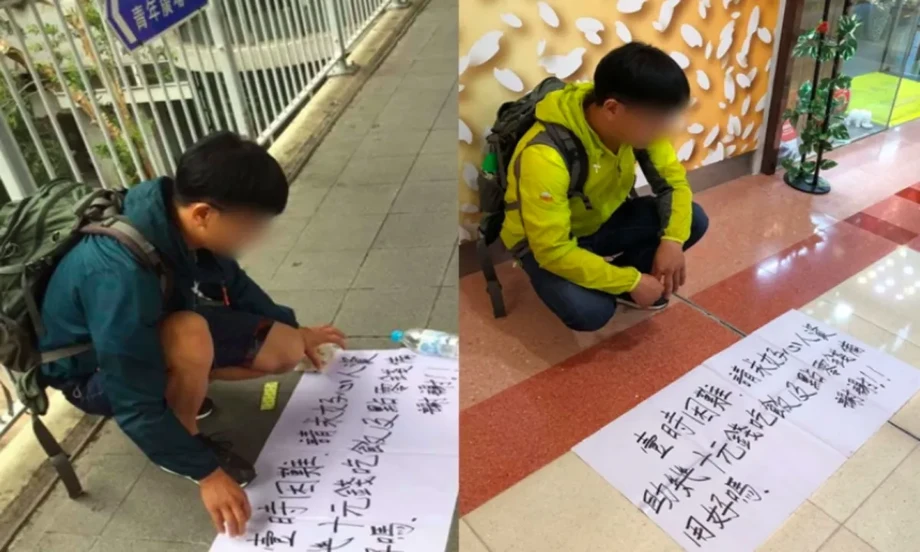
A Bizarre Scene in Causeway Bay
A 37-year-old woman sparked outrage on social media platforms on 29 November 2026 after ordering her 11-year-old son to sit on the pavement and beg for money in Causeway Bay. The incident occurred outside the Hysan Place shopping mall and nearby streets. Passersby encountered the unharmed boy sitting beside a cardboard box, with a handwritten sign reading in Chinese characters: "I broke a crystal ornament and need to pay for it. Uncles and Aunts, please help!" The scene drew comparisons to traditional street begging, yet the boy was clean and unharmed, raising questions about the circumstances leading to his temporary placement on the ground.
Contents
Social media posts circulating on the Threads platform captured photographs of the event. Onlookers reported that the boy had previously knocked over crystal items inside the luxury department store Lane Crawford. Rather than paying for the damage herself, the mother reportedly fetched a box and instructed the child to collect the compensation money from the public. The unusual measure prompted bystanders to alert the police, leading to a dispute at the scene.
The incident highlights a clash between personal responsibility, legal obligations, and public perception. While the financial loss was relatively small, the method of recovery—making a child solicit alms from strangers—struck many as disproportionate. Observers questioned why members of the public should bear the cost of a parent's decision.
Details of the Dispute at Lane Crawford
Police confirmed they received a report from Lane Crawford staff at nearly 7:00 pm on the day of the incident. The report stated that the 11-year-old boy had broken two crystal ornaments at a counter. The combined value of these items was approximately 2,000 Hong Kong dollars. The dispute arose when the mother declined to pay the compensation amount, leading to the unusual arrangement where the son would beg for the funds.
Officers attended the scene to mediate between the mother and the child, as well as with potential witnesses. They classified the case as "criminal damage discovered." The retailer is understood to be considering pursuing a civil claim for the compensation separately from any immediate public collection efforts. This dual approach allows the store to secure the funds while the mother deals with her son's immediate accountability.
The specific legal citation regarding the act of begging is Section 26A of the Summary Offences Ordinance (Cap. 228). This ordinance states that any person who wanders abroad or places themselves in any public place, street, or waterway to beg or gather alms commits a criminal offence. Furthermore, anyone who causes, procures, or encourages a child to do so is equally liable. The law aims to prevent the exploitation of children and maintain order in public spaces.
Legal Consequences for Child Begging
The application of the Summary Offences Ordinance brings specific penalties to those involved. Offenders face a fine of 2,000 Hong Kong dollars and up to one month's imprisonment upon a first or second conviction. For a third or subsequent offence, the penalty rises to a fine of 2,000 Hong Kong dollars and 12 months' imprisonment.
Legal experts note that while the boy's act of sitting with a box could be viewed as a form of begging, the mother's role is critical. By causing or encouraging the child to engage in this activity, she shares the liability. The law protects children from being used as instruments for financial gain or avoidance of responsibility. The incident has revived discussions about what constitutes "begging" in a modern urban context, especially when the act is voluntary and part of a learning process.
Some online commentators pointed out that besides the potential charge of child begging, the mother's actions might border on neglect or abuse, depending on the duration and conditions. Knowing the child is active but unable to teach him effectively, taking him shopping becomes a financial risk. The incident serves as a cautionary tale about the costs of oversight in parenting.
Public Reaction and Social Media Debate
Online users expressed widespread disbelief and criticism over the mother's actions. Many questioned why the public should pay for the child's mistake. Comments on Threads and other platforms highlighted the sentiment: "I want to ask the mother: why should everyone bear the cost when your son breaks something?" and "This mother is really crazy. If you do not know how to educate, maybe you should not have had the child."
The debate extended to the practical implications of the law. Citizens warned that forcing a minor to beg is not only illegal but also potentially damaging to the child's dignity. The visual of a young boy, clean and unharmed, sitting on the pavement with a sign appealed to the public's sense of justice. People were more willing to help if they understood the context, yet many felt the method of recovery was overly harsh.
The incident also touched on the broader issue of parenting styles in Hong Kong. The mother's approach, using public shaming or direct financial accountability, was seen by some as a traditional but effective disciplinary measure. Others viewed it as an overcorrection that exposed the child to unnecessary public scrutiny.
Context of the Mandatory Reporting Ordinance
The incident occurs against the backdrop of recent legislative changes concerning child welfare. The Mandatory Reporting of Child Abuse Ordinance (Cap. 650) was passed by the Legislative Council on 11 July 2024 and gazetted on 19 July 2024. This Ordinance will take effect on 20 January 2026.
The Ordinance aims to ensure early and effective detection and intervention of serious child abuse cases. It requires certain professionals in schools, social welfare institutions, and medical institutions to report suspected serious child abuse cases. The law defines serious harm as any harm that endangers a child's life, physical health, or psychological health.
There are 25 specific mandatory professionals covered, including teachers, social workers, pharmacists, dentists, and medical practitioners. These professionals must report if they reasonably suspect a child is suffering from or is at real risk of suffering serious harm during the course of their work. The law provides statutory immunity for professionals who make reports in good faith, protecting them from civil or criminal liability.
Exemptions from reporting apply if the professional honestly believes the harm was caused solely by an accident not caused by neglect, or solely by the child themselves. This distinction is crucial for cases like the Causeway Bay incident, where a minor's accidental damage might not constitute abuse if handled appropriately.
What Happens Next for the Mother and Son
The immediate outcome for the boy was his removal from the scene by the police, allowing him to continue his day without further public exposure. The mother may face administrative penalties or be required to pay the outstanding amount if the police deem the act of encouraging begging as a violation of the Summary Offences Ordinance.
Lane Crawford may pursue a civil claim separately. If they do, the process will likely involve standard legal procedures to recover the 2,000 Hong Kong dollars. The store's decision to consider civil action indicates a preference for resolving such matters outside of the criminal court system, unless the behavior is deemed egregious.
For the mother, the incident serves as a public reminder of the responsibilities involved in parenting. The legal framework provides tools for accountability, but also protection for those who act in good faith. The case illustrates how everyday interactions can trigger legal scrutiny in a highly regulated urban environment.
Key Takeaways from the Legal Framework
The incident underscores several key points for residents navigating similar situations. Understanding the definitions of begging, neglect, and abuse is essential. The Mandatory Reporting Ordinance provides a clear pathway for professionals to act, while the Summary Offences Ordinance sets the rules for public behavior.
Parents are encouraged to consider alternative methods of accountability for their children. Alternatives to public begging might include paying the compensation directly, using the child's own savings, or imposing household chores as restitution. These methods allow the child to learn responsibility without the potential stigma of street begging.
The public's response, while sometimes harsh, reflects a collective care for the well-being of children. The willingness to help the boy with his sign shows that people are supportive of those taking responsibility, even if the method of recovery is unconventional.
Conclusion
The Causeway Bay incident has become a viral example of the intersection between law, parenting, and public life in Hong Kong. It highlights the importance of clear communication between parents, authorities, and the community. As the Mandatory Reporting of Child Abuse Ordinance moves closer to its effective date, such cases will serve as precedents for how minor incidents are handled.
The story concludes with a lesson in accountability. The boy learned the value of his actions, the mother navigated the legal implications, and the public played an active role in the resolution. The case remains a topic of discussion, offering insights into the evolving nature of civic responsibility.
Key Points
- An 11-year-old boy was asked to beg on the street in Causeway Bay on 29 November 2026 after breaking crystal ornaments at Lane Crawford.
- The mother, aged 37, refused to pay the 2,000 Hong Kong dollars compensation, leading to the unusual arrangement.
- The incident is governed by Section 26A of the Summary Offences Ordinance (Cap. 228), which makes child begging a criminal offence.
- Online reaction was mixed, with many criticizing the mother's method but supporting the principle of personal accountability.
- The Mandatory Reporting of Child Abuse Ordinance (Cap. 650) will take effect on 20 January 2026, providing a broader context for child welfare.
- Lane Crawford is considering civil action to recover the compensation amount.