A Bold Timeline for a Complex Task
Vietnam has set an aggressive target to complete its first nuclear power plant within six years, a goal that stands in sharp contrast to the decades of delays common in the global energy sector. The country aims to have the Ninh Thuan 1 plant operational by the fourth quarter of 2035, with construction starting in the first quarter of 2029. This timeline is considered ambitious because international history shows many projects stretching from 15 to nearly 20 years.
Contents
The project is led by Vietnam Electricity Group, known as EVN, in cooperation with Russia's Rosatom. The plant will use the VVER-1200 reactor, a Generation III+ design that incorporates advanced safety features learned from past incidents like Fukushima. These reactors use passive safety systems that rely on natural physical laws, such as gravity and heat convection, rather than electricity or human intervention to keep the core cool. This design choice is central to Vietnam's strategy to speed up construction while maintaining the highest safety standards.
Despite the optimism, the Ministry of Industry and Trade has proposed pushing the operational start dates to 2037 or 2038 for Ninh Thuan 1, and 2039 or 2040 for the second plant, Ninh Thuan 2. Planners estimate that a minimum of 12 years is needed from the completion of feasibility studies to operation, suggesting the original targets might need adjustment. However, EVN retains an alternative proposal for earlier completion in 2034 or 2035 if conditions remain favorable.
The drive toward nuclear energy is not just about electricity supply but also about economic stability. With energy prices rising due to geopolitical tensions and potential US tariffs, Vietnam seeks to reduce its dependence on imported fossil fuels. The government views nuclear power as a stable, low-carbon source that can support the growth of data centers, artificial intelligence hubs, and manufacturing sectors that require reliable, continuous power.
Adopting Russian Expertise to Cut Construction Time
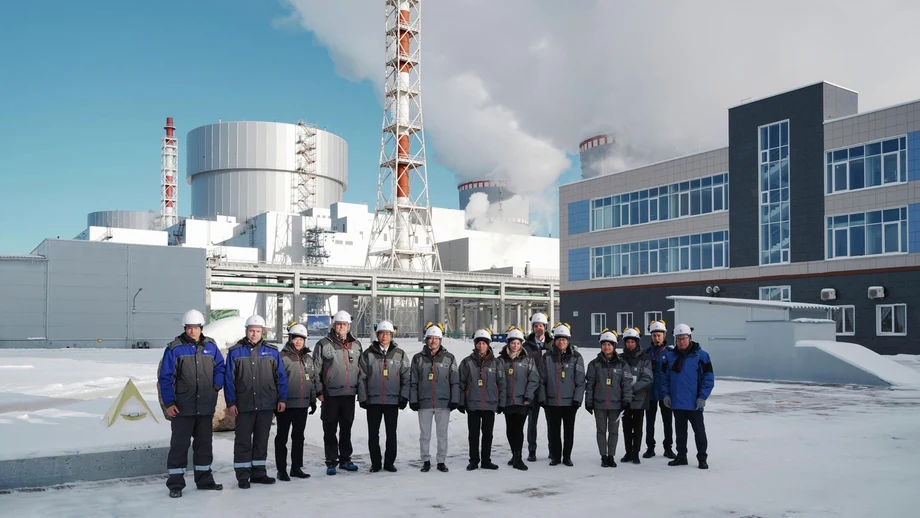
Vietnam's strategy to achieve a five to six year construction period relies heavily on standardizing the design and using proven technology. Instead of starting with a new, untested design, Vietnam has chosen to use the Leningrad NPP-2 plant in Russia as a reference project. This approach allows Vietnamese engineers to adapt a design that is already in stable operation, eliminating the need for extensive new testing and cutting two to three years from technical approvals.
Rosatom, the state-owned Russian nuclear corporation, applies a modular assembly method that has shown superior speed in Russia. For standardized designs like the Novovoronezh II plant, Rosatom has maintained construction rhythms of 60 to 70 months. By importing these methods, Vietnam aims to streamline concrete pouring, pressure vessel installation, and equipment calibration. The supply chain is also integrated, from heavy mechanical manufacturing to fuel supply, reducing bottlenecks that often delay Western projects.
The legal framework has also been reformed to support this speed. In August 2026, the National Assembly passed Resolution 44/2026/QH16, splitting the original large project into three independent ones: Ninh Thuan 1, Ninh Thuan 2, and a separate resettlement project. This separation allows parallel procedures for site licensing and contract negotiations, freeing the project from cross-dependencies that previously caused administrative delays.
Russian partner Rosatom has signed an intergovernmental agreement in March 2026 for the construction of two VVER-1200 reactors totaling 2,400 megawatts. The partnership extends beyond energy, with plans for a Center for Nuclear Science and Technology in Dong Nai to produce radiopharmaceuticals and semiconductor materials, and an Additive Manufacturing Center with Petrovietnam to support industrial 3D printing.
Challenges in Law and Land Clearance
Even with advanced technology and a streamlined process, Vietnam faces significant hurdles in the areas of legal frameworks and land clearance. For the first nuclear project in the country, the existing laws, decrees, and technical standards need continuous refinement to align with both International Atomic Energy Agency regulations and Russian standards.
Land clearance for Ninh Thuan 1 is progressing, with 82.3 percent of the area recovered and 423.8 hectares reclaimed. However, unresolved overlaps with Nui Chua National Park for Ninh Thuan 2 remain a bottleneck. In Ninh Thuan 1, about 36 hectares have been handed over out of a total resettlement area of 65.62 hectares, but delays in handing over remaining land are affecting construction efficiency. The lack of contiguous land means contractors cannot operate multiple construction fronts simultaneously.
In Ninh Thuan 2, a shortage of fill material is impacting progress. The project requires approximately 461,000 cubic meters of earth, with 231,000 cubic meters needing to be supplied. The government is working with military and police branches to authorize the extraction of materials from designated areas. Additionally, 47 land overlap cases between forest land and residential land in Ninh Thuan 2 need to be resolved quickly to unblock construction sites.
Human Resources and Regulatory Independence
Building the plant is only half the challenge; staffing it is the other. Vietnam needs a workforce with high-level expertise in project management, finance, contracts, and operations. The core gap lies in the depth of specialization of the independent nuclear regulatory authority. This body must have the technical capacity to independently review safety reports and approve design parameters provided by Rosatom.
Training must be tied to actual regulatory assessments rather than just theoretical programs. As the project moves from construction to commissioning, domestic staff must understand testing procedures and be able to read experimental data from control systems to detect design deviations before the official fuel loading.
Deputy Minister Le Xuan Dinh emphasized that nuclear development is a complex, long-term national program. It requires sustained political commitment, a robust institutional framework, and qualified human resources. The government is promoting local participation, aiming for a 30 percent domestic involvement in capital investment by 2035. This includes local companies undertaking construction, operation, and maintenance, as well as producing equipment and materials.
Strategic Balancing Act with Global Powers
While Russia is the primary partner for Ninh Thuan 1, Vietnam is carefully managing its relationships with other global powers to secure the best terms. Japan signed a nuclear memorandum of understanding with Vietnam in November 2026 for small modular reactors, though it withdrew from the large-scale plant discussions in 2025, citing the ambitious 2035 target as unrealistic. Japan's focus is now on small modular reactors for deployment in the 2040s.
South Korea's KEPCO has agreed to speed up talks on Ninh Thuan 2, offering financing and technology transfer. The United States remains an important partner for next-generation reactor technologies. This strategy, described as bamboo diplomacy, allows Vietnam to avoid excessive dependence on any single power while capitalizing on competition to secure favorable terms.
The timing is critical. Global energy markets remain vulnerable to instability, and Japan, which is heavily dependent on imported energy, sees Vietnam as a key partner in the Indo-Pacific. Vietnam possesses significant rare earth resources, estimated at 3.5 million metric tons by the US Geological Survey in 2025, which complements the technological capabilities offered by foreign partners.
Looking Ahead to 2035 and Beyond
Setting a target to complete the construction phase of Ninh Thuan 1 between 2029 and 2035 is a strategic move that reflects Vietnam's energy determination. The use of standardized Russian VVER-1200 reactors and the reference project model provide a solid technical foundation for shortening construction time. However, success depends on parallel efforts in regulatory independence, workforce preparation, and strict control of construction stages.
As the draft power plan adjusts timelines, the risk of supply shortfalls remains if timelines are too short. Analysts warn that setting overly ambitious dates for expensive, emerging technologies can increase the risk of future capacity gaps. The final decision on the exact operational dates rests with the Ministry of Industry and Trade, with the ministry giving no specific date for final approval of the revised plan.
Key Points
- Vietnam targets a five to six year construction period for Ninh Thuan 1, aiming for commercial operation by the fourth quarter of 2035.
- The plant will use Russian VVER-1200 reactors, leveraging standardized designs to cut technical approval time by two to three years.
- The Ministry of Industry and Trade proposes delaying the start of operation to 2037 or 2038 for Ninh Thuan 1 and 2039 or 2040 for Ninh Thuan 2.
- Land clearance is progressing, with 82.3 percent of Ninh Thuan 1 land reclaimed, though overlaps with Nui Chua National Park cause delays.
- A 2026 resolution split the nuclear project into independent units to streamline legal and administrative processes.
- Vietnam is balancing partnerships with Russia, South Korea, and Japan to secure technology and favorable financing terms.
- The government aims for 30 percent domestic participation in project investment by 2035 to build local industrial capacity.