A Billion Dollar Bowl Ignites Taihe
On November 28, 2026, the city of Taihe in Anhui Province transformed into a culinary capital as it hosted its inaugural Ten Thousand People Banquet. The event drew over 100,000 visitors to the Hanlin Square, turning the historic square into a stage for cultural heritage and industrial innovation. What began as a humble street snack has evolved into a massive economic engine, with the annual business income of the local noodle industry now exceeding 20 billion yuan.
Contents
The banquet was more than just a feeding frenzy. It served as a bridge connecting local farmers with global franchise owners. From the first street stalls to automated production lines, Taihe board noodles (Banmian) have traveled thousands of miles to reach diners in the United Kingdom and across mainland China. This dual narrative of tradition and modern industry defined the day's festivities.
Taihe Banquet Highlights
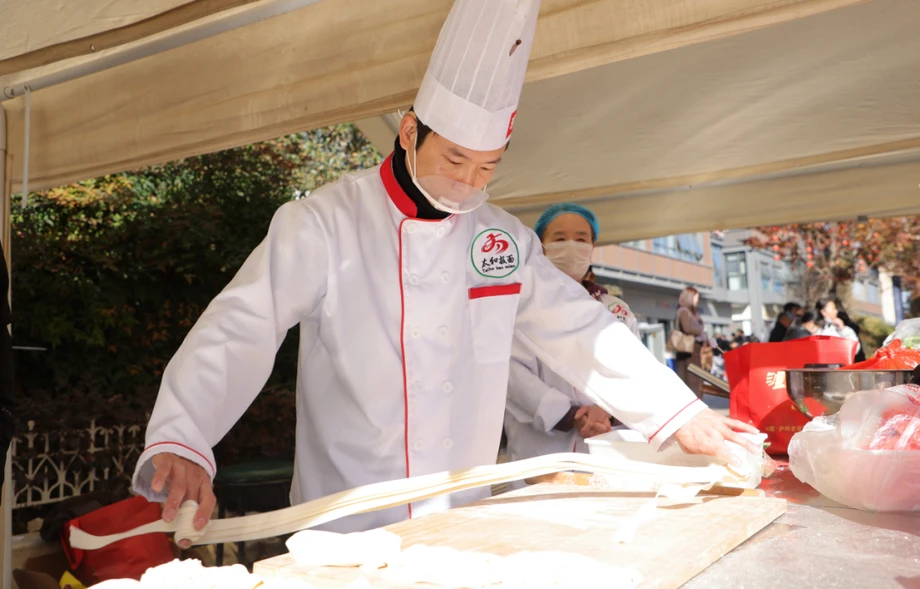
Attendees witnessed a spectacular opening ceremony featuring a three-meter giant cauldron simmering broth, ten large drums, and a Han-style ceremonial procession. The event celebrated the noodle's long history, tracing its origins through figures like Zhang Fei and Xu Guangying before moving to the modern era of industrialization. Ten local noodle shops set up one hundred round tables, offering free bowls to visitors, while fifty master noodle makers from around the country demonstrated their craft.
The scale of the operation was evident in the logistics. While the main stage focused on the ceremonial aspects, fifty additional stores participated in a free tasting area. Here, giant pots cooked noodles and braised meats like chicken feet and tofu skin. The initiative honored city workers, offering free noodles to sanitation workers and delivery riders, acknowledging the role of these new employment groups in the urban fabric.
The Economics of a Noodle
The numbers behind the Banmian industry are as substantial as the portion sizes. The industry currently employs approximately 100,000 direct workers and supports the livelihoods of over 300,000 people through related jobs. This vast network of entrepreneurs operates more than 50,000 stores nationwide.
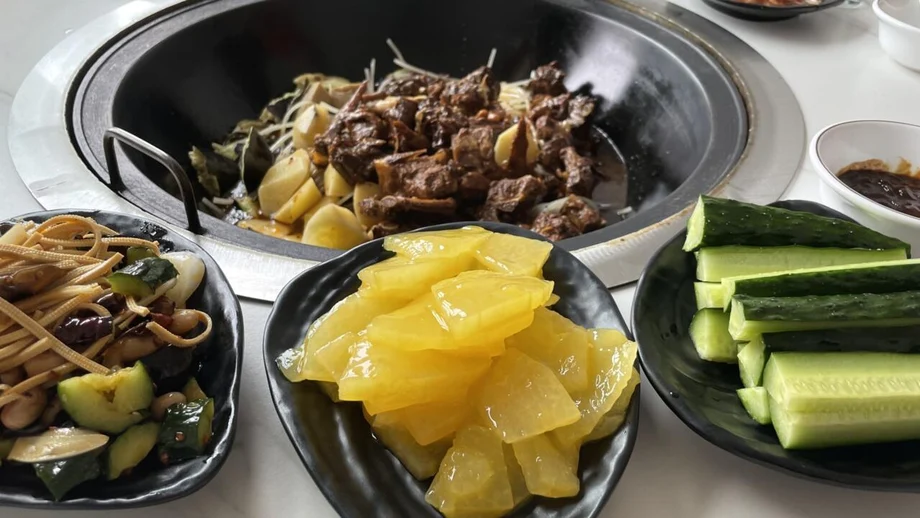
Every bowl of noodles relies on local ingredients that have formed an industrial belt. The clear broth is not just water and spice; it is infused with over thirty flavors of aromatic herbs, many of which are cultivated in Taihe's own Chinese medicine planting bases. Taihe is recognized as a highland for medicinal herbs, and these local products provide the unique depth to the soup.
The noodles themselves depend on the quality of wheat. As a major grain-producing county, Taihe ensures that the wheat used for the wide, chewy noodles meets strict standards for texture. The red chili element comes from the "Xiayanghong" variety, a specific breed developed in collaboration with the Anhui Academy of Agricultural Sciences. This chili provides the characteristic spicy kick without being overly pungent.
The green vegetable component is supplied by the 15,000 mu of local small greens. These leafy vegetables are harvested fresh from the local vegetable plots to ensure they remain crisp. Additionally, the mutton used in the dish comes from the local Baishan goats, which are known for their tender meat that lacks the strong gamey taste found in some other breeds.
From Street Stalls to Global Markets
The story of Taihe board noodles is one of migration and adaptation. Generations of residents have taken the recipe with them as they traveled, setting up stalls in major cities and eventually expanding internationally. The narrative of the noodle is deeply tied to the character of the people, often described as having a spirit of being upright and sincere.
A key figure in this global expansion is Li Sen, who opened a noodle shop near the University of Leeds in the United Kingdom in August 2024. After studying abroad in 2007, he decided to bring the taste of his hometown to the British street. His shop, named "ANHUI-style Noodles," has seen long queues of customers eager to try the authentic taste.
Liu Huali, a local business owner, noted that the business is about more than just food. It is a way to connect with the wider world. The expansion into markets like the UK demonstrates that regional Chinese cuisine can compete on a global stage, offering a familiar comfort to overseas Chinese communities while attracting local diners.
The event also highlighted the role of returnee entrepreneurs. Fifty master noodle makers who had spent decades running shops in cities like Tianjin were invited back to Taihe. Their presence added prestige to the banquet, as they demonstrated their techniques to the crowd. One master, Luo Kui, who has operated a shop for over thirty years, was a featured guest.
Cultural Heritage Meets Modern Innovation
While honoring tradition, the event also showcased how industrialization is reshaping the industry. The introduction of automated production lines allows for mass production without sacrificing quality. Companies like Anhui Wuyuan Food Company are at the forefront of this shift.
Anhui Wuyuan Food Company, located in the Taihe Economic and Technological Development Zone, produces instant Taihe board noodles. The company's automated production lines can produce 150,000 buckets of instant noodles daily. This industrial output helps meet the growing demand for convenient, high-quality noodle products.
The company's annual sales reached 260 million yuan last year, a testament to the success of its business model. The production process ensures that the noodles maintain their signature chewy texture even after being packaged and transported.
The cultural exhibition at the Hanlin Square complemented the industrial displays. Visitors could explore the "Taihe Four Sets," which include eating board noodles, listening to Taihe Qingyin (a traditional musical form), tasting Chinese herbal medicine, and appreciating Taihe calligraphy and painting. The square was filled with folk performances, including dragon dances, lion dances, and the Xiyang drum music.
A special area was dedicated to non-heritage skills, where visitors could try their hand at Xiyang embroidery and flower cake making. The agricultural exhibition featured local specialties like Taihe Gongchun, Jie Geng, and Fentai meatballs, alongside the traditional "Taihe Four Hemp" products: hemp leaves, hemp twisted dough sticks, hemp candy, and hemp flakes.
The Chinese medicine and health exhibition offered consultations and samples of herbal teas. The calligraphy and painting exhibition showcased works by local masters, allowing visitors to experience the artistic heritage of the region.
Regional Synergy and Future Outlook
The banquet was also a platform for regional cooperation. Two major exchange meetings took place simultaneously with the main festivities. One focused on the board noodle industry, where experts, university professors, and business leaders discussed standardization and brand building. The other was a cultural tourism exchange involving seven cities in the Fuyang cultural tourism circle, including Fuyang, Zhumadian, Xinyang, Zhoukou, Lu'an, Bozhou, and Huainan.
These cities agreed to collaborate on tourist routes and encourage the flow of visitors between regions. This regional integration aims to boost the local economy further by attracting more tourists to the area.
Lin Yiwen, a visitor from Taiwan who settled in Taihe, found the noodles to be a perfect example of local hospitality. She noted that the mutton tasted fresh and was not gamey. She now plans to open a noodle shop in Taiwan, bringing the taste of Taihe back to her hometown.
The event concluded with a sense of optimism. The organizers stated that the goal is to use the noodle as a medium to promote cultural tourism and industrial development. By highlighting the unique features of the industry and its cultural roots, Taihe aims to solidify its position as a leading city for board noodles.
The Essentials
- Event date: November 28, 2026, in Taihe, Anhui Province.
- Attendance: Over 100,000 visitors attended the Hanlin Square banquet.
- Economic impact: The noodle industry generates over 20 billion yuan in annual revenue.
- Scale: 50,000 stores and 100,000 employees are part of the industry.
- Global reach: Noodle shops in places like the UK and across China showcase the product.
- Local ingredients: Utilizes local Baishan goats, Xiayanghong chili, and 15,000 mu of small greens.
- Industrial innovation: Automated production lines increase daily output to 150,000 buckets of instant noodles.