A migration beneath a moving train
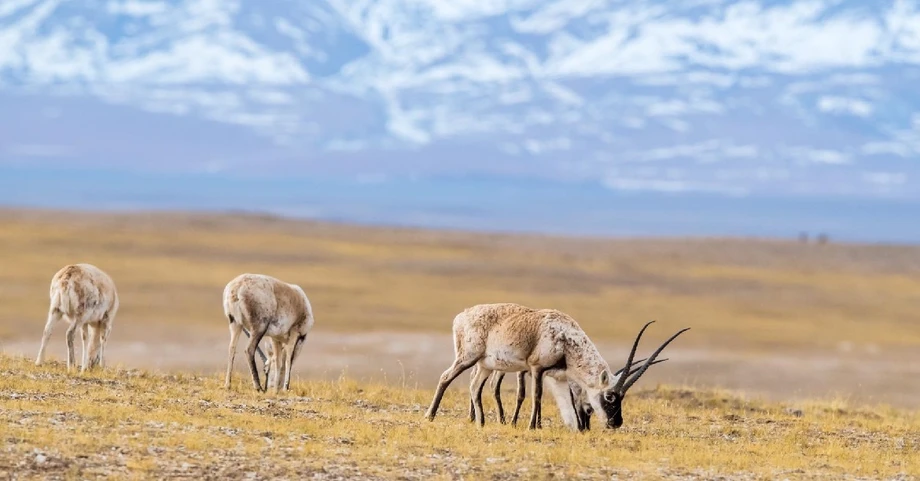
More than a dozen Tibetan antelope grazed beneath Wudaoliang North Bridge in July as a passenger train rolled overhead. The animals did not raise their heads when the train arrived, and they did not move away after it passed. The scene, recorded on the phone of railway planning official Zhang Caihong, captured a remarkable change for a line crossing some of the most fragile terrain on the Qinghai-Tibet Plateau.
Contents
- A migration beneath a moving train
- Two decades measured in passengers and cargo
- Why much of the railway stands on bridges
- The temperature map behind the engineering
- How antelope learned to use the crossings
- Holding back sand and restoring grass
- Freight that changed what reaches the plateau
- Keeping rubbish and sewage off the plateau
- The workers planting trees at 3,300 metres
- Electrification and the next engineering test
- Key Points
Every year from May to August, female antelope travel west across Hoh Xil to give birth around Zhuonai Lake and Sun Lake before returning with their young. When the railway was being built, engineers feared that its bridges and embankments would interrupt that journey. Zhang, a deputy section chief in the planning and statistics department of China Railway Qinghai-Tibet Group, recalled the first crossing survey.
In 2004, our first monitoring found that the usage rate of the wildlife passages was only 56.6 percent. We were nervous and worried that the railway had affected the antelope migration. Now look. They treat the bridge opening as shade. They cool down and graze there, and they do not react when a train comes.
That calm scene has developed over the 20 years since the railway entered full operation on July 1, 2006. Its environmental record includes bridges designed to protect frozen ground, a station moved to preserve a migration route, hundreds of kilometres of sand barriers and changing methods for keeping train waste off the plateau.
Two decades measured in passengers and cargo
The railway runs 1,956 kilometres from Xining, capital of Qinghai Province, to Lhasa in the Tibet Autonomous Region. It is described as the plateau railway with the highest average elevation and the greatest length in the world. Anniversary figures credit it with 104 million passenger journeys and 824 million tonnes of freight over 20 years. Scheduled passenger services have increased to 13 pairs a day, with a pair meaning one train in each direction, while average daily freight operations have grown to 136 trains.
Those transport totals sit beside an unusual set of environmental measurements. Wildlife passage use reached 100 percent in 2011 and has remained at that level in railway monitoring. The line crosses ecologically sensitive areas including the Hoh Xil World Natural Heritage site and Sanjiangyuan National Park, where protecting grass, water and frozen soil shapes everyday engineering decisions.
- June 2000: Surveying began, including about 470 kilometres between Golmud and Tongtianhe.
- 2003: Construction fully began between Wangkun and the Tanggula Mountains, bringing workers and heavy equipment into Hoh Xil.
- 2004: The first survey put wildlife passage use at 56.6 percent.
- July 1, 2006: The complete railway opened to operation.
- 2011: Passage use reached 100 percent, and the first electric locomotive left Xining West Station on June 29.
- December 2014: The New Guanjiao Tunnel opened, completing double track electrification between Xining and Golmud.
- July 2026: The railway marked 20 years of full operation.
Why much of the railway stands on bridges
Builders had to answer four connected questions before construction: how to keep trains safe, how to preserve wildlife migration, how to avoid damaging frozen ground and how to protect plateau vegetation. Zhang said the usual practice of building first and repairing environmental damage later was reversed. Planners first considered how to preserve the ecosystem, then how to build the railway.
Permafrost is ground that remains frozen for at least two consecutive years, although its upper layer can thaw seasonally. On this plateau, the frozen ground is easily disturbed by heat. A conventional railway embankment can absorb and transfer warmth, allowing ice in the soil to melt. The ground may then settle unevenly, deforming the track above it.
Raising the railway on bridges addresses several problems at once. Cold air can circulate beneath the structure, reducing the heat transferred into the ground. Open spaces allow antelope and other animals to pass, while an embankment could act like a wall across their route. Maintenance can also take place on the bridge rather than requiring workers to repeatedly walk across delicate meadows.
Vegetation presented a different challenge. Grass roots on the plateau are shallow, and damaged ground can recover very slowly. Zhang described a small test at extremely high elevation in which a marked patch was trampled. The patch had become bare when it was examined the following year.
The project also introduced environmental supervision into Chinese railway construction through a system with four participants. The project owner directed the work, contractors carried out environmental measures, engineering supervisors monitored daily construction, and specialist environmental supervisors inspected compliance. Zhang said this gave environmental protection a status comparable to engineering quality, instead of leaving it as an accessory that could be overruled by construction teams. The approach was subsequently used on other major railway projects.
The temperature map behind the engineering
Liu Zhengping, a professor level senior engineer at China Railway First Survey and Design Institute Group, spent 27 years working on the line and its frozen ground. His team began surveying in 2000, crossing areas around the Kunlun and Fenghuo mountains above 5,000 metres. At Wudaoliang, situated at 4,600 metres, he collapsed and temporarily lost his peripheral vision. A former railway health official later explained that oxygen deprivation affecting the optic nerve could cause that loss of visual field.
From 2001 through 2006, Liu led teams measuring ground temperatures along the route in early January and late September, when oxygen levels were especially low and the weather was severely cold. They accumulated 120,000 sets of readings. The information supported a ground temperature zoning map for the permafrost sections, helping planners avoid unsuitable geology and choose engineering measures for different temperature conditions.
The research changed the design approach in three ways: analysis moved from fixed conditions to changing conditions, temperature control moved from simply retaining existing cold to actively cooling the ground, and individual treatments gave way to combined measures. Liu summarized his career with a short phrase.
One task, a lifetime.
Monitoring continued for another 20 years around Qingshuihe and the Chumar River, producing 250,000 sets of data on ground temperature and deformation. Liu said settlement of the railway subgrade had largely converged, meaning the ground movement had substantially stabilized, while the frozen soil beneath it had received effective protection. The research later informed Chinese projects including the high speed line between Harbin and Dalian and the railway from Lhasa to Shigatse. Engineers working on a railway for an iron ore mine on Baffin Island in Canada also sought technical advice.
How antelope learned to use the crossings
Lian Xinming, a researcher at the Northwest Institute of Plateau Biology under the Chinese Academy of Sciences, has studied Tibetan antelope for many years. He cautions that a road or building can affect animals even when nobody is shouting or chasing them. Its physical presence is itself a form of human activity.
During construction in 2003, the railway imposed a daily two hour work stoppage during the antelope crossing period. Even so, Lian and his team observed that only slightly more than 400 antelope passed on the railway side that year. None crossed on the highway side they observed, and the animals instead gave birth where they were.
Early encounters with the bridges revealed another problem. Hoh Xil has very little natural shade because its native vegetation generally grows only 20 to 30 centimetres high. A large bridge created an unfamiliar dark patch beside a towering structure. Antelope stopped at the edge of the shadow and repeatedly tested the opening until one crossed and others followed.
The animals also adapted in an unexpected way. A group initially prevented from crossing began giving birth locally. The group started with roughly 10 to 20 animals and developed into a fixed calving area where several hundred now give birth without making the crossing. Lian said this challenges the assumption that antelope cannot reproduce successfully unless they complete their traditional migration.
Wudaoliang North Bridge has since become a principal migration route chosen by the animals. Its broad openings and clear views allow them to see through the structure, while railway monitoring records the rise in passage use from 56.6 percent in 2004 to 100 percent in 2011.
A further test came during expansion work on the Golmud to Lhasa section in 2015. The reserved site for Hoh Xil Station lay directly on a migration route. The entire station was moved 8.8 kilometres north toward the Chumar River, adding more than 13 million yuan to the investment and creating pressure to reduce the number of train services. Zhang explained the decision.
After repeated discussions, we decided to change the original site. If we should yield, we must yield. Investment increased, but everyone felt that giving way to wild animals was the right thing to do.
The relocation preserved the migration corridor. Liu later joined expansion work in 2016, which was completed in 2018.
Holding back sand and restoring grass
Windblown sand can bury rails, pack stones around the track bed and block drainage channels. Cui Jianye, who leads the Yinmaxia bridge and tunnel maintenance work area in Delingha, described more than 120 kilometres of track exposed to wind and sand and more than 600 square kilometres of affected ground. His teams use tall walls farther from the railway and low grids closer to it, slowing the wind and trapping sand in layers.
The grids are built from materials available nearby, including stones from the Gobi, earth and salt blocks from saline land, and reeds. When a sandstorm deposits material on the line, workers may have only a two hour maintenance window to bag the loose sand and bury it locally so that it does not return. Cui said moving dunes along the Xitieshan to Dabuxun section have largely been fixed, while the extent and thickness of sand accumulation during extreme weather have declined.
The railway engineering ledger lists 442.6 kilometres of sand hazards along the line. Cumulative treatments include 19.559 million square metres of protective grids, 464.466 kilometres of sand walls and 12.4 kilometres of sand embankments, covering a treated area of 770.53 square kilometres.
Luo Dan, 45, of the Amdo line workshop, supplied a practical comparison. Sections under his responsibility once required crews to remove 100,000 cubic metres of sand from the track bed each year when stone grids were used. After grass grids and sand walls were introduced, the annual volume fell to 40,000 cubic metres, a reduction of 60 percent.
Planting complements those barriers. Well based drip irrigation supported a 98 kilometre belt of tamarisk trees along the Xining to Golmud section. Crews completed 140 kilometres of artificial grass planting in permafrost areas above 4,500 metres and restored vegetation on 120 kilometres of embankment slopes in the Tangnan section. Since full operation began, China Railway Qinghai-Tibet Group reports greening 1,002 kilometres beside the railway, or 94.7 percent of the mileage considered suitable for greening, and planting 3.5387 million trees and shrubs.
Freight that changed what reaches the plateau
Qi Senlin, 51, a driver at the Golmud locomotive depot, was among the first freight drivers on the Golmud to Lhasa section. The Tanggula Pass reaches 5,072 metres, where oxygen is less than half the level on the plains and temperatures can fall to minus 40 degrees Celsius. Early diesel locomotives lost substantial power in the thin air, just as drivers struggled with altitude sickness.
Qi began test work in December 2005, driving several locomotive types to collect operating data. The eventual arrangement coupled two locomotives and allowed a maximum trailing load of 2,500 tonnes. A newer domestic locomotive entered service in 2019, providing higher speeds between stations and greater hauling capacity.
Freight on the Golmud to Lhasa section has grown from one pair of trains a day at opening to a regular 11 pairs. Cargo has expanded from more than 10 categories to more than 50, including steel, cars, refrigerated food and e-commerce parcels. In 2025, the railway carried 7,215 tonnes of vegetables and other fresh goods, while plateau products such as yak meat, Tibetan pork, barley foods and local drinks gained access to markets across China.
Lhasa West Station illustrates the physical scale of that growth. Its freight yard has expanded from four loading lines to 11, with annual arrivals and departures exceeding six million tonnes. Qi has also driven 750,000 kilometres without a safety incident and trained 15 apprentices. He describes the change in personal terms.
The Kunlun Mountains are still the same Kunlun Mountains, but life on the plateau has become sweeter.
Keeping rubbish and sewage off the plateau
The Golmud to Lhasa section has one track rather than two, and passenger trains entering and leaving Tibet operate as sealed environments for waste collection. Rubbish remains in closed containers throughout the journey and can be unloaded only at Xining, Golmud and Lhasa. Specialist contractors then handle its safe disposal.
Sewage follows a separate system. Trains initially used vacuum equipment and emptied their tanks at stations. Ground based extraction replaced that arrangement after 2017, sending waste through underground pipes into septic tanks. Distributed extraction equipment now allows two openings to operate together before the material is sent to designated sites for treatment that reduces its volume and recovers usable resources.
Tuotuohe Station, described as the first station at the source of the Yangtze River, removes station rubbish twice each week. Two workers permanently staff the local sewage treatment plant. Its MCR membrane process and ultrafiltration equipment produce water meeting the quality standard for drinking water sources.
Heating has also changed. Outside the Golmud and Lhasa areas, the Golmud to Lhasa section uses electric heating or air source heat pumps. From 2015 through 2025, about 12.4488 million yuan funded solar heating upgrades at the Tuotuohe living base, Lhasa station buildings and staff dormitories, replacing oil fired boilers. Solar installations at stations provide a second backup power supply.
Environmental equipment requires continuing expenditure as well as new construction. From 2007 through 2025, accumulated spending on reinforcement and maintenance reached 271.0876 million yuan. Employees must receive training in environmental laws and practical operating procedures before taking their posts.
The workers planting trees at 3,300 metres
Li Jie found almost bare ground when he arrived at the Oulongshan maintenance work area in 2013. He and his colleagues obtained saplings as thick as a thumb from towns more than 100 kilometres away, soaked them until roots developed and planted them. New branches supplied cuttings for more trees. Fertilizer meant collecting sheep manure from herders more than 20 kilometres away.
Water arrived by truck only once a week, so the workers built their own irrigation pipes and reserved part of their domestic supply for the saplings. One tree eventually became more than 200, with some growing from a few tens of centimetres to more than 10 metres. Li said local sandstorms declined from more than 10 a year to two or three.
At the Lhasa boiler work area, Wang Yougang began planting on waste ground 18 years ago. His first plants died, but he continued replacing them. One surviving tree encouraged him to try for 10, and 10 encouraged him to try for 100. The site now contains a dense grove created through repeated planting.
Electrification and the next engineering test
The first electric locomotive departed Xining West Station on June 29, 2011, ending the absence of electrified railway operation on the plateau. The New Guanjiao Tunnel then enabled the Xining to Golmud section to complete double track electrification in December 2014. Electric locomotives draw power from overhead wires instead of burning diesel in the locomotive, avoiding exhaust from that fuel and the risk of oil dripping onto the route.
Electrification work has now started on the Golmud to Lhasa section. Railway officials expect it to reduce diesel consumption and shorten passenger journeys. No completion date or quantified fuel saving was given.
Frozen ground remains central to the design. After the expansion project ended in 2018, Liu began research for the electrification work, leading tests on foundations for the overhead power structures. One concern is frost jacking, a process in which freezing soil can push a foundation upward. Future electric and digital upgrades will therefore depend on the same patient temperature monitoring that supported the original line.
For Zhang, environmental discipline also rests on small acts of respect. On her first journey over the Golmud to Lhasa section, her mentor told her to buy large plastic bags so that every vehicle could carry one and no rubbish would be thrown outside. He also told her to sound the horn twice when passing a track patrol booth.
They are guarding this road for us, and we must respond properly. Everyone on this line deserves respect.
Key Points
- The 1,956 kilometre railway marked 20 years of full operation in July 2026.
- It has carried 104 million passenger journeys and 824 million tonnes of freight.
- Monitored use of wildlife passages rose from 56.6 percent in 2004 to 100 percent in 2011.
- Hoh Xil Station was moved 8.8 kilometres at a cost exceeding 13 million yuan to protect an antelope migration route.
- Sand control, planting and maintenance have stabilized dunes, restored slopes and reduced annual sand removal in one section by 60 percent.
- Sealed waste collection, station sewage treatment and cleaner heating limit pollution along the route.
- Electrification of the Golmud to Lhasa section has begun, but no completion date has been announced.