A cheaper stent, and a harder question
By April 2026, more than 10 million coronary stents purchased through China's central procurement program had been used in patients, accounting for over 90 percent of all heart stents used during the same period. Prices that once sat in the 10,000 yuan range had fallen below 1,000 yuan. A stent is a tiny mesh tube placed in a narrowed heart artery to keep blood flowing. The procedure, known as percutaneous coronary intervention (PCI), can stop a heart attack or relieve chest pain without surgery to open the chest.
Contents
- A cheaper stent, and a harder question
- What changed inside a hospital bill
- Did clinical results hold up?
- How quality is checked, piece by piece
- Why more patients can be treated closer to home
- Three product generations, and room for doctors to choose
- Can purchasing savings support the next device?
- Why overseas evidence now matters
- The purchasing model expands beyond heart stents
- What the next phase has to protect
- The Bottom Line
The National Healthcare Security Administration addressed the obvious concern about such a dramatic price cut in a study released in May 2026. Using data from routine medical care, it found that treatment numbers rose steadily after procurement, the average number of stents used in each procedure fell, and clinical results remained stable. The administration also put the average total hospital bill for a patient receiving coronary intervention at nearly 60,000 yuan before procurement and 44,000 yuan afterward. That is a saving of about 16,000 yuan, or roughly 27 percent, before medical insurance reduces the patient's personal payment further.
Hospitals received a financial reason to participate as well. Under payment arrangements based on a patient's diagnosis, a hospital can retain more of the insurance payment when it treats the patient for less. The policy has therefore moved beyond simply negotiating a cheaper piece of metal. Its stated goals are to protect quality, keep clinical care stable, discourage destructive price competition and encourage innovation. Shanghai MicroPort Medical Equipment Group provides a useful example: three generations of its stents entered the original national round and two subsequent purchasing rounds, forcing the company to connect low prices with manufacturing discipline, new research and overseas sales.
What changed inside a hospital bill
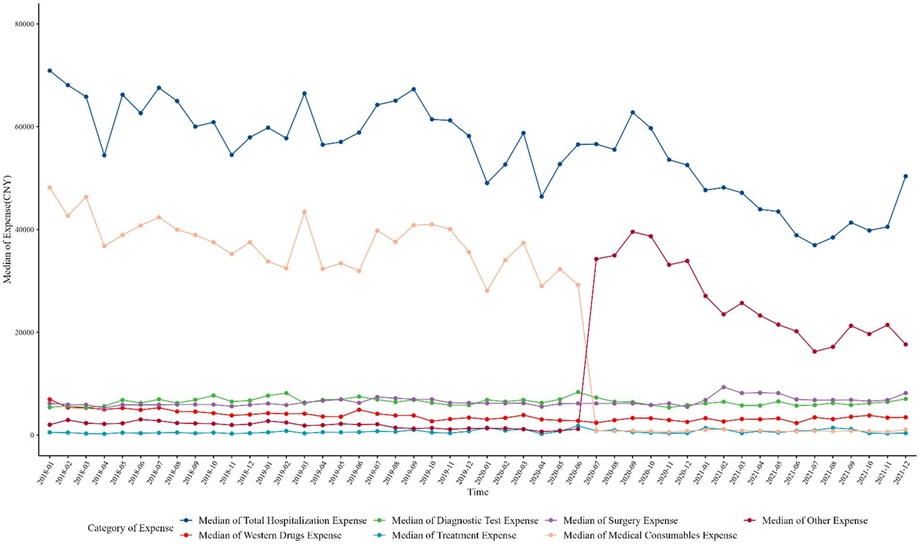
A research team from institutions including Sun Yat-sen University and Guangdong Second Provincial General Hospital examined how these reforms altered individual bills. Published in Frontiers in Public Health on Jan. 30, 2025, the hospital expense study covered 3,134 patients who received coronary stents at the Guangzhou tertiary hospital between January 2018 and December 2021. Its interrupted time series design compared monthly trends before and after each reform, rather than relying on two isolated snapshots. Expenses were adjusted using Guangzhou's health care consumer price index.
The median total hospitalization expense was 63,124.98 yuan before the reforms. It fell to 58,332.50 yuan after Guangdong removed hospital markups on consumables, then to 48,266.34 yuan during national stent procurement. The reduction from the first period to the last was about 23.5 percent. These medians come from one hospital and differ from the administration's national average of nearly 60,000 yuan falling to 44,000 yuan, but both show patients paying substantially less.
Consumable spending produced the sharpest change. The median fell from 39,119.52 yuan before the reforms to 785.79 yuan after national procurement. The statistical model estimated an immediate reduction of 32,160.81 yuan in median medical consumable expenses when procurement began, reported with p below 0.001. The underlying reason was visible in the stent market itself: the paper describes the average stent price as falling from roughly 13,000 yuan to just over 700 yuan, a reduction of about 93 percent.
One billing category moved in the opposite direction. The median for other expenses increased by 28,350.39 yuan during national procurement, while the model estimated an immediate rise of 34,866.88 yuan, also with p below 0.001. That broad category includes items such as nursing, rehabilitation and blood charges. The authors suggested that hospitals offset lost revenue by shifting some consumable costs into less clear accounting categories. Their finding makes scrutiny of the entire invoice, rather than the stent line alone, an important part of protecting savings.
A national dataset cited by the researchers explains why consumables were such a large target. Among 597,460 patients admitted for acute myocardial infarction in 2020, average hospital spending was 30,171 yuan. Consumables accounted for 13,990.4 yuan, or 46.37 percent, exceeding treatment and surgery fees combined.
Did clinical results hold up?
Eight core hospitals supplied the administration's clearest clinical comparison. They performed 43,000 coronary interventions before procurement and nearly 50,000 afterward, an increase of 15 percent. Researchers compared more than 90,000 patients across the two periods and tracked major adverse cardiovascular events within two years. These events included death, a new acute myocardial infarction, another procedure to restore blood flow, stroke, readmission because of heart disease and thrombosis, meaning a clot, inside the stent.
None of the differences reached statistical significance, and most event rates were slightly lower after procurement. Readmission for heart disease moved from 5.5 percent to 5.4 percent. New myocardial infarction fell from 1.8 percent to 1.6 percent, while clotting inside the stent fell from 0.3 percent to 0.2 percent. Patients were also receiving fewer stents per procedure on average, although the administration did not provide the numerical averages for the two periods.
At the same hospitals, use of imaging inside coronary vessels rose by more than 200 percent, assessment of vessel function rose by more than 300 percent, and use of complex intervention techniques rose by more than 50 percent. Imaging lets a doctor see the vessel wall and measure a blockage from inside. Functional assessment helps determine whether a narrowing is actually restricting blood flow. Together, these tools can help a doctor decide where a stent is needed and whether it has expanded properly. The administration linked their wider use to the smaller share of the procedure budget consumed by an expensive stent, bringing domestic practice closer to levels in developed countries.
How quality is checked, piece by piece
MicroPort said the versions selected for procurement use the same raw materials, production processes and factory release tests as the versions first brought to market. Since the initial round, its stents had undergone 23 national or provincial spot checks, while its balloons, accessories and imaging products had undergone another 26. According to the company, every inspection passed. Several of its stent products have also been used clinically for almost 20 years, giving doctors a much longer record than a single purchasing cycle can provide.
Qu Minming, senior director of quality at Shanghai MicroPort, said inspection begins before a stent receives its drug coating. He described the manufacturing checks in this way:
We have always been very strict about quality. After the bare metal is cut, we inspect the entire surface of every stent, and only those that pass move to the next process. After the drug coating is applied, we conduct another full inspection to make sure the coating meets the standard.
Pressure testing provides another measurable safeguard. A stent arrives inside a delivery system that is threaded through a blood vessel and usually expanded with a balloon. Clinical release commonly uses pressure of about 10 atmospheres, with one atmosphere roughly equal to air pressure at sea level. MicroPort said its delivery systems have a burst pressure of at least 16 atmospheres and are validated internally at levels as high as 30 atmospheres. Those figures describe an engineering safety margin, not the pressure normally applied inside a patient.
Factory checks are followed by monitoring after the products enter clinical use. The company said it follows patients over extended periods, collects information about adverse events and feeds that information back into its quality controls. For a device that can remain in an artery for years, that continuing record matters alongside the price printed on a purchasing document.
Why more patients can be treated closer to home
National procedure counts show the widest change in access. Incomplete statistics put the number of coronary interventions at about 1.9 million in 2024, compared with roughly 1 million in 2020. The number of medical institutions performing heart stent implantation rose from more than 2,400 in 2020 to more than 3,600 in 2023. Secondary hospitals, which generally serve local populations rather than providing the most specialized tertiary care, increased from 1,200 to nearly 1,700 over that period.
County chest pain centers helped support that expansion by creating faster systems for diagnosing and treating heart attacks. For a patient with a blocked artery, the ability to receive PCI at a nearby county hospital can save the time otherwise spent traveling to a large city. More institutions offering the procedure therefore changes where emergency treatment happens, not merely how much a device costs.
MicroPort established its Feiyan team more than a decade ago to train operators, arrange deliveries and support patient monitoring in county markets. The company says its coronary products now reach about 4,000 domestic hospitals, covering more than 90 percent of institutions qualified to perform PCI and including about 2,000 county hospitals. Scattered deliveries and high logistics costs can make remote areas unattractive to distributors. MicroPort said it absorbs part of the delivery cost for places including Xinjiang and Tibet to maintain supplies.
Three product generations, and room for doctors to choose
MicroPort entered Firebird 2 in the first national round, Firebird PRO in the 2022 renewal and Firehawk in the latest coronary stent renewal in 2026. A company representative said products were selected for their technical features and clinical settings rather than through price alone. Firehawk involves a more complex manufacturing system and was supported by a large clinical trial conducted in several countries. According to the company, doctors had long wanted it included so that more domestic patients could use it.
Different generations also carry different research costs. Spending on developing a mature product may already have been recovered through years of sales, while a newer device still has substantial fixed research costs. The company said its bids account for manufacturing, supply chains, extended patient monitoring and support after sale. It argued that procurement rules leave reasonable room for that revenue to support further research.
Hospitals determine their committed purchasing volume with reference to 80 percent of the previous year's use, leaving some demand outside that commitment. Doctors can use this flexibility for calcified arteries, where calcium has hardened the vessel; bifurcations, where an artery divides; and chronic total occlusions, which are complete blockages that have been present for a long time. The operator can select a device according to the anatomy instead of treating every lesion as identical.
- End of 2018: Public hospitals in Guangdong removed markups on medical consumables.
- July 2019: The State Council called for public medical institutions nationwide to end consumable markups by the end of that year and gradually adopt central procurement.
- October 2020: The State Council's Joint Procurement Office conducted national quantity based procurement of coronary stents. Products at the new prices entered public hospitals at the beginning of 2021.
- 2022: The first coronary stent renewal added MicroPort's Firebird PRO.
- 2026: The latest coronary renewal added Firehawk, while a separate sixth national round expanded procurement into other cardiovascular and urological devices.
- April and May 2026: National use passed 10 million procured stents, and the administration published its clinical outcome study.
By the third round, purchasing decisions combined price with clinical positioning, evidence gathered over time and a manufacturer's ability to maintain supply.
Can purchasing savings support the next device?
Sun Congcong, vice president of coronary promotion at Shanghai MicroPort, said the company responded to procurement with intelligent manufacturing and detailed cost management while maintaining quality. He said the 2026 renewal also eased hospital purchasing pressure and local medical insurance payment burdens. Sun described the resulting change in the business model:
As centralized procurement becomes routine, the company is shifting to a model driven by both efficiency and innovation.
Sun said mature businesses now support emerging businesses. He cited the CSBP microcirculation damper, which MicroPort describes as a world first, as an example of a specialized product serving a relatively narrow clinical setting outside central procurement. In his account, predictable revenue from mature stents gives the company room to pursue demanding clinical needs that would be poorly served by competing only on the price of an established device.
Firehawk provides the clearest research example. Its TARGET AC study compared the stent directly with a mainstream imported product. Results from the large European trial were published in full by The Lancet in 2018, which MicroPort described as the journal's first publication of a Chinese medical device study in its history of almost 200 years. A later international study, TARGET FIRST, appeared in The New England Journal of Medicine. Such evidence can support applications to regulators in other countries and may eventually inform clinical guidelines.
Other devices address treatment without leaving a permanent metal implant. MicroPort's balloon that releases drugs into the vessel wall was included in the sixth national procurement round and now covers nearly 1,000 hospitals. Its absorbable stent went through ten years of research and five years of clinical validation, and is designed to degrade gradually after three years in the body. The company has also built a cardiovascular portfolio spanning stents, devices that create pathways through vessels, tools intended to make PCI more efficient, imaging inside vessels and products for lesions that are difficult to cross.
Why overseas evidence now matters
Overseas sales give these research programs another route to financial returns. MicroPort says its coronary stents have entered more than 60 countries and over 3,000 hospitals. By September 2025, both its cumulative global shipments and cumulative implants had exceeded 10 million units. Revenue from established products can support new research, while trials conducted in several countries provide evidence for applications to regulators abroad.
The company's approach now extends beyond exporting finished stents. It is taking experience with complex coronary disease to Southeast Asia, the Middle East and Latin America, while pursuing CE certification in Europe and registration with the United States Food and Drug Administration for newer products. Its intended cycle is straightforward: validate devices through clinical work in China, use international evidence to gain access to overseas markets, then return overseas earnings to domestic research.
The purchasing model expands beyond heart stents
The sixth national round showed how the purchasing method is spreading. The National Healthcare Security Administration announced the procurement results on Jan. 14, 2026, covering 440 products from 202 manufacturers. All 42 balloons coated with drugs, submitted by 32 manufacturers, were selected. Song Xiantao, vice president of Beijing Friendship Hospital, said these devices can help when an implanted stent becomes blocked again or when a vessel is too small for a stent.
The round also included devices for urinary stone surgery for the first time: 398 products from 170 manufacturers, including ureteral guidewires and balloon dilation catheters. Li Jun, chief physician of urology at Beijing Friendship Hospital, said minimally invasive stone surgery previously cost between 20,000 and 30,000 yuan. He expected procurement to reduce the total cost of treatment.
Lu Yun, a pharmaceutical pricing expert at China Pharmaceutical University, said the rules were designed to discourage bids so cheap that they could undermine fair competition or dependable supply. She explained the pricing approach in these terms:
To avoid unfairly low bids, the program did not simply use the lowest price as the benchmark.
Lu also described a revival mechanism that gave more manufacturers an opportunity to win. By January 2026, national procurement covered 142 types of medical consumables across nine major categories, including cardiology, orthopedics, ophthalmology and urology. When the results were announced, patients were expected to begin receiving the latest devices at their new prices around May 2026.
What the next phase has to protect
Patients, hospitals and manufacturers now face three connected tests. Clinical teams need dependable devices and enough freedom to handle difficult arteries. Hospitals need payment and accounting systems that preserve savings without moving costs into obscure billing categories. Manufacturers need efficient production and sufficient revenue to maintain supplies, conduct trials and seek approval in other countries. The national outcome study, MicroPort's inspection record and the Guangzhou billing research each address a different part of that system.
Several commercial details remain undisclosed. MicroPort has not given its winning price for Firehawk in the 2026 renewal, nor has it provided dates for decisions on CE certification or FDA registration. The administration's clinical study concerns stents used after procurement; the absorbable stent and CSBP device belong to the company's separate development program.
For a patient, the most immediate change is concrete: a stent costs less, a county hospital is more likely to offer the procedure, and doctors have greater room to use imaging or select a device for difficult anatomy. For a manufacturer, the change is equally practical. Manufacturing discipline, clinical evidence and regulatory access matter more than sustaining a high price for a mature stent.
The Bottom Line
- More than 10 million centrally procured coronary stents had been used by April 2026, representing over 90 percent of heart stent use in that period.
- The National Healthcare Security Administration put the average hospital bill for coronary intervention at nearly 60,000 yuan before procurement and 44,000 yuan afterward.
- A study at eight hospitals found procedure numbers rose 15 percent, while major cardiovascular outcomes within two years remained statistically stable.
- A separate study of 3,134 Guangzhou patients confirmed steep consumable savings but identified an increase in ambiguous other expenses.
- Institutions performing stent implantation grew from more than 2,400 in 2020 to over 3,600 in 2023, including substantial expansion among secondary hospitals.
- MicroPort says all 49 documented product spot checks passed, while its three stent generations show a shift toward evidence, efficiency and international research.
- The sixth national round selected 440 products from 202 manufacturers and expanded procurement into urinary stone surgery devices.