A Shinjuku meeting place prepares to say goodbye
The bronze Suica penguin that has watched over a popular meeting point outside JR Shinjuku Station since July 2016 is preparing for its own departure. East Japan Railway Company, usually called JR East, says the statue's display will be phased out and Suica Penguin Square will be renamed as the character hands over to a purple rabbit. The statue could be removed as early as spring 2027, although no exact date has been announced.
Contents
- A Shinjuku meeting place prepares to say goodbye
- What will happen to the statue and the square?
- How did the purple rabbit win?
- Key dates in the Suica handover
- Why is JR East changing the character now?
- How teppay changes what Suica can do
- Local services and gates that need no tap
- What happens to Pensta shops and the Shinjuku meeting point?
- What to Know
The sculpture stands about 2.5 metres tall when its pedestal is included. It depicts the penguin walking toward the future, while a panel shaped like a Suica card is set into the back of the base. Its departure will remove a familiar piece of visual shorthand for anyone arranging to meet friends, colleagues or family members beside the station.
The square itself opened in March 2016, four months before the statue arrived. Covering about 2,000 square metres, it connects directly with the station's New South Exit ticket gates. From the deck, visitors can watch trains entering and leaving Shinjuku Station and look across at the NTT Docomo Yoyogi Building, a prominent part of the local skyline. Tourism promoters have recommended the plaza as a place to experience the Shinjuku cityscape, giving it a purpose beyond that of a station entrance.
Concern about the sculpture appeared on social media soon after JR East announced the penguin's retirement. The character has represented Suica since the payment service began in 2001, so the farewell affects both a piece of station furniture and a face associated with everyday travel for roughly a quarter of a century.
What will happen to the statue and the square?
JR East's corporate communications department gave its clearest answer on November 26, 2026. The company said the square's name would change and the bronze statue's display would end in stages. It added that further details would be announced once they had been decided.
The company has described the mascot's retirement as a graduation, using the language of completing one stage before moving to another. JR East says the same idea applies to the sculpture, and that the penguin will return to its creator.
The penguin will graduate from its role as Suica's image character and return to its creator. As the baton is passed to the new character, the statue will graduate too.
Several practical decisions remain open. JR East has not announced the square's new name, an exact removal date or another location where the penguin might be displayed. It has also not decided whether to erect a statue of the purple rabbit on the vacated site, or whether the rabbit's eventual nickname should become part of the square's new name.
The graduation concerns the character rather than the payment service. Suica cards and mobile accounts will continue operating, while the place formerly identified by the penguin acquires a new identity.
How did the purple rabbit win?
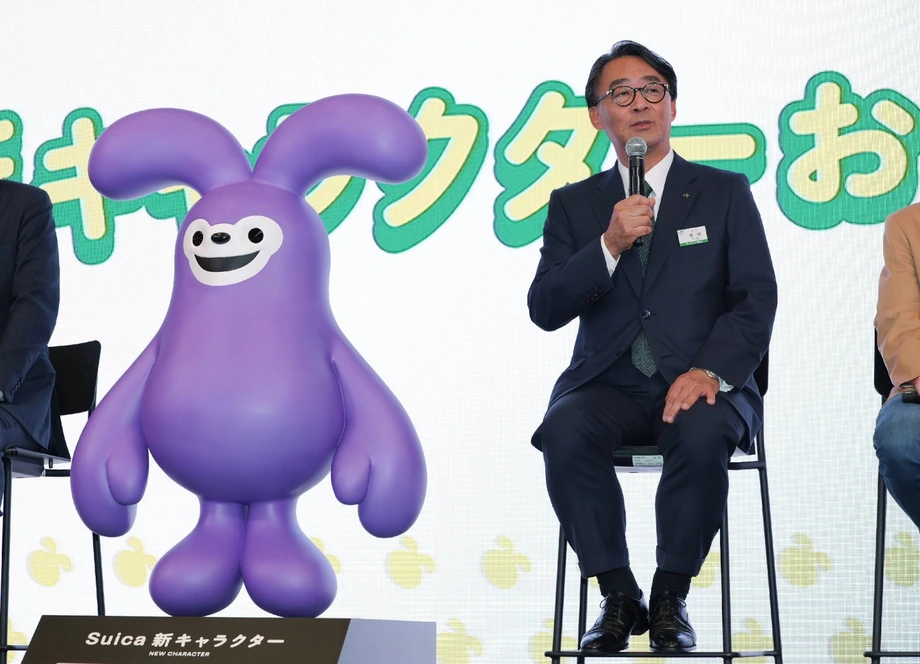
The successor emerged from a public vote among three proposed designs. JR East announced the result on November 18, 2026: the purple character resembling a rabbit received 860,152 votes out of 1,664,399 cast. That is about 51.7% of the total. The other two designs collected 804,247 votes between them, leaving the rabbit with a lead of 55,905 votes over their combined total.
The design does not yet have its final public nickname. Suggestions are being accepted through December 15, 2026, following a process that has already allowed Suica users and other members of the public to help choose the character's appearance. JR East plans to reveal the selected nickname at the handover ceremony on March 31, 2027.
That ceremony will mark the penguin's retirement and the formal transfer of its promotional role. The new mascot is scheduled to make its official debut in April 2027, giving the rabbit a separate public starting point at the beginning of Japan's new fiscal year.
Key dates in the Suica handover
- 2001: Suica launches, with the penguin serving as its image character.
- March 2016: The plaza outside JR Shinjuku Station's New South Exit opens.
- July 2016: The bronze penguin statue appears in the plaza.
- November 11, 2025: JR East announces that the penguin will retire at the end of fiscal 2026.
- November 18, 2026: The purple rabbit design wins the vote and is unveiled in Tokyo.
- November 26, 2026: JR East confirms that the statue display will be phased out and the square renamed.
- December 15, 2026: Submissions for the rabbit's nickname close.
- March 31, 2027: The handover ceremony reveals the nickname and marks the penguin's retirement.
- April 2027: The new character officially debuts.
Japan's fiscal 2026 ends on March 31, 2027. That explains why a retirement announced as taking place at the end of the fiscal year reaches its ceremony in spring 2027 rather than December 2026.
Why is JR East changing the character now?
The mascot change gives a visible form to JR East's attempt to broaden Suica beyond train fares and small shop purchases. Suica began as a contactless card whose stored balance could be tapped at a ticket gate. Its uses have since expanded to shopping, dining and money transfers, while smartphones have become an increasingly important way to hold the service.
At the Tokyo unveiling on November 18, JR East President Yoichi Kise connected the new mascot with a much broader role for the technology.
We want to evolve Suica into a device that can meet most daily needs if people have it (on their smartphones).
Kise said the new character also expressed a desire to move forward with customers in the new era created by Suica. The rabbit's arrival therefore coincides with changes to payments, public services and station gates, rather than serving as an isolated redesign of station posters and merchandise.
JR East announced the retirement plan on November 11, 2025, with special campaigns planned before the penguin's departure. The company was also preparing QR and barcode payments in the Suica app for autumn 2026 and more room for larger transactions. At that time, around 120 million physical and mobile Suica cards had been issued, and more than 2 million retailers accepted the service.
How teppay changes what Suica can do
JR East launched teppay through the Mobile Suica smartphone app in October 2026. The service handles payments made through codes and allows money transfers between users. It enters a market where services such as PayPay, which is affiliated with SoftBank Group, already have a strong presence.
The largest permitted teppay settlement is 300,000 yen, compared with 20,000 yen for conventional IC card systems. The new ceiling is 15 times the older figure. For an ordinary user, that moves the service beyond the familiar pattern of tapping for a fare, a drink or a convenience store purchase and creates room for substantially larger transactions through the app.
Teppay had about 2 million active users in early November 2026, shortly after its introduction. That initial figure sits alongside the much larger Mobile Suica base, giving JR East an existing audience to which it can promote code payments and transfers.
The app strategy also explains why JR East is treating the mascot vote and nickname search as more than merchandise promotion. Each public stage draws attention to a service whose intended role is expanding, while the penguin's farewell campaigns give long-term users a recognisable way to mark the transition.
Local services and gates that need no tap
Miyagi and Gunma prefectures are scheduled to receive local versions called Gotochi Suica in spring 2027. These will combine Suica functions with administrative services linked to Japan's My Number personal identification system. My Number provides an identification number for interactions with government, and the planned connection extends the card's role into public services as well as transport and payments.
Spring 2028 is the target for another major change: ticket gates at 40 stations, mainly in central Tokyo, that passengers can walk through without tapping a card or phone. A compatible smartphone carrying the relevant app will allow a passenger to pass through the gate without making the familiar tapping motion. JR East sees this arrangement as an important way to make Suica easier to use and encourage wider adoption.
The company puts current Mobile Suica issuance at about 46 million and aims to reach 70 million by fiscal 2031. Moving from 46 million to 70 million would add 24 million, an increase of roughly 52%. Kise told a November 10 news conference that the measures were intended to make a substantial contribution to building a Suica ecosystem, meaning a broader network of journeys, purchases, transfers and public services conducted through Suica.
Those targets extend well beyond the rabbit's April 2027 debut. The character handover is the earliest visible milestone in a programme whose gate installations and account growth goals continue into the following years.
What happens to Pensta shops and the Shinjuku meeting point?
One shop selling Suica penguin merchandise already has a closing date. JR East Cross Station, which operates the Pensta stores, announced on November 16, 2026 that its Ecute Omiya North branch would close on November 30. Plans for the remaining Pensta locations were undecided, and JR East says the operating company will announce their futures.
For people using the Shinjuku sculpture as a rendezvous point, the most immediate change will be practical. A direction that simply tells someone to wait beside the penguin may eventually lead to a square with another name and no bronze bird. The New South Exit and its viewing deck will remain identifiable, but the final instructions for visitors will depend on JR East's decisions about the replacement name and any new statue.
The rabbit will therefore inherit more than space on a card or app screen. It will represent a service seeking to handle larger payments, money transfers, local administrative functions and entry through station gates without a tap. The penguin's departure from Shinjuku turns that corporate programme into a physical change that commuters and visitors will be able to see.
What to Know
- JR East will phase out the Shinjuku penguin statue's display and rename Suica Penguin Square.
- The 2.5 metre sculpture could be removed as early as spring 2027 and will return to its creator.
- The square's new name, a replacement rabbit statue and the statue's future display location remain undecided.
- The purple rabbit won 860,152 of 1,664,399 votes, or about 51.7%.
- Its nickname will be revealed on March 31, 2027, before an official debut in April.
- Teppay allows settlements of up to 300,000 yen and had about 2 million active users in early November 2026.
- Local Suica services are planned for Miyagi and Gunma in spring 2027, followed by gates requiring no tap at 40 stations in spring 2028.
- JR East aims to increase Mobile Suica issuance from about 46 million to 70 million by fiscal 2031.
- Pensta's Ecute Omiya North branch is scheduled to close on November 30, 2026, while plans for other branches remain undecided.