A 2030 plan for digital farming and water use
Azerbaijan wants artificial intelligence to help protect crops, map soils, guide irrigation and measure the results of farm subsidies, alongside a drive to bring modern irrigation to about 300,000 hectares by 2030. Deputy Agriculture Minister Elchin Zeynalov paired that irrigation goal with two other targets: 30 modules developed using artificial intelligence and 3 percent of agricultural state support services delivered through digital channels.
Contents
- A 2030 plan for digital farming and water use
- What the state program puts in motion
- How 33 AI models are moving into ministry work
- Why 300,000 hectares of irrigation matter
- Orchard growth brings a new pest control strategy
- What the startup forum put on display
- Schools and colleges supply the skills pipeline
- The dates to watch and the details still missing
- What to Know
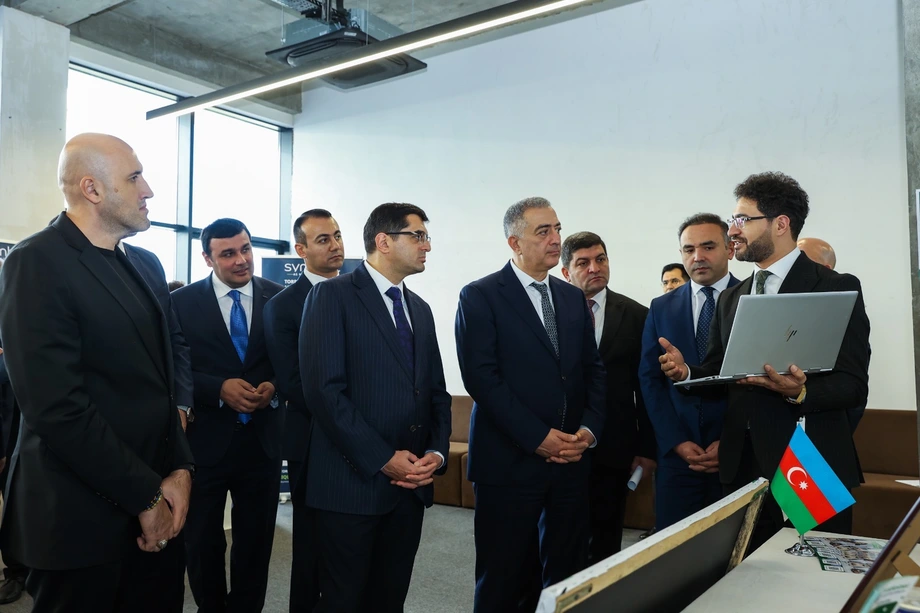
Zeynalov spoke on 27 November at the Fifth Anniversary Agricultural Startups and Innovation Forum, held at the SABAH.city innovation campus. The Ministry of Agriculture's Agricultural Innovation Center and SABAH.city organized the event, which brought together government, science and education representatives, private companies and young founders. Its purpose was to widen the use of new technology in agriculture and strengthen the startup environment around it.
The deputy minister connected that effort to climate change, limited water and land reserves, and rising global demand for food. His examples were practical: agricultural drones can observe fields, sensors can collect local readings, digital platforms can organize information, and smart irrigation can regulate water. Used together, such tools are intended to help farmers achieve better results with fewer resources and smaller losses.
Zeynalov said innovation in land management, crop production, farming and horticulture could directly increase productivity. He also urged support for young people starting agricultural businesses, arguing that entrepreneurship programs and artificial intelligence could make work simpler for farmers and companies while improving both the volume and quality of production.
What the state program puts in motion
The policy framework is the State Program on the Development of Production and Processing of Agricultural, Fisheries and Aquaculture Products in the Republic of Azerbaijan for 2026 to 2030. Zeynalov said the program identifies innovation and digitalization as main priorities. It provides for wider use of artificial intelligence, expanded capabilities for the Electronic Agricultural Information System and the development of management based on data.
Management based on data means using consistent records and analysis to guide decisions. For agriculture, those records can concern fields, crops, water, livestock and public support. The Electronic Agricultural Information System gives this work a digital foundation, while artificial intelligence can help find patterns or produce assessments from large amounts of information.
The two digital targets measure separate parts of that transformation. A module is a software component built for a defined task, so the goal of 30 points to a collection of practical tools. The 3 percent target measures the share of agricultural state support services delivered through digital channels, giving the ministry a numerical way to track the move toward electronic service delivery.
Farmers will encounter the program through a combination of software, field equipment and advice. A sensor network can supply information about conditions, but irrigation equipment is needed to control water and agronomic knowledge is needed to choose the right response. The program therefore connects digital development with changes in cultivation, water management and agricultural training.
How 33 AI models are moving into ministry work
At the Azerbaijan-Italy Business Forum in Baku, Surkhay Novruzov, head of the Ministry of Agriculture's Agricultural Artificial Intelligence project, gave a detailed account of the software already being introduced. He said 33 monitoring models based on artificial intelligence were entering the agricultural sector and that young local specialists had developed all of them.
The 33 models have three main purposes. Twenty five are designed to raise agricultural productivity, five assess the effectiveness of subsidies and three support livestock farming. Their subjects include plant protection, crop yields, irrigation, soil mapping and harvesting. The subsidy models add a public administration function, examining whether government support is producing effective results.
Novruzov used the term monitoring models for these 33 tools, while Zeynalov's separate 2030 target counts modules developed using artificial intelligence. Novruzov also described progress through use cases, meaning specific tasks that the technology has been built to perform. Integration is the subsequent work of connecting a completed tool with the ministry's systems and regular procedures.
Novruzov then described how many use cases had been completed and how many tools had entered the ministry's routine work.
Work has now been completed on 24 use cases, most of which are currently at the integration stage. Many solutions are already ready, ranging from assessments of government support effectiveness and pollination levels to satellite monitoring and mapping. Three of them have already become part of the Ministry of Agriculture's day-to-day operations.
Pollination assessments can show how effectively flowers are being pollinated, a process required for many crops to form fruit or seed. Satellite monitoring can extend observation across large farming areas, while mapping can present the results geographically. These examples show that the project covers field production as well as oversight of government support.
Why 300,000 hectares of irrigation matter
Vusal Hajiyev, deputy head of the Plant Protection and Fumigation Center at the Agricultural Services Agency under the Ministry of Agriculture, gave further details on 20 November 2026. Speaking at the Baku conference Agronomy and Plant Health: From Science to Practice, he repeated the goal of applying modern irrigation systems across 300,000 hectares. That area is equivalent to 3,000 square kilometers.
The crop targets include increasing wheat yields by approximately 20 percent. Hajiyev also listed an approximate 17 percent increase for cotton and sprout crops. Yield means the amount harvested from a given area, so higher yields allow more production without requiring the same proportional increase in cultivated land.
Modern irrigation delivers water in a more controlled way, allowing farmers to respond to crop requirements and field conditions. Hajiyev said these systems support plant development, efficient water use and the conservation of soil resources. He also connected them with maintaining suitable moisture around plants, limiting the spread of plant diseases, supporting normal activity by soil microorganisms and sustaining optimal soil moisture.
Hajiyev said sustainable and competitive production requires attention to every stage, beginning with soil preparation and the selection of healthy seed of good quality. Agronomists, the specialists who advise on crop production, form a bridge between the goals in the state program and the results farmers achieve. They also serve as direct field implementers of those goals.
Orchard growth brings a new pest control strategy
Intensive orchards are planned to expand from 50,000 hectares to 70,000 hectares. This would add 20,000 hectares, an increase of 40 percent from the starting area. Intensive orchards generally use denser planting and closer management than traditional orchards, placing greater demands on irrigation, nutrition, pollination and plant protection.
Hajiyev said the expansion would increase the workload of agronomists and require them to use more innovative methods. His list included tools for pollinating fruit and flowers, work with new varieties, selection of pollinators and rootstocks, modern fertilization regimes and updated plant protection systems. Rootstocks are the rooted parts onto which cultivated fruit varieties can be grafted, influencing how the resulting trees grow.
Plant protection is expected to rely more heavily on integrated control. Hajiyev said biological control and biotechnological methods should take priority before a move to highly toxic pesticides with broad effects. Biological control uses natural enemies or other living processes to restrain pests, offering another way to protect crops while reducing the pesticide burden in intensive orchards.
Pheromone traps can help agronomists identify harmful insects by using chemical signals to attract them. Climate information can also be used to assess the risk of diseases spreading before visible damage becomes widespread. Hajiyev said fertilizers and other cultivation measures could help prevent some of these risks. He linked the combined approach with lower pesticide use and production of better quality crops suitable for export.
What the startup forum put on display
More than 100 startup founders representing 22 higher education institutions joined the forum, and nearly 100 projects were displayed. The exhibition covered data analytics, livestock and crop production, robotics, drones, artificial intelligence and the Internet of Things, or IoT. IoT means equipment such as sensors and connected machines sharing readings over a network. Other projects addressed irrigation and water management, soil and climate, logistics and supplies, and agricultural machinery.
Anar Jafarov, director of the Agricultural Innovation Center, presented a report on the center's work with startups, development of the agricultural startup community and initiatives already carried out. A video also reviewed bootcamp events, where early projects are developed through intensive training. Founders explained their displays to visitors, who later toured the SABAH.city infrastructure. The exhibition gave Zeynalov's call for youth entrepreneurship a practical setting, with founders showing how digital tools could enter farm production.
Schools and colleges supply the skills pipeline
Deputy Minister of Science and Education Kenan Karimzada told the forum that more than 500,000 school pupils are involved in Digital Skills projects and more than 300,000 in STEM projects. STEM combines science, technology, engineering and mathematics. Participants gain knowledge in coding, information technology, engineering and agricultural technologies, creating a broad base for later technical work.
For the 2026 to 2027 academic year, Karimzada reported more than 2,400 admissions to higher education in agricultural specialties and more than 2,800 to vocational education. Together, those figures exceed 5,200 people. He said work continues on modern vocational centers in the regions, wider practical training and stronger cooperation with agricultural enterprises. Those links will be needed as farms adopt digital tools and the irrigation and orchard plans create demand for agronomists and technicians who can apply their training in the field.
The dates to watch and the details still missing
The policy period and the public statements provide several fixed markers for measuring progress.
- 2026 to 2030: The state program makes innovation and digitalization priorities for agriculture, fisheries, aquaculture and processing.
- 2026 to 2027 academic year: More than 2,400 people are reported admitted to higher agricultural education and more than 2,800 to vocational education.
- 20 November 2026: Hajiyev set out the crop yield, modern irrigation and intensive orchard goals at the Baku agronomy conference.
- By 2030: The targets are 30 modules developed using artificial intelligence, 3 percent of agricultural state support services delivered digitally and about 300,000 hectares covered by modern irrigation.
The fullest current measure of software progress is 24 completed use cases, most at the integration stage, and three models already used in the ministry's daily operations. The remaining integrations have no stated completion date. The statements also did not provide a current total for land already equipped with modern irrigation or annual installation milestones on the way to 300,000 hectares.
Farmers can therefore expect development on several fronts at once: software moving into ministry procedures, startups testing practical tools, expanded agricultural education and changes in irrigation and orchard management. The published figures provide clear endpoints for 2030, while the integration total offers an early measure of how much of the artificial intelligence program has moved beyond development.
What to Know
- Azerbaijan aims to have 30 modules developed using artificial intelligence by 2030.
- The share of agricultural state support services delivered through digital channels is targeted at 3 percent.
- Modern irrigation is planned for approximately 300,000 hectares by 2030.
- A separate rollout covers 33 monitoring models, with work complete on 24 use cases and three models already in daily ministry operations.
- Twenty five models address productivity, five assess subsidy effectiveness and three support livestock farming.
- Crop goals include wheat yield growth of about 20 percent and growth of about 17 percent for cotton and sprout crops.
- Intensive orchards are planned to grow from 50,000 to 70,000 hectares, accompanied by wider use of biological and integrated pest control.
- More than 100 startup founders from 22 higher education institutions attended the forum, where nearly 100 projects were displayed.
- More than 500,000 pupils are involved in Digital Skills projects, while reported agricultural admissions for 2026 to 2027 exceed 5,200 across higher and vocational education.