A New East West Corridor Opens at 7am
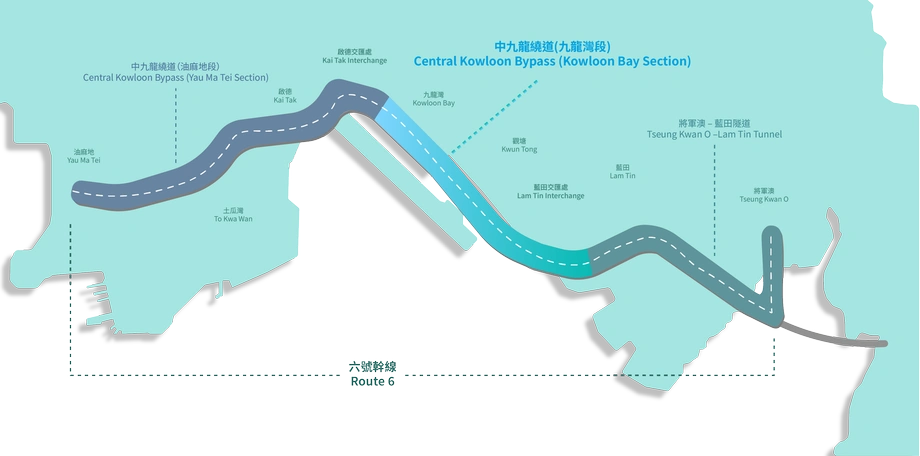
At 7am on December 6, traffic will enter the Kowloon Bay Section of the Central Kowloon Bypass, the final piece needed to complete Route 6. A government announcement said the new section is about 3.4 kilometres long, including 3.1 kilometres of tunnel, and will join the already opened Yau Ma Tei Section with the Tseung Kwan O-Lam Tin Tunnel. The completed route links Tseung Kwan O, Kowloon East and Kowloon West, giving drivers a way to cross Kowloon without threading through many busy local roads.
Contents
- A New East West Corridor Opens at 7am
- The Route, the Toll and the Lane Rules
- Why the Trip Becomes Much Shorter
- A Short Timeline of a Long Project
- Building Under an Active Harbour
- The Technology Behind the Tunnel
- Buses Bring the Benefits to People Without Cars
- Opening Day Lane Choices and Police Controls
- What the Diversion Figures Mean for Districts
- The Bill and the Case for a Flat Toll
- What Remains Unsettled in the First Weeks
- What to Know
For motorists the change is easy to describe: a trip between Tseung Kwan O town centre and Yau Ma Tei in the busiest hours is expected to fall from about 65 minutes to about 12. The Civil Engineering and Development Department gave that forecast. The Transport Department expects about one tenth of traffic on the Kwun Tong Bypass to move to the new corridor. All vehicles will pay HK$8 all day through HKeToll, the electronic system that charges cars as they pass without stopping at a toll booth. The Yau Ma Tei Section has been toll free since it opened on December 21, 2025; charging starts when the full bypass is in use. Officials said drivers should expect heavier traffic at first as they learn the new lane layout.
The Route, the Toll and the Lane Rules
Route 6 is a 12.5 kilometre chain made up of the Yau Ma Tei Section, the Kowloon Bay Section and the Tseung Kwan O-Lam Tin Tunnel. The bypass itself has been described as 7.7 kilometres across its two tunnel sections. The Yau Ma Tei Section runs from the Yau Ma Tei interchange of the West Kowloon Highway through Ma Tau Kok, Ho Man Tin and southern Yau Tsim Mong to Kai Tak. The Kowloon Bay Section continues from Kai Tak to Cha Kwo Ling and the Lam Tin interchange. Yau Ma Tei has three lanes in each direction; Kowloon Bay has two lanes in each direction. The speed limit is 80 kilometres an hour, and the operating company is listed as Chun Wo Tunnel Management Limited.
The HK$8 charge applies to every vehicle type, including taxis, goods vehicles and minibuses. Payment is made through HKeToll at a point on the eastern exit of the Yau Ma Tei Section near the Kai Tak roundabout, so drivers do not stop to pay. Franchised buses using Route 6 will not pay the toll, so passengers face no extra cost from the charge.
- Lam Tin interchange connects to the Tseung Kwan O-Lam Tin Tunnel, with a branch to Cha Kwo Ling Road.
- Kai Tak interchange serves the Kai Tak cruise terminal, Hong Kong Children's Hospital, Shing Cheong Road and Kai Tak Bridge Road.
- Exit 3A leads to Kwun Tong and Hong Kong East only through the Kwun Tong Bypass; Exit 3B serves Kowloon Bay, Kai Tak, Kai Tak Sports Park and To Kwa Wan; Exit 3C continues into the Yau Ma Tei Section.
- Exit 4A serves Tai Kok Tsui and Link Road, Exit 4B serves Hong Kong West and Western Harbour Crossing, and Exit 4C serves Yau Ma Tei, the high speed rail station and Link Road.
Access to Yau Ma Tei changed on August 3, 2025, when the old West Kowloon Highway exit became an entrance to the bypass. Drivers from the Cheung Tsing Highway use the Cheung Sha Wan exit to Link Road. Traffic from the Tsing Sha Highway toward Sha Tin uses exit 2D and Lai Po Road. Vehicles from Mei Ching Road or the Kwai Tsing container terminals use Container Port Road South and Lai Po Road. Motorists who miss the Cheung Sha Wan exit can use the Tsim Sha Tsui branch and Axiang Road toward Jordan Road.
Why the Trip Becomes Much Shorter
Before Route 6, a driver going from Tseung Kwan O to West Kowloon usually had to use the Tseung Kwan O Tunnel, Kwun Tong Bypass, Kai Tak Tunnel and Gascoigne Road Flyover, or take Kwun Tong Road, Lung Cheung Road and Boundary Street. In peak traffic that could take about 65 minutes. The new route is designed for through traffic, so cars do not have to join each local road along the way. Officials forecast about 12 minutes between Tseung Kwan O and Yau Ma Tei, a saving of about 53 minutes each way, or about 106 minutes for a return trip if the forecast holds. Earlier project descriptions also said the Yau Ma Tei to Kai Tak portion would fall from about 30 minutes to about five minutes.
Leung Sai-ho, Deputy Commissioner for Transport (Planning and Technical Services), said the full route should pull traffic from major corridors such as the Kwun Tong Bypass. He said the department had already seen a diversion effect after the Yau Ma Tei Section opened and would keep watching traffic through cameras and survey teams.
We have already observed a 20 percent diversion effect after the opening of the Yau Ma Tei section."
"Our team will keep closely monitoring the traffic situation through our traffic surveillance system and ad-hoc deployed survey teams to see whether traffic flow is performing according to our expectations.
The figures describe different things. The 20 percent figure refers to what was observed after the Yau Ma Tei Section opened. The expected effect on the Kwun Tong Bypass from the Kowloon Bay opening is about 10 percent. A wider assessment from the Civil Engineering and Development Department put the possible diversion of east west Kowloon traffic at about 20 percent. For a driver, the practical change is fewer cars using local streets in Kwun Tong, Kowloon Bay, To Kwa Wan and Yau Ma Tei for long cross district trips.
A Short Timeline of a Long Project
The road was planned decades before cars could use it. Work began in the 1990s, changed shape through public consultations and funding debates, and reached construction in stages spread across two tunnel systems.
- 1991: The government began planning the Central Kowloon Route after Airport Core Programme decisions in 1990.
- 1998 and 2002: The proposal changed from two lanes in each direction to three lanes in each direction, the basis of today's Yau Ma Tei Section.
- 2007 to 2009: Extra funding was sought and the first public consultation was held. The western entrance near Yau Ma Tei required rebuilding facilities including the district police station and jade market.
- January 2016: The Executive Council approved construction of the Central Kowloon Route. Work began in the fourth quarter of 2017.
- 2019: Major contracts were awarded, including the T2 main contract to Bouygues Travaux Publics for HK$10.918 billion.
- November 9, 2021: The tunnel boring machines Ria and Victoria were launched at the Kai Tak shaft for the eastbound and westbound Kowloon Bay tunnels. The Yau Ma Tei tunnel machine was named Nebula.
- Late 2022: The Tseung Kwan O-Lam Tin Tunnel opened.
- November 26, 2025: Chief Executive John Lee announced that the Yau Ma Tei Section would open on December 21.
- December 21, 2025: The Yau Ma Tei Section opened, with Secretary for Transport and Logistics Chan Mei-bo presiding. Citybus ran a special open top service and gave certificates to participants.
- September 30, 2026: Chan told the Transport Committee of the Legislative Council that the Kowloon Bay Section would open on December 6.
- November 27, 2026: Opening, toll, bus and road arrangements were announced, setting December 6 at 7am as the full commissioning time.
The long timetable explains why the opening matters now: the bypass closes a gap that left Route 6 incomplete even after two major sections were already carrying traffic.
Building Under an Active Harbour
The Kowloon Bay Section runs under the Kwun Tong Typhoon Shelter between Kai Tak and Cha Kwo Ling. The government announcement said two 14 metre wide tunnel boring machines were used, avoiding reclamation and allowing waterfront facilities to keep operating during the works. A tunnel boring machine is a giant moving drill that cuts through soil and rock while workers stay protected inside. Engineering descriptions put the work about 40 to 50 metres below the seabed, with each machine about 120 metres long and 4,200 tonnes.
Length descriptions vary. The official opening information gives 3.4 kilometres for the section and 3.1 kilometres of tunnel. Other public descriptions put the road at 3 kilometres, with 2.7 kilometres of undersea tunnel, while another figure gives 2.4 kilometres of subsea tunnel. These figures describe the road and tunnel in slightly different ways.
The Yau Ma Tei Section was built through dense urban ground. More than 2,400 blasts were used in drill and blast work. Under Queen Elizabeth Hospital, blasting was limited to 15 minute intervals so medical equipment would not be affected. The tunnel passes under the MTR network near Nathan Road with as little as three metres between road and rail tunnels. A 370 metre underwater section between Ma Tau Kok and Kai Tak used temporary reclamation, which was removed after construction.
The Technology Behind the Tunnel
Working deep under water brought a time problem. Replacing worn cutting tools on a tunnel boring machine once required workers to enter a compressed air chamber. Pressurising took about 45 minutes and decompression took two to three hours, leaving only about two hours of real work each day. The team developed atmospheric pressure cutter changing technology, using a double airlock chamber like the doors of a submarine so tools could be changed in a dry, normal pressure space. The method won the seventh International Design Safety Award.
Leung Chung-lik, Director of the East Development Office of the Civil Engineering and Development Department, said more than 95 percent of tunnel components were made away from the site and assembled in Hong Kong, like large building blocks. That reduced time on site, improved safety and eased pressure on an ageing construction workforce.
Ng Chau-kin, Chief Engineer in the East Development Division of the Civil Engineering and Development Department, said an automated tunnel inspection system used drones and unmanned ground vehicles to find defects without global positioning signals. A drone rises from a four wheel ground vehicle, records ultra high definition colour and heat images, then returns to the vehicle to be carried onward. He said the system was 23 times faster than manual checks, cost 50 percent less, kept accuracy at 98 percent and gained three patents. The works were described as finishing with zero overspending and zero delay, with more than 140 awards including a Geneva International Exhibition of Inventions silver award, an Edison Award gold award and an R and D 100 Award.
The works also had serious accidents. On October 14, 2020, an excavator being lifted at the Ho Man Tin shaft broke loose and fell, with no injury. On April 21, 2021, a concrete bucket struck a 40 year old worker at the Kai Tak site and he died. On February 18, 2023, muddy water surfaced near the Cha Kwo Ling waterfront during tunnelling. On May 16, 2023, a 49 year old Nepalese worker was hit by a loader at the To Kwa Wan works and died; police treated the case as an industrial accident.
Buses Bring the Benefits to People Without Cars
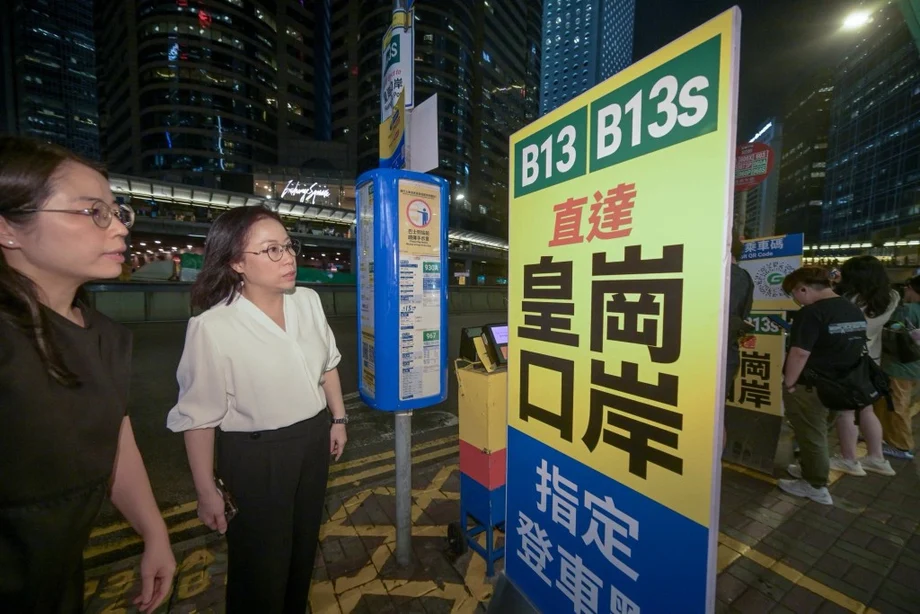
Three franchised bus routes will use the whole Route 6, extending the benefit beyond drivers. Citybus Airport Express route A28X will change from the 7:20am departure on December 6, running from Tseung Kwan O Station through Tiu Keng Leng, Sheung Tak and LOHAS Park to the airport and the Hong Kong port of the Hong Kong Zhuhai Macao Bridge. The fastest trip from LOHAS Park to the airport is expected to be about 40 minutes. KMB route 290E between Tseung Kwan O Industrial Estate and Tsuen Wan West, and Citybus route 795 between Tseung Kwan O Industrial Estate and Cheung Sha Wan (Hoi Tat), will change from their first buses on December 7. Route 795 is expected to reach Jordan and the high speed rail station in about 15 minutes from LOHAS Park, and Yau Ma Tei and Mong Kok in about 20 minutes, with trips up to 10 minutes shorter.
Wong Pak-kin, Chief Transport Officer (Bus and Rail) at the Transport Department, said the number of bus routes using Route 6, including the Central Kowloon Bypass and Tseung Kwan O-Lam Tin Tunnel, will reach 20 by the end of this year, with about 300 trips each day. Routes already using parts of the corridor include 33X, 234D, 252S, 258X, 259S, 259X, 268P and 269S in weekday peak periods, X6C between Mei Foo and the Kai Tak hospital on weekdays, B14 between Kai Tak and Huanggang, and A28X in the morning peak. Bus services will be reviewed as passenger demand becomes clearer.
Opening Day Lane Choices and Police Controls
The Yau Ma Tei Section will close from midnight to 7am on December 6 for traffic sign updates, road markings and final HKeToll preparation. More than 80 temporary signs will be installed because drivers struggled with lane choices when that section first opened. The Transport Department urged motorists to watch its driving guide videos and choose routes based on actual traffic conditions. Police will control major junctions including Shing Cheong Road at Kai Tak, the eastbound Eastern Harbour Crossing, Cha Kwo Ling and the Lam Tin tunnel area. Drivers who park or wait in the tunnel before opening face fixed penalty tickets and towing.
Eastbound drivers going to Tseung Kwan O or Cha Kwo Ling should travel along the Yau Ma Tei Section and use the two right lanes at the Kai Tak interchange. Drivers for Cha Kwo Ling or Yau Tong need the left lane inside the Kowloon Bay tunnel and must take the left exit at the branch. Those continuing to Tseung Kwan O simply enter the Tseung Kwan O-Lam Tin Tunnel after leaving the Kowloon Bay Section.
Westbound drivers can enter from the Tseung Kwan O-Lam Tin Tunnel mainline, the northern exit of the Cha Kwo Ling Road roundabout, or the Kowloon exit of the Eastern Harbour Crossing, following signs for Yau Ma Tei. Once inside the Kowloon Bay tunnel westbound, traffic continues into the Yau Ma Tei Section to West Kowloon, Tai Kok Tsui, Yau Ma Tei and Western Harbour Crossing, with no intermediate exit. Drivers for Kai Tak or Kowloon Bay should keep using existing roads.
Some older lane controls will stay for now. Kai Fuk Road northbound still allows only franchised buses to go directly onto the Kwun Tong Bypass; other vehicles use Sheung Yee Road and Wang Chiu Road near MegaBox. Leung Sai-ho said the double white lines may be removed after traffic falls and drivers adapt, but no date was given. Senior Inspector Cheng Yiu-lam of the West Kowloon Traffic Division warned that the rightmost lane at the Yau Ma Tei tunnel exit leads only toward Kwai Chung, so a driver wanting Tsim Sha Tsui would need to turn around at the Mei Ching Road roundabout. Inspector Ho Kin-pong of the East Kowloon Traffic Division said police would use patrols and cameras against illegal lane changes. Assistant Commissioner for Transport (Transport Projects) Pun Shui-sun said signal timings at Sheung Yee Road can be adjusted if queues build.
What the Diversion Figures Mean for Districts
Route 6 links homes and jobs that sit on different sides of Kowloon. It connects the Tseung Kwan O residential and industrial area, the West Kowloon Cultural District, the Kai Tak Development and cruise terminal, the Kowloon East business district, the high speed rail station at West Kowloon and the Tseung Kwan O Innovation Park. The corridor is part of the long term eight vertical and eight horizontal transport plan, a strategy based on building capacity before demand grows. For businesses, the route gives vehicles from Tseung Kwan O a faster path through the Tseung Kwan O Cross Bay Link, Route 6, the West Kowloon Highway and the Tsing Ma Bridge toward the airport, instead of sending them through Kwun Tong and Kowloon Bay.
Property examples show why access matters locally. Before opening, homes in Tseung Kwan O examples ranged from HK$14,956 to HK$18,344 per square foot, while West Kowloon examples ranged from HK$27,003 to HK$31,664, about 25 percent to 43 percent higher. Rents in Tseung Kwan O examples ran from HK$41 to HK$49 per square foot, against HK$61 to HK$71 in West Kowloon examples. Those figures sit alongside expectations that Tseung Kwan O, Kwun Tong and Kowloon Bay could draw more interest once travel times fall.
The Bill and the Case for a Flat Toll
Public contract figures put the Yau Ma Tei tunnel at HK$43.7 billion and the Kowloon Bay tunnel at HK$10.918 billion. Broader figures put the Central Kowloon Bypass at HK$42 billion, about US$5.4 billion, and Route 6 at more than HK$68 billion, with Kowloon Bay work around HK$16.017 billion. They cover different packages and totals. Major contracts included Bouygues Travaux Publics for the T2 main contract and the middle tunnel at about HK$6.226 billion, Gammon for Kai Tak West at about HK$6.24 billion, Build King with South Korean SK Construction for Yau Ma Tei East and West at HK$5.02 billion and HK$3.464 billion, a joint venture for Kai Tak East at HK$1.974 billion, and Nishimatsu Construction for the Ho Man Tin shaft at HK$268.5 million. Official opening information gives Route 6 as 12.5 kilometres, while one pre opening property comparison used about 11.9 kilometres.
Leung Chung-lik said the HK$8 toll balances diversion, affordability and recovery of part of the tunnel operating cost. A higher toll would discourage use, while a lower toll would leave too little spare capacity for future demand. The flat price is meant to attract private cars and working vehicles, including goods vehicles, minibuses and taxis, away from crowded surface roads.
What Remains Unsettled in the First Weeks
No date was given for removing the Kai Fuk Road double white lines or for converting construction shafts into underground car parks with automated parking. The Transport and Logistics Bureau has only said it is considering the car park idea, including the shaft at the former temporary Yau Ma Tei jade market. The Transport Department will monitor the bypass and nearby roads through surveillance systems and survey teams. Bus routes will be reviewed against passenger demand.
Environmental work around the tunnels will continue to shape the neighbourhoods. The western Yau Ma Tei exit and ventilation building were moved away from Ferry Street toward Hoi Wang Road and the West Kowloon interchange, with covers and a green belt of more than 200 metres. Ventilation buildings at Kai Tak, Ho Man Tin and Yau Ma Tei use green designs named flowing clouds and water, movement with time and sky garden. Landscape decks are planned at Yau Ma Tei and Kai Tak, covering about 32,000 and 11,500 square metres. Yan Cheung Road Park opened on October 7, 2026, and a Ma Tau Kok study proposes greening about three hectares and relocating the vehicle testing centre so the area can reach 30 percent green coverage.
What to Know
- The Kowloon Bay Section opens at 7am on December 6, completing Route 6.
- Route 6 links Tseung Kwan O, Kowloon East and Kowloon West through three connected road sections.
- The HK$8 toll applies all day to all vehicle types through HKeToll, with no stopping to pay.
- Peak journeys between Tseung Kwan O and Yau Ma Tei are forecast to fall from about 65 minutes to about 12.
- The Yau Ma Tei Section closes from midnight to 7am on December 6 for final signs, markings and toll preparation.
- Citybus A28X changes on December 6; KMB 290E and Citybus 795 change on December 7.
- Police will enforce lane rules at Kai Tak, Cha Kwo Ling, the Eastern Harbour Crossing and the Lam Tin tunnel area.