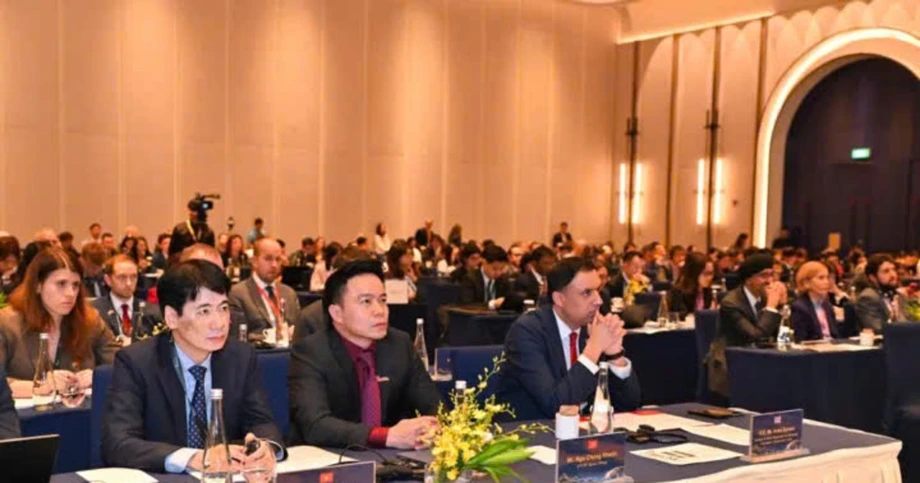
The Hanoi Forum Sets a Practical Test
Vietnam opened the 2026 CPTPP, ASEAN and EU Business Forum on November 26 at the Fairmont Hanoi Hotel, 10 Tran Nguyen Han Street, Hoan Kiem Ward, with a two hour session built around one question: how can trade promises become contracts, investment projects and supply chains that work in daily life. The Ministry of Industry and Trade issued the forum invitation with a time of 3:30 PM to 5:30 PM. An event recap dated November 27 placed the opening on November 25 afternoon; the official invitation listed the forum itself on November 26. The theme was From Dialogue to Business Action.
Contents
- The Hanoi Forum Sets a Practical Test
- What the Forum Was Built to Deliver
- Four Priorities Put on the Table
- The EU Push Links Resilience, Digital Trade and Vietnam
- Companies Ask for Predictable Rules, Not Just Lower Tariffs
- VinFast Wants Certainty Before Product Launches
- Design, Skills and Green Standards Cross Borders
- The Numbers Behind Vietnam's Opportunity
- CPTPP Expansion Changes the Scale of the Test
- Early Warnings and Digital Rules Become Work Programmes
- What Businesses Need From 2027
- Key Points
Deputy Minister of Industry and Trade Luong Hoang Thai told ministers and business leaders that the three groupings bring different strengths. The Comprehensive and Progressive Agreement for Trans-Pacific Partnership brings high standard trade rules, ASEAN brings fast growth and manufacturing capacity, and the EU brings market size, capital, technology and innovation. European Commissioner for Trade and Economic Security Maroš Šefčovič pressed for results that companies can see, especially partnerships between companies and signed contracts. Philippine Secretary of Trade and Industry Ma. Cristina A. Roque said companies need reliable partners, suppliers, investors and new markets, while governments need to make companies confident enough to invest and expand.
What the Forum Was Built to Deliver
The Ministry of Industry and Trade published a tentative agenda that sets out a simple path: dialogue, recommendations, commitments and business action. Around 250 participants were expected, including trade ministers, senior officials, chief executives, business associations, diplomatic missions and international organisations. The format moved beyond the business matching held in Ho Chi Minh City in July. Ministers and chief executives were asked to name one barrier governments should remove, where the three regions could build supply chains for the next generation, and what governments and companies could do together in 2027. About 15 minutes was set aside for ministers to answer questions submitted during registration.
The main deliverable was the Ha Noi Business Action Package 2026. It has three parts: a single page set of five business priorities, a showcase of three to five flagship partnerships in trade, investment, technology or supply chains, and a Business Connectivity Initiative inviting future CPTPP chairs to keep the minister and chief executive dialogue going. The proposed recommendations cover digital and paperless trade, supply chain links, regulatory transparency, green trade procedures and access for smaller firms. Partnerships were to be chosen if they involved at least two of the three groupings, had clear commercial goals, fitted the forum themes and were ready to be announced. The agenda did not name those partnerships, and it said there would be no signing ceremonies during the showcase.
- July 22, 2026: A CPTPP business forum and business matching programme in Ho Chi Minh City drew nearly 200 delegates, including 115 business and organisational representatives, with 53 firms in more than 20 meetings between companies.
- November 23 to 25: senior officials held the fifth CPTPP Senior Officials Meeting in Hanoi.
- November 26: the CPTPP EU dialogue ran from 8:30 AM to 10:00 AM, the CPTPP ASEAN dialogue from 11:00 AM to 1:00 PM, and the business forum from 3:30 PM to 5:30 PM.
- November 27: the 11th CPTPP Commission Meeting ran from 9:00 AM to noon, followed by a ministerial press briefing from 3:00 PM to 3:45 PM.
Four Priorities Put on the Table
Luong Hoang Thai set out four areas where he said cooperation should concentrate. The first is wider market access through better use of existing free trade agreements and lower costs of compliance. A free trade agreement cuts or removes tariffs, the tax charged at the border, but companies still spend money on paperwork, product tests, certificates and proof of where goods were made. Those costs can be harder for a small exporter to absorb than the tariff itself.
The second priority is investment and diversified supply chains that use the market strength of one region, the production base of another and the capital and technology of the third. The third is to make green transition, digital transformation and innovation drivers of growth. The fourth is closer work between government and business, so companies can propose initiatives, build partnerships and turn opportunities into projects. The forum was designed around that same idea, with business recommendations presented to ministers rather than a narrow discussion of individual technical barriers.
The EU Push Links Resilience, Digital Trade and Vietnam
Maroš Šefčovič said cooperation between governments must produce practical outcomes for companies. He pointed to the EU's network of free trade agreements, which he said is the largest in the world and covers more than half the global population. For ASEAN, he noted free trade agreements already in force with Singapore and Vietnam and said the EU wants deeper work in digital trade, green technology, sustainable services and resilient supply chains. He described bilateral agreements with ASEAN members as a path toward a future agreement between the two regions.
European Commissioner for Trade and Economic Security Maroš Šefčovič described the EU Vietnam Free Trade Agreement as proof that a trade deal can work for both sides. He said:
The EU-Vietnam Free Trade Agreement (EVFTA) is a good example of cooperation through a free trade agreement, demonstrating the benefits achieved by both sides,
The commissioner said EU Vietnam trade had reached US$80 billion since the agreement took effect and that Vietnam was running a trade surplus with the EU. He also said the EU wants clearer chances to invest in Vietnamese infrastructure, transport, telecommunications and renewable energy. He said he had discussed the recent visit to the EU by Party General Secretary and State President To Lam with Minister of Industry and Trade Le Manh Hung. On United States tariff policy, he said the EU opposed the measures outlined in the Section 301 findings and was working with the United States on excess supply and reform of global trade chains. A Section 301 investigation is a United States trade tool used to examine another economy's policies and can lead to tariffs.
Companies Ask for Predictable Rules, Not Just Lower Tariffs
Warrick Antony Cleine, chairman of the British Business Group Vietnam and chief executive of KPMG Vietnam, put the focus on procedures that slow trade even when tariffs are low. He cited rules of origin, repeated product inspections and manual customs steps. Rules of origin are the tests that decide where a product counts as made, which matters because only qualifying goods receive preferential tariff treatment. Cleine called for simpler measures other than tariffs, mutual recognition of professional qualifications, easier movement of skilled workers, and clearer rules for digital trade and data.
The practical effect is felt by customs brokers, factory managers and service firms that must repeat the same checks in several markets. Cleine also called for more trade in services and deeper participation by small and medium enterprises in regional value chains. Ma. Cristina A. Roque made the same point from government's side, saying businesses need dependable partners and market access, while public policy should give them confidence to invest. The message from the discussion was that a signed trade agreement is only useful if the steps at the border and inside offices are manageable.
VinFast Wants Certainty Before Product Launches
Kariyanto Hardjosoemarto, Global Market Expansion Manager at VinFast, named predictable market access as the first need of a car maker expanding abroad. He said certification, product inspection, customs steps and local documents all affect the timing of a launch. If approval times are uncertain, a company cannot plan a product launch, set up a dealer network or deliver vehicles with confidence.
VinFast invested in manufacturing in India and Indonesia in 2025. Kariyanto said those plants can create openings for local component makers, logistics providers and technical service suppliers. He proposed a government company mechanism to identify common barriers in the car industry and a supplier connection programme based on real purchasing needs. Under such a programme, manufacturers name the parts or services they need, business associations find suitable suppliers, and technical partners help assess capacity and train workers. That gives smaller firms a route into larger production networks.
Design, Skills and Green Standards Cross Borders
Alif Arif Iskandar A. Wahab, principal and director of Malaysia's VERITAS Architects, pointed to a different set of barriers in architecture, design and engineering advice. Architects and consultants often face fresh licensing requirements in a new market or must find a local partner. Green building certificates are not widely recognised across countries, so a project can be assessed more than once. He proposed mutual recognition of qualifications and green standards, faster approval for investment projects, especially in industry and data centres, and teams of designers and engineers from several disciplines that can serve investors and regulators through one structure.
Nguyễn Hoàng Trung, deputy general director and chief financial officer of FPT Software, offered five business actions: joint investment and new value chains, controlled testing spaces for artificial intelligence and other new technology, shared training programmes, common standards and technology transfer, and platforms that connect businesses and investors across regions. A controlled testing space, often called a sandbox, lets a company try a new service under regulator supervision before wider use. FPT has more than 45,000 employees, operates in over 30 countries and serves more than 1,000 customers, including over 130 Fortune 500 companies. The company tests technology inside its own operations before offering it to clients, an approach it calls Customer Zero.
The Numbers Behind Vietnam's Opportunity
Vietnamese officials and business groups brought hard numbers to the discussion. The Import Export Department said the share of exports using preferential CPTPP certificates rose from 2 percent in 2019 to 10 percent in 2025, worth more than US$6 billion. That is an increase of eight percentage points, but it also leaves most exports outside the preferential scheme. Officials said the rate is lower than under the EU Vietnam and United Kingdom Vietnam agreements partly because exporters can choose benefits from several overlapping free trade agreements. A survey by VCCI's WTO and Integration Center found that only one in four participating businesses understood the benefits of the CPTPP, with foreign invested firms most familiar.
The market gap is large. CPTPP members other than Vietnam imported about US$4.25 trillion of goods in 2025, while Vietnam exported more than US$70 billion to the bloc, a share above 1 percent. Canada alone imports more than US$700 billion a year. Vietnamese textile and footwear exports already hold 20 percent to 22 percent of that market, while food and agricultural products remain modest. Customs data showed Vietnam's trade with CPTPP members reached US$114.2 billion in the first nine months of 2026, up 24.8 percent from a year earlier, with exports at US$64.04 billion, up 23.5 percent.
Textiles show why rules of origin matter. Exports to CPTPP members rose from US$6.27 billion before the agreement took effect to US$8.3 billion in 2025, but imports of fabric and other inputs from the bloc stayed around US$1.58 billion to US$1.59 billion. Vietnam's textile industry is strong at cutting and sewing, while weaving, dyeing and finishing remain weaker. The CPTPP rule for textile products is often described as from fibre onward, meaning the qualifying production steps must begin early in the chain. Đỗ Thị Thúy Hương, vice chair and general secretary of the Vietnam Electronics Business Association, said moving from the United States to Canada or Mexico requires complex changes in supply chains, not a new destination on an invoice. Smaller firms also lack market information, resources and partners. Vietnam will begin self certification of origin in 2029, which will put more responsibility on companies to keep accurate records.
CPTPP Expansion Changes the Scale of the Test
The business forum sat beside the 11th CPTPP Commission Meeting on November 26 and 27. Members agreed to start accession negotiations with the United Arab Emirates, Indonesia and the Philippines. New Zealand will chair the working group for the United Arab Emirates, Australia for Indonesia and the United Kingdom for the Philippines. Members also pushed for an early end to Uruguay's negotiations, and a Mexican representative said a road map had been agreed for handling rules of origin issues with the three new candidates.
Deputy Minister of Industry and Trade Luong Hoang Thai announced the accession decisions at an international press briefing and framed them as evidence that high standards can attract new members. He said:
This outcome affirms the appeal of the CPTPP and the commitment of members to expansion on the basis of maintaining high standards and ensuring the quality of the agreement,
Members also agreed to negotiate upgrades in services, cross border services, electronic commerce, customs procedures and simpler trade steps, with a goal of substantially concluding talks by mid 2027. The plan includes competitiveness, help for businesses and women's economic empowerment. An interim CPTPP support office will be based in Japan, and members approved a platform on economic coercion and a list of arbitration panel chairs. The bloc has 12 members after the United Kingdom joined in December 2024, nearly 600 million consumers and about 14 percent of global economic output. Peru will take the chair in 2027, with Vietnam and Malaysia as vice chairs.
Early Warnings and Digital Rules Become Work Programmes
CASRAI published the joint ministerial statements issued after the CPTPP EU and CPTPP ASEAN dialogues in Hanoi. The statements describe the two dialogue frameworks as connecting 28 economies responsible for more than one third of global output. Wider event material described the gathering as 39 nations across five continents, about 40 percent of global trade, 30 percent of world economic output and more than one billion people. The statements built on talks held in Melbourne in 2025 and covered supply chains, digital commerce, customs cooperation and the World Trade Organisation.
The CPTPP EU statement launched the EU CPTPP Supply Chain Early Warning Network. The network will bring officials together to spot disruption risks, share information quickly and discuss response measures. It is voluntary and not binding, and its first meeting is set for early 2027. European Commissioner for Trade and Economic Security Maroš Šefčovič said early information sharing would help partners anticipate disruption and support companies and people who depend on open trade. He called the network:
a step forward toward stronger resilience and a closer partnership
The statements also said the parties would keep electronic transmissions free of customs duties after the World Trade Organisation moratorium lapsed at the 14th Ministerial Conference in Yaoundé. A moratorium is a temporary pause; in this case it had paused tariffs on digital transmissions such as software, scientific datasets and digital services. The commitment matters to research universities, laboratories and companies that move large datasets across borders. Officials will prepare a joint report on digital trade cooperation in the first half of 2027 and a reference paper on logistics services. The CPTPP ASEAN side also agreed to expand the Partnership on Wide Energy and Resources Resilience Asia, known as POWERR Asia, and to align work with the ASEAN Digital Economy Framework Agreement. Both statements called for stronger rules of origin verification and customs cooperation against unlawful transshipment and tariff avoidance. The ministers also committed to avoid restrictive trade measures and to use responses to shocks that are transparent, proportionate, targeted and not longer than needed.
What Businesses Need From 2027
The next two years will test whether the Hanoi action package becomes ordinary working practice. The CPTPP upgrade talks aim for a broad conclusion by mid 2027. The early warning network meets for the first time in early 2027, the digital trade report is due in the first half of 2027, and Vietnam moves to self certification of origin in 2029. Delegates at the forum also proposed studying a CPTPP Business Advisory Council, so company input would not depend only on major meetings. They asked for mutual recognition of test results, paperless trade and data connections, along with more investment in energy, essential minerals, high technology and semiconductors.
Prime Minister Lê Minh Hưng met the EU commissioner and CPTPP ministers on November 26 and linked the论坛 agenda to Vietnam's own development plan. He said Vietnam aims for average annual economic growth of at least 10 percent from 2026 to 2030 and wants to become a developed country with high incomes by 2045. He called for stronger CPTPP ASEAN EU ties in supply chains, trade, investment, digital change and green transition, and for more help to small and medium enterprises using CPTPP commitments. Delegates also expressed confidence in Vietnam's preparations to host APEC Year 2027. For a small exporter, the change being sought is concrete: fewer repeated tests, clearer proof of origin, faster approvals, trusted data rules and a better chance of finding a buyer in another region.
Key Points
The forum in Hanoi turned a trade dialogue into a set of specific requests, dates and deliverables.
- The forum ran on November 26 from 3:30 PM to 5:30 PM at the Fairmont Hanoi Hotel, with about 250 participants expected.
- The Ha Noi Business Action Package 2026 includes five business priorities, three to five flagship partnerships and a plan for continued dialogue.
- Vietnam outlined four priorities: better use of free trade agreements, resilient supply chains, green and digital growth, and closer work between government and business.
- EU Vietnam trade reached US$80 billion under the EU Vietnam Free Trade Agreement, and the EU wants more investment in Vietnamese infrastructure, transport, telecommunications and renewable energy.
- CPTPP members opened accession talks with the United Arab Emirates, Indonesia and the Philippines and set a mid 2027 goal for upgrade negotiations.
- The EU CPTPP Supply Chain Early Warning Network will hold its first meeting in early 2027, while a joint digital trade report is due in the first half of 2027.
- Vietnam's use of preferential CPTPP certificates rose from 2 percent in 2019 to 10 percent in 2025, worth more than US$6 billion, leaving room for wider use.