Turning a Waste Pile Into Pavement
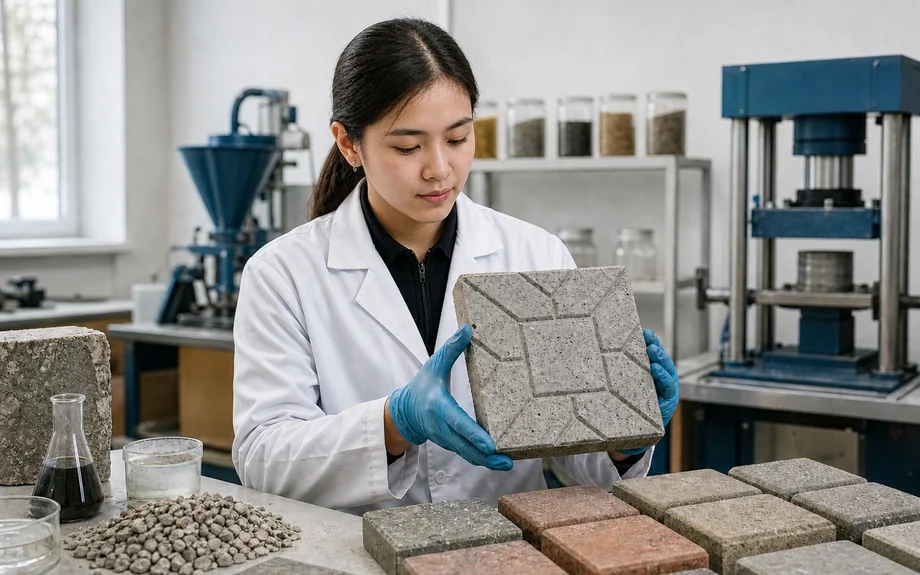
Balausa Musabek, a fourth year student at Korkyt Ata Kyzylorda University, has developed a way to make sidewalk tiles from ash produced by Kyzylorda's heat and power plant. The mix uses plant ash, gravel sand from the Tasboget deposit and local raw material. According to the ministry's statement, published by the Ministry of Science and Higher Education on 20 November 2026, laboratory tiles reached a compressive strength of 75.42 megapascals, about 23 percent above control samples.
Contents
- Turning a Waste Pile Into Pavement
- Why the Ash Pile Matters in Kyzylorda
- The Recipe Behind the Tile
- How Strong Is the New Sidewalk Tile?
- From Laboratory Samples to a Courtyard
- What Builders Could Save
- Why Local Raw Materials Matter Beyond Kyzylorda
- What Must Happen Before Factory Production
- How the Idea Compares With Other Waste Based Building Work
- What Changes for the City and the Builders
- Key Points
The project gives a practical use to material that has been piling up in Kyzylorda for decades and could also lower building costs. Musabek, who discussed the work on Jibek Joly's Bugin.LIVE program, said the tiles absorbed less water, resisted abrasion better and were rated F300 for frost resistance. In plain language, the idea is to turn a dusty waste product into a paving stone strong enough for daily use.
Why the Ash Pile Matters in Kyzylorda
Kyzylorda has been storing ash from its heat and power plant since the period from 1991 to 1993. Musabek said the pile now takes up a sizable area and that wind can lift the fine waste into the air. Ash is the powder left after fuel is burned. When it is dry, its smallest particles can travel as dust, which is why a waste heap can affect people beyond the fenced site.
Balausa Musabek, the student developer, traced the project to that everyday problem. She described the reason in her own words.
In Kyzylorda, ash from the heat and power plant has been collecting for many years. From an environmental point of view, this is bad for people. It pollutes the air and also takes up a large area. That is why we decided to use that ash as a construction material.
Kazakhstan recycles less than one third of household waste, a figure that gives wider weight to local efforts to find uses for discarded material. The Kyzylorda project focuses on industrial ash rather than household waste, but it follows the same basic goal: keep material in use instead of letting it occupy land or move into the air.
The Recipe Behind the Tile
The project began from scientific work by Gulnur Zhakypova, a PhD supervisor and university teacher at Korkyt Ata Kyzylorda University. Musabek developed it into a separate project aimed at production. The public description names the main inputs as heat and power plant ash and gravel sand from the Tasboget deposit, with local raw materials used to reduce cost and pressure on the environment.
Students passed the ash through special screens and filters, added the needed additives and ran repeated trials. They also studied the microstructure of the samples, meaning the tiny arrangement of grains and bonds inside the tile. For a reader, that detail matters because strength depends on what happens inside the material. The exact proportions were not given.
How Strong Is the New Sidewalk Tile?
Researchers carried out 45 laboratory test cycles. The new composition reached 75.42 megapascals under compression, meaning it resisted being squeezed up to that pressure before failure. A megapascal is a unit of pressure. The 23 percent edge over control samples gives a plain comparison: the same test on ordinary samples produced a lower result.
The new tile also took in less water and showed better resistance to abrasion, the wearing away caused by rubbing and foot traffic. Its frost resistance was assessed at F300. The official figures describe the material as able to withstand at least 300 freeze thaw cycles without destruction. In cold places, water can enter tiny pores, freeze, expand and crack a tile, so this rating is one of the stronger signs of durability.
From Laboratory Samples to a Courtyard
Tiles made with the new technology were laid in the courtyard of a residential building for use testing. During the observation period, no visible cracks or chips appeared on the surface. That step matters because pavement faces repeated footsteps, weather, dirt and small impacts in ways a laboratory sample cannot fully copy.
The length of the courtyard observation was not stated, and the project team has not published a long record of wear. Even so, the trial gives the technology something a lab test cannot provide: evidence that the tiles could be installed and used in an ordinary place. A courtyard is a small setting, but it is closer to a sidewalk than a mould in a laboratory.
What Builders Could Save
The cost calculation is precise. The project puts the old cost at 47,238 tenge per cubic meter of tiles and the new cost at 41,328 tenge. Ten thousand cubic meters a year would reduce spending by 59.1 million tenge. Tenge is Kazakhstan's currency.
The saving of 5,910 tenge per cubic meter equals about 12.5 percent of the old cost, because 5,910 is roughly one eighth of 47,238. If a maker produced the stated 10,000 cubic meters, the per unit saving repeated ten thousand times produces the 59.1 million tenge figure. Musabek has argued that local raw materials can also save energy and market costs, while cutting the amount of waste left unused.
Why Local Raw Materials Matter Beyond Kyzylorda
Musabek, the student developer, said the method could be tried with materials from other parts of Kazakhstan. She described the wider idea in these words.
We are using only ash from Kyzylorda. In general, local raw materials in other regions of the country can also be used to make different materials. This helps save energy and costs in the market. I think it also benefits the environment.
Other regions would still need their own ash, sand and safety tests before using the recipe. The value of her point is practical: transport and buying inputs can be costly, so a material found nearby can make construction cheaper when it passes the needed checks. Musabek also plans to test concrete and other construction elements, and to consider artificial intelligence in laboratory work.
What Must Happen Before Factory Production
The tile is ready enough for a courtyard trial and a laboratory record, but it is not yet in production. Work on commercialization is under way. Zhakypova, the project supervisor, and the student team are preparing the technology for industrial use. The laboratory result is one stage in that plan.
The next step is an additional environmental assessment to see whether harmful elements could wash out of the material. This process is called leaching: rain or water passes through a solid material and carries dissolved substances with it. After that, the team plans factory condition trials and the launch of a specialized line for making the tiles. No date was given for the assessment, the factory tests or the line.
- 1991 to 1993: ash began accumulating at the Kyzylorda plant site.
- 20 November 2026: the Ministry of Science and Higher Education published the test figures and cost calculations.
- Next steps: environmental assessment, factory trials and a specialized production line.
How the Idea Compares With Other Waste Based Building Work
A construction experiment at Harvard used unwanted sheep wool to make a warm facade tile. Natural fibres were processed without petroleum products and pressed into dense two layer panels. The panels hold heat, protect walls from weather and offer a use for textile waste.
The Kyzylorda tile addresses a different part of a building. It is meant for pavement, so the key tests are compression, water absorption, abrasion and freezing. Both projects show how waste can become a building product when researchers measure the properties that matter for the place where it will be used.
What Changes for the City and the Builders
For Kyzylorda, the most concrete change would be a new destination for ash that has accumulated for decades. If the technology reaches safe production, the city could use a local waste stream in paving while reducing the need to buy outside material. For builders, the published calculation points to 5,910 tenge saved on every cubic meter, or 59.1 million tenge at an annual output of 10,000 cubic meters.
Musabek said young people have a special role in building a recycling culture and that environmental responsibility begins with daily actions. Her project turns that idea into a measurable object: a tile with a strength figure, a freeze rating, a cost per cubic meter and a place in a residential courtyard. The next test is whether safety checks and factory trials can carry it beyond the student laboratory.
Key Points
- Balausa Musabek, a fourth year student at Korkyt Ata Kyzylorda University, developed sidewalk tiles using power plant ash and Tasboget gravel sand.
- Testing over 45 cycles produced tiles with 75.42 megapascals of compressive strength, about 23 percent above control samples.
- The tiles showed lower water absorption, better abrasion resistance and F300 frost resistance, and a courtyard trial showed no visible cracks or chips.
- Costs are projected to fall from 47,238 to 41,328 tenge per cubic meter, saving 5,910 tenge per cubic meter.
- At 10,000 cubic meters a year, the projected saving is 59.1 million tenge.
- Environmental assessment, factory trials and a specialized production line remain ahead, with no date announced.