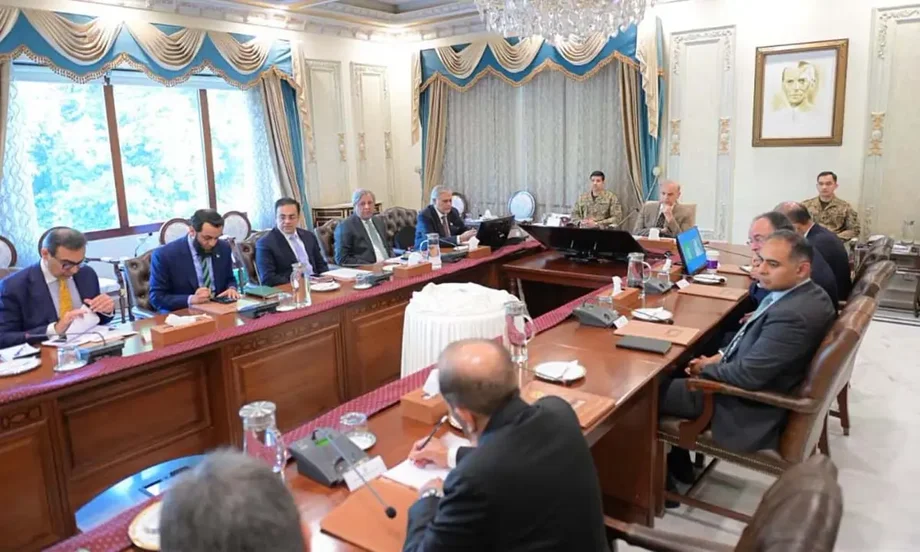
A deadline-driven push to sell the state
Prime Minister Shehbaz Sharif told officials on Wednesday to speed up Pakistan's privatisation programme, ordering every transaction in progress to finish inside its own timetable and asking for a fresh list of loss-making public companies that could be added to the queue. The instruction came at a review meeting in Islamabad on state-owned enterprises (SOEs), the businesses the government owns and runs, from electricity distributors to a farm lending bank and the national airline.
Contents
- A deadline-driven push to sell the state
- What the prime minister asked officials to do
- Three power distributors lead the queue
- PIA and First Women Bank show what a finished deal looks like
- A farm bank sale with strings attached
- Airports go on concession, not on the block
- A merger bill puts the PPP authority into the delivery business
- The M-6 as a test of the new model
- Why the ledger drives the timetable
- Three decades of sell-offs and the resistance to them
- What is still open
- Key Points
The pressure has a number attached. Loss-making SOEs recorded Rs342.8 billion ($1.23 billion) in losses in the first half of the current fiscal year, while government financial support to state companies rose 31 percent to a record Rs804 billion ($2.88 billion), according to finance ministry figures cited by the prime minister's adviser on privatisation, Muhammad Ali.
Officials briefed the meeting that 27 state-owned enterprises now sit in the programme, arranged in three phases. The prime minister's instruction was procedural as much as political. "Legal hurdles must not be allowed to cause delays in the privatization process, and effective measures should be taken to resolve them," he said, according to the government's account of the meeting.
He said the sale of inactive and financially unviable entities would ease the burden on the national exchequer and free money for welfare and development projects, and that transparency had to hold at every stage of the process.
What the prime minister asked officials to do
Beyond speed, the meeting produced a short list of orders. Officials were told to carry out a fresh assessment of public-sector entities to find more loss-making organisations for the programme, to coordinate closely across ministries and institutions, and to keep continuous watch on each transaction so that the deadlines set under the programme are met.
Shehbaz also wants a regulatory framework in place for the power distributors once they leave government hands, a point he first raised at a separate review of the electricity companies on 9 June 2026. "Loss-making state-owned enterprises are our priority for privatisation," he said at that earlier meeting, according to officials present.
The attendance list shows how far the file reaches across the cabinet: Deputy Prime Minister and Foreign Minister Ishaq Dar; Defence Minister Khawaja Asif; Law Minister Azam Nazeer Tarar; Finance Minister Muhammad Aurangzeb; Economic Affairs Minister Ahad Cheema; Power Minister Awais Leghari; Information Minister Attaullah Tarar; Commerce Minister Jam Kamal; Climate Change Minister Musadik Malik; Minister of State for Finance Bilal Azhar Kayani; the adviser on privatisation and Privatisation Commission chairman, Muhammad Ali; and Farooq Sattar, who chairs the National Assembly Standing Committee on Privatisation.
Three power distributors lead the queue
Electricity distribution companies, known as Discos, are the regional monopolies that buy power from the national grid and bill the homes and factories on their wires. They carry a large share of the power sector's losses, which is why they sit at the front of the sale programme. Nine Discos are in the programme. The first batch is Islamabad Electric Supply Company (IESCO), Gujranwala Electric Power Company (GEPCO) and Faisalabad Electric Supply Company (FESCO), and the meeting also reviewed Lahore Electric Supply Company (Lesco).
Expressions of interest, the first formal signal that investors want to examine a company, were advertised in national and international newspapers, and the Cabinet Committee on Privatisation has approved the transaction structure, the framework that sets what is being sold and on what terms. Deadlines for investors to submit documents were fixed at 7 August 2026 for FESCO, 21 August 2026 for GEPCO and 7 September 2026 for IESCO. Officials said international companies have shown interest and investor roadshows are under way, with sessions planned for Saudi Arabia, Türkiye and China.
Bidding for the three is targeted for the first quarter of 2027, between January and March, Ali said at the CFA Society Pakistan Investment Forum in Karachi on 26 November 2026. Those are targets rather than confirmed auction dates, and no reserve price or size of stake for the three companies has been published.
PIA and First Women Bank show what a finished deal looks like
Two sales have already crossed the line. Pakistan International Airlines completed its first financial closing, the stage at which contracts are signed and money changes hands, and transferred administrative control on 29 June 2026. The airline had sold 75 percent of its shares in a televised auction in December 2025 to a consortium led by Arif Habib Corporation for Rs135 billion, with the government keeping 25 percent.
Ali put figures on the PIA outcome: Rs80 billion ($287 million) in fresh equity went into the airline and Rs10 billion ($35.9 million) came to the government, with another Rs90 billion ($323 million) expected from the next phase in June 2027. First Women Bank was sold in October 2025, when the government handed a majority stake to UAE-based International Holding Company in a government-to-government transaction.
Both deals are treated inside the government as proof that difficult transactions can be closed. Ali has described them as a milestone in completing complex financial sales, and he points to the foreign buyer at First Women Bank as evidence that overseas investors will enter Pakistan's financial sector.
A farm bank sale with strings attached
Zarai Taraqiati Bank Ltd (ZTBL) lends to farmers, and the prime minister wants its sale structured so that the lending survives the change of owner. He told the meeting that ZTBL should keep prioritising agricultural loans and financial assistance to small and medium-scale farmers, arguing that access to finance for smaller growers is central to raising per-acre productivity, farm incomes and food security.
The bank has been on the list since at least 2021, when preliminary work on selling it began alongside the power distributors. Officials said special consideration is being given to protecting its agricultural lending role while the transaction is designed, and no price, stake size or timetable for the sale has been made public.
State Life Insurance Corporation, the state insurer, was reviewed at the same meeting. The government has not published the size of the stake on offer or the structure of that transaction either.
Airports go on concession, not on the block
Three airports are in the programme: Islamabad International, Jinnah International in Karachi and Allama Iqbal International in Lahore. These are outsourcing arrangements rather than sales. A concession gives a private operator the right to run, manage and develop an asset for a fixed period while the state keeps ownership, which is how most airport partnerships work around the world.
A financial advisory agreement for the Karachi and Lahore transactions was signed on 19 November 2026 with a consortium led by EY Middle East, and the Asian Development Bank is advising on Islamabad. A request for proposals, the document that tells bidders what they must build and deliver, is targeted for Islamabad International in the first quarter of 2027.
A merger bill puts the PPP authority into the delivery business
The Public-Private Partnership Authority (P3A) was created to advise on deals in which the state and private firms build infrastructure together. A bill now before Parliament would merge it into the Privatisation Commission and turn its job from advice into delivery, so that the same body that sells state assets also runs partnership projects.
The authority's portfolio stands at 15 projects with an estimated combined value of Rs1,352 billion, the meeting was told. The list includes the M-6, M-13 and M-10 motorways, the Guru Nanak Expressway, Qasr-e-Naz and the Karachi Industrial Park. Parliament has not yet voted on the merger, and no date for that vote has been announced.
The M-6 as a test of the new model
The clearest example of how the model is meant to work sits on the Hyderabad-Sukkur Motorway, known as the M-6. The P3A approved development of Sections I and II, covering about 121 kilometres, on 18 November 2026. The two sections will be offered to private investors under separate 25-year concession agreements, and Ali said the government expects around $700 million of investment in them.
Under the arrangement, private investors finance, build and operate the motorway sections and recover their money through toll revenue during the concession. The state avoids putting the construction cost on its own books while keeping ownership of the road at the end of the period. For the P3A, the project tests whether the body can move from advising on such deals to closing them.
Why the ledger drives the timetable
The case for selling rests on a simple ledger. Alongside the Rs342.8 billion of losses at loss-making SOEs, profitable state enterprises earned Rs423.3 billion ($1.52 billion) in the same six months. The government received Rs839.8 billion ($3.01 billion) from state companies against the Rs804 billion ($2.88 billion) it paid out in support, leaving a positive net fiscal flow of Rs35.8 billion ($128.5 million), according to finance ministry figures.
Support of Rs804 billion is the highest on record, and it is the item the government wants to shrink. The programme runs under a $7 billion International Monetary Fund bailout, which makes the sale timetable part of Pakistan's commitments to lenders rather than a domestic choice alone.
Ali frames the argument in terms of the state's role. "The government's primary responsibility is not to run commercial enterprises but to ensure effective policymaking and regulation," he said, according to remarks circulated by his office, adding that public money should go to education, healthcare and welfare rather than to repeated bailouts of state businesses. Speaking at the Karachi investment forum, he put it another way: "The government's role is not to run businesses but to create an enabling environment for the private sector."
The revenue target is modest against the losses. Ali has said the government is aiming for at least six privatisation transactions and Rs150 billion ($538 million) to Rs200 billion ($718 million) in proceeds by June 2027, covering electricity distributors, financial institutions and airport operations.
Three decades of sell-offs and the resistance to them
Pakistan has run this argument since 1991, when the programme was launched on 22 January under Prime Minister Nawaz Sharif as a deliberate reversal of the 1970s nationalisation of banks, mills and utilities. The most aggressive phase came under Shaukat Aziz between 1999 and 2008, when roughly 80 percent of the banking sector passed to private owners and growth touched about 9 percent in 2004. The record of that era, including its controversies, is set out in Privatisation in Pakistan.
The rollback came from the courts and the streets. The Supreme Court halted the Pakistan Steel Mills sale in 2007 and the transaction never restarted. Workers at Pakistan Telecommunication Company Ltd staged a revolt in Islamabad in 2005 before the company was sold, and in 2012 union strikes over plans to sell WAPDA and the power distributors forced the government of the day to stop and keep the remaining power companies in state hands.
- 22 January 1991: the privatisation programme is launched by Prime Minister Nawaz Sharif.
- 2003 to 2007: about 80 percent of the banking sector is sold under Shaukat Aziz.
- 2007: the Supreme Court halts the Pakistan Steel Mills sale.
- 26 August 2021: Services International Hotel in Lahore is auctioned for Rs1.951 billion; the sale agreement is signed in November 2024.
- July 2025: Pakistan Railways hands the commercial management of 11 trains, including the Hazara Express and Millat Express, to private operators while keeping the track and regulation.
- October 2025: First Women Bank's majority stake goes to UAE-based International Holding Company.
- December 2025: 75 percent of PIA is sold to a consortium led by Arif Habib Corporation for Rs135 billion.
- 29 June 2026: PIA's first financial closing and transfer of administrative control.
- 18 November 2026: the P3A approves development of M-6 Sections I and II.
- Late November 2026: the prime minister orders faster sales and a fresh scan for loss-making firms.
Each of those dates carries the same warning for the current programme: a transaction survives only if it clears the courts, the unions and the cabinet committees. The government's own multi-year plan, the Privatisation Programme covering 2024 to 2029 published by the Privatisation Commission, sets out the pipeline the present meeting is trying to keep on schedule.
What is still open
Several pieces of the programme remain undecided. Parliament has not scheduled a vote on the bill merging the P3A with the Privatisation Commission. The first quarter 2027 bidding window for FESCO, GEPCO and IESCO is a target, and the government has not disclosed stake sizes or a floor price for any of them. Terms for ZTBL and State Life have not been published, and no closing date has been given for the three airport concessions.
For the people on the other side of these transactions, the stakes are immediate. Farmers who borrow from ZTBL are being told the lending will continue after a sale. Workers at the Discos face a change of employer in the next two years. Commuters on the M-6 corridor will pay tolls to a private operator for 25 years, after which the road returns to the state.
Key Points
- Prime Minister Shehbaz Sharif ordered officials to complete every privatisation transaction within its set timeline and to identify more loss-making state firms for sale.
- Officials told the meeting that 27 state-owned enterprises are in the programme, spread across three phases.
- Loss-making SOEs lost Rs342.8 billion ($1.23 billion) in the first half of the fiscal year, while state support to them rose 31 percent to a record Rs804 billion ($2.88 billion).
- Nine power distributors are in the programme; IESCO, GEPCO and FESCO form the first batch, with investor document deadlines of 7 August, 21 August and 7 September 2026.
- Bidding for the three Discos is targeted for January to March 2027, and a request for proposals on outsourcing Islamabad International Airport is targeted for the same quarter.
- PIA's first financial closing and transfer of management control took place on 29 June 2026, after 75 percent was sold for Rs135 billion in December 2025.
- The prime minister wants ZTBL to keep lending to small and medium-scale farmers after privatisation.
- A bill in Parliament would merge the Public-Private Partnership Authority into the Privatisation Commission, moving it from advice to project delivery across 15 projects worth Rs1,352 billion.
- The P3A approved M-6 Sections I and II, about 121 kilometres, on 18 November 2026, with 25-year concessions and around $700 million of expected private investment.
- The government is targeting at least six transactions and Rs150 billion to Rs200 billion in proceeds by June 2027 under a $7 billion IMF bailout.