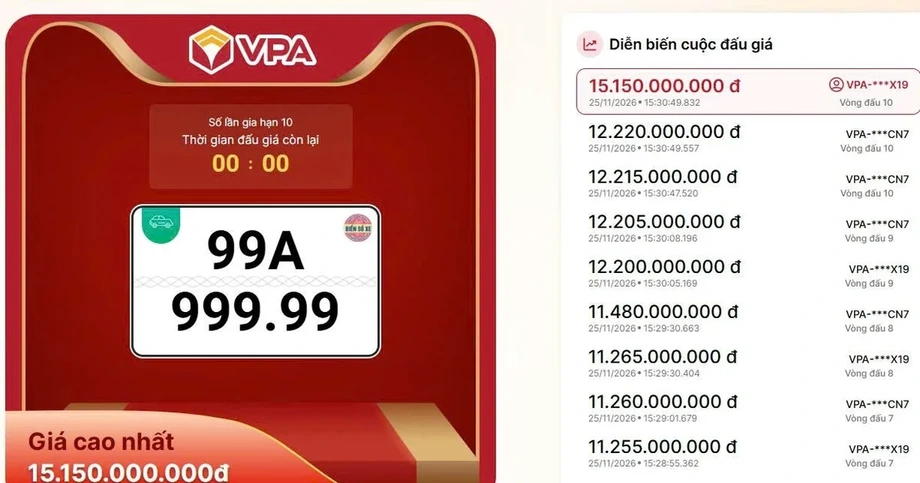
A lucky number plate that has now been sold three times in about 15 months found another buyer on 25 November, when the auction page of Vietnam Auction Partnership (VPA) showed the plate 99A-999.99 closing at 15.15 billion dong. The plate is registered to Bac Ninh city, north of Hanoi, and its five nines make it one of the most sought after combinations in the country.
Contents
The result, published on the afternoon of 25 November, marks the third appearance of the same plate on the auction floor. Each of the two earlier winners walked away without paying, sending the number back for sale. That pattern, and the falling price that came with it, is the part of the story that matters for anyone watching how Vietnam sells its most desirable plates.
The five nines are the draw. Vietnamese plates carry a province or city code, a letter series and five digits. Under the code 99A, the digits 999.99 form what Vietnamese buyers call a ngu quy plate, meaning five of a kind, a pattern treated much like a lucky charm. Demand for such numbers pushed the plate to 21.87 billion dong in its first sale and 27.89 billion dong in its second, before the third round settled at a little over half the second price.
Three Auctions, Two Defaults and a Falling Price
The number first reached the floor on 12 August 2025, when bidding pushed it to 21.87 billion dong. The winner never completed the financial obligations that come with a winning bid, so the plate was offered again in November 2025, this time closing at 27.89 billion dong. The second winner also failed to pay, and the plate returned for a third round.
- 12 August 2025: first auction, top bid of 21.87 billion dong, not paid.
- November 2025: second auction, top bid of 27.89 billion dong, not paid.
- 25 November: third auction, closing price of 15.15 billion dong, payment due within 30 days of notification.
The arithmetic of the decline is blunt. The third price is 45.7 percent below the 27.89 billion dong bid of the second round and 30.7 percent below the 21.87 billion dong of the first. A plate that once drew bids above 27 billion dong has now been valued by the market at 15.15 billion dong, roughly the level of a good apartment in central Hanoi.
What happens next depends on the newest winner. Under the rules, the full amount must be paid within 30 days of the result being announced. If the money does not arrive, or arrives short, the result is cancelled and the plate goes back to auction or into the national vehicle registration system.
What a Winning Bid Actually Commits You To
Buying a plate at auction in Vietnam is not like buying a lottery ticket. The bid is a commitment, and the state holds a deposit to make sure winners mean it. For an ordinary car plate the deposit is 40 million dong, and for a motorbike or scooter plate it is 5 million dong. Bidders pay it before the session, online, because the auctions are run entirely over the internet.
Winners see their deposit moved into a dedicated collection account held by the Ministry of Public Security, which transfers the money into the state budget. Bidders who lose get their deposit back within three days of the auction closing. The serious money is the winning price itself, which must be paid in full inside the 30 day window.
Missing that deadline carries a triple penalty. The deposit is kept, any partial payment already made is kept, and the bidder is barred from plate auctions for 12 months. The plate itself is then either re-auctioned or pushed into the normal registration system for ordinary use. Both earlier winners of 99A-999.99 fell into exactly this trap, which is why the same five nines have now been sold three times.
Why This Round Required a 500 Million Dong Deposit
Special formats carry special terms. Plates in the AAAAA pattern, with the letter above four, and the ABCDE pattern with a four, must post a much larger deposit when they are offered again after a second auction. For cars that figure is 500 million dong, and for motorbikes and scooters it is 50 million dong, twelve and a half times the ordinary deposit.
The rule is designed for exactly the situation 99A-999.99 has created. When a plate with a rare pattern keeps drawing bidders who do not pay, the state loses time and money on repeated sales, and speculative bidding becomes cheap. Raising the deposit to 500 million dong makes it expensive to bid on a special plate without the intention or the ability to complete the purchase.
The Wider Market: 12,500 Billion Dong Since 2023
The traffic police department (C08) of the Ministry of Public Security, which oversees the programme, reported that 150,000 plates were auctioned successfully in 2026, made up of more than 50,000 car plates and 100,000 motorbike and scooter plates. Those sales put 4,300 billion dong into the state budget.
Since the first session in September 2023, the cumulative take from plate auctions has reached 12,500 billion dong. The 2026 figure of 4,300 billion dong therefore represents roughly a third of the entire revenue collected since the programme began. Motorcycle plates do much of the volume work, accounting for two thirds of the 150,000 plates sold, while car plates, with their far higher prices, do the heavy lifting on revenue.
That balance explains why the department tracks both numbers. A five nines plate such as 99A-999.99 is a single transaction worth 15.15 billion dong, but it takes thousands of ordinary motorbike plates to match it. At a 5 million dong deposit each, the small plates add up through volume rather than price.
Which Plates Have Actually Paid Up
Auction results and money in the bank are two different things, as the short history of 99A-999.99 shows. At the start of November the traffic police department reported that the highest price actually paid in the year was 6.185 billion dong, for the Hanoi plate 30B-999.99, another five of a kind number. That sale was completed in full.
Next came 51L-999.99 at 4.825 billion dong, followed by 30C-999.99 at 4.505 billion dong. All three are five nines plates, and all three sit in the same city level price band of between 4.5 and 6.2 billion dong. The 15.15 billion dong bid for 99A-999.99 is about 2.45 times the largest completed payment reported this year, a gap that reflects both the plate and the uncertainty over whether this winner will pay.
Should the third bidder default as well, the paid podium would be unchanged, and 99A-999.99 would head for a fourth round with an even heavier deposit requirement and a price that has already fallen once.
How the Pilot Programme Works
Vietnam began auctioning car plates in 2023 as a pilot, built on Resolution 73/2022 of the National Assembly and Decree 39/2023 of the government. The pilot turned a piece of public property, the right to use a desirable number, into a revenue stream, and it moved the trade in lucky plates from informal deals into a supervised online market.
The supervision is aimed at speculation and at inflated bidding, the practice known in Vietnamese as tao gia ao, or creating a phantom price. A bidder who pushes the price up and then disappears distorts the market for everyone else, and the deposit and ban rules exist to discourage it. The repeated defaults on 99A-999.99 are the clearest test the system has faced.
Every session is conducted online, which keeps a record of each bid and makes the process visible to the ministry that runs it. Bidders register, post their deposit and bid from a computer rather than in a room, and results are published on the auction operator's page, as VPA did for 99A-999.99 on 25 November.
What the Winner Can Do With the Plate
A winning bid buys the right to attach the number to a vehicle the winner owns. The plate cannot be sold on its own; it travels with the car or motorbike. Within that limit, owners have real freedom. They can transfer the vehicle and its plate, swap it, give it away, or pass it on as an inheritance.
That flexibility is part of what makes the five nines plates valuable. A rare number becomes an asset tied to a vehicle, one that can change hands along with the car. It also explains why prices can run into the billions of dong for a pattern that costs almost nothing to produce.
VPA published the closing price but did not identify the winning bidder, and no date beyond the 30 day payment window has been given for the money to arrive. Whether 99A-999.99 finally stays with a buyer, or returns for a fourth appearance, will be settled by that deadline.
Key Points
- The plate 99A-999.99 from Bac Ninh city sold for 15.15 billion dong on 25 November, its third auction.
- The first auction, on 12 August 2025, closed at 21.87 billion dong; the second, in November 2025, at 27.89 billion dong; neither winner paid.
- The third price is 45.7 percent below the second and 30.7 percent below the first.
- Winners must pay in full within 30 days or lose their deposit, forfeit any money paid and face a 12 month ban from plate auctions.
- Special format plates re-auctioned after a second round require a 500 million dong deposit for cars, compared with the ordinary 40 million dong.
- The traffic police department reported 150,000 plates sold in 2026 for 4,300 billion dong, and 12,500 billion dong in total since September 2023.
- The highest completed payment reported this year was 6.185 billion dong for the Hanoi plate 30B-999.99.
- Plate auctions began as a pilot under Resolution 73/2022 and Decree 39/2023, run online to curb speculation and phantom pricing.