A Major Milestone in Electric Aviation
Commercial Aircraft Corporation of China, known as COMAC, achieved a major breakthrough on November 14, 2026. The state-owned aerospace manufacturer successfully completed the first crewed test flight of the CE-25A, a 10-metric-ton electric aircraft designed for short-haul intercity routes. Taking off from an airfield in Binzhou, located in the eastern Chinese province of Shandong, the aircraft carried a crew of three consisting of two pilots and a flight-test engineer. State broadcaster CCTV reported that the entire test session lasted 57 minutes and 46 seconds, with the plane spending 16 minutes and 38 seconds actually in the air and covering a distance of 60.4 kilometers (37.5 miles). COMAC stated that all onboard systems performed as expected and all performance indicators met expectations.
Contents
The CE-25A represents a notable step forward in the global push for zero-emission regional aviation. While smaller training planes and light aircraft have flown with electric power in recent years, few commercial-scale demonstrators have carried human crews. The flight follows 19 uncrewed autonomous test flights that began on February 2, 2026, after the aircraft was first unveiled as a concept at the China International Import Expo in Shanghai in November 2023. COMAC developed the aircraft in a joint venture alongside leading battery manufacturer Contemporary Amperex Technology Co. Limited, known as CATL, Shanghai Jiao Tong University, and other domestic partners.
Design and Propulsion Innovation
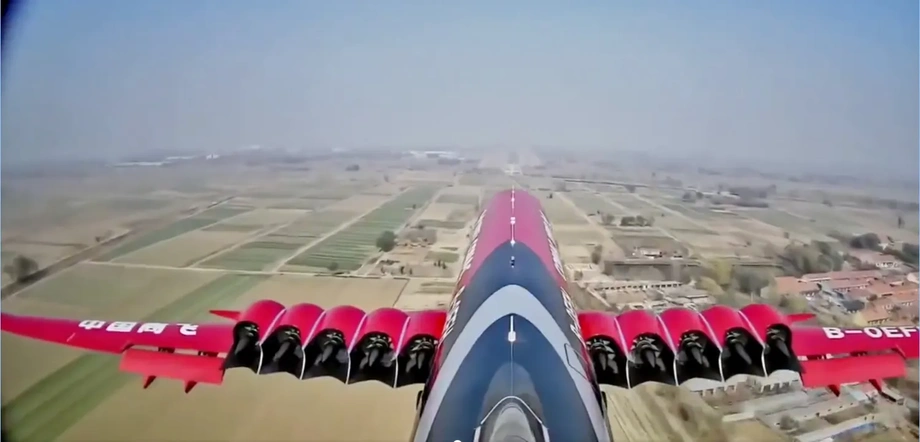
Visually distinct from conventional passenger jets, the CE-25A features a wide, flat-bottomed body, a T-shaped tail, and long, low-set wings. Instead of traditional jet engines or open propellers, the aircraft relies on a distributed electric propulsion system consisting of ten enclosed electric fans, technically known as ducted fans, mounted in tight rows of five right above the rear end of each wing. This unconventional arrangement aims to improve aerodynamic efficiency and manage airflow across the wing surfaces.
The aircraft is engineered to seat 19 passengers and operate at a cruising speed of 300 kilometers per hour (186 mph) at an altitude of 2,400 meters (7,874 feet), with a stated maximum range of 400 kilometers (246 miles) and a maximum takeoff weight of 10 metric tons (22,046 pounds). The designation of the aircraft reflects its specific design goals and regulatory targets. The letter C stands for China and COMAC, E stands for electric, the number 25 refers to its compliance framework under China's airworthiness rules for transport-category aircraft, and the letter A denotes its status as the first model in the series.
Regulatory Approval and Certification Process
Following the successful crewed flight, the CE-25A is moving deeper into the regulatory approval process. The Civil Aviation Administration of China has formally accepted COMAC's application for a type certificate, which opens the formal airworthiness review for the aircraft. Acceptance of the application is a mandatory early step in the regulatory procedure, which involves document reviews, witnessed tests, and certification flight tests to verify that the design meets all applicable safety and environmental requirements.
The aircraft is being held to the rigorous safety requirements of CCAR-25, China's rulebook for transport-category aircraft. COMAC has cleared that specific regulatory hurdle before with its larger commercial airliners, including the C909 regional jet and the single-aisle C919. However, certifying a novel electric powertrain, a distributed ducted-fan wing, and a large battery pack requires new means of compliance, and regulators will demand extensive safety evidence before granting final commercial approval. No launch customer, commercial price, or target date for passenger service has been announced yet.
The Battery Partnership and Energy Challenges
The development of the CE-25A is heavily tied to advancements in battery technology, driven primarily by its partnership with CATL. The joint venture responsible for the aircraft was formed in July 2023 with 600 million yuan of registered capital. Industry analysts have pointed to CATL's advanced condensed battery technology, introduced in April 2023 with an energy density of up to 500 watt-hours per kilogram at the cell level, as a likely power source for the aircraft, though neither COMAC nor CATL has officially confirmed which specific battery pack is installed.
Aviation experts note that battery-powered flight faces strict physical limitations because batteries hold a small fraction of the energy of jet fuel by weight. Engineering calculations indicate that a 400-kilometer range requires significant electrical energy, and adding standard commercial reserves for diversions and unexpected delays can substantially reduce the effective operating range. The battery market context remains dynamic, recalling how CATL's lithium mine shutdown in Jiangxi province previously disrupted global supply chains and tightened oversight of strategic minerals. While the CE-25A successfully completed its short test flight, establishing its full stated range with passengers and commercial reserves remains a key hurdle for the engineering team.
Global Context in Electric Aviation
The successful test places COMAC alongside a small group of international aerospace companies attempting to bring large electric aircraft to market. In North America and Europe, several startups are pursuing similar goals with different aircraft configurations. Sweden-founded, US-based Heart Aerospace flew its full-scale X1 demonstrator in August 2026 from Plattsburgh, New York, for 27 minutes. The X1 is an 11-metric-ton aircraft built as a technology demonstrator for a planned 30-seat hybrid-electric production model known as the ES-30, which targets a 2031 entry into service with battery market stability playing a crucial role in future production costs.
Other regional projects have faced headwinds. Eviation flew its nine-passenger Alice electric aircraft in September 2022, but subsequently paused much of its development work. Meanwhile, regional airlines are beginning to plan for commercial operations. Scottish regional airline Loganair agreed to purchase all-electric Alia CX300 aircraft to support passenger and cargo operations starting around 2029, following test programs that demonstrated the potential to reduce operating costs significantly on short routes.
Timeline of Key Developments
- July 2023: COMAC, CATL, and Shanghai Jiao Tong University form a joint venture with 600 million yuan in registered capital.
- February 2, 2026: The CE-25A completes its first uncrewed autonomous validation flight.
- Late October 2026: Photos of the red-and-black CE-25A bearing civil registration B-0EFH surface publicly on social media.
- November 14, 2026: The aircraft completes its first crewed test flight in Binzhou, Shandong province, carrying two pilots and a flight-test engineer for 16 minutes and 38 seconds.
At a Glance
- The CE-25A is a 10-metric-ton, 19-seat electric passenger aircraft developed by COMAC, CATL, and other partners.
- The first crewed flight took place on November 14, 2026, in Binzhou, Shandong province, lasting 16 minutes and 38 seconds over 60.4 kilometers.
- Propulsion is provided by 10 electric ducted fans mounted in rows above the wings.
- The Civil Aviation Administration of China has accepted COMAC's application for a type certificate, initiating the formal airworthiness review.
- While the aircraft targets a 400-kilometer range and a 300 km/h cruising speed, commercial service dates and launch customers have not yet been announced.