Robots Set to Transform Workplace Training in Singapore
Training staff for demanding roles usually involves hiring human actors to simulate difficult scenarios. These actors can grow tired, deviate from scripts, or drop character during crucial moments. The approach also incurs recurring costs, with daily actor fees starting at $500. Singapore training consultancy Straits Interactive is preparing to introduce a solution in the first quarter of 2027 by deploying a lifelike robot named FaceyBot.
Contents
- Robots Set to Transform Workplace Training in Singapore
- Understanding the Technology Behind FaceyBot
- Why Physical Presence Matters in Professional Training
- Preparing Executives for Complex Corporate Discussions
- Medical and Caregiver Training Applications
- Addressing Technical Challenges and Multilingual Capabilities
- The Competitive Landscape in Humanoid Robotics
- Psychological Impact and Proper Deployment
- At a Glance
Developed in partnership with Chinese manufacturer Shenzhen Xiaoquan Technology Culture, the robot is designed to provide consistent, untiring role-playing practice for customer service and eldercare trainees. The technology aims to replace human actors for repetitive training sessions without accumulating high daily expenses. The deployment marks a shift toward automated physical simulations in professional development across the country.
Understanding the Technology Behind FaceyBot
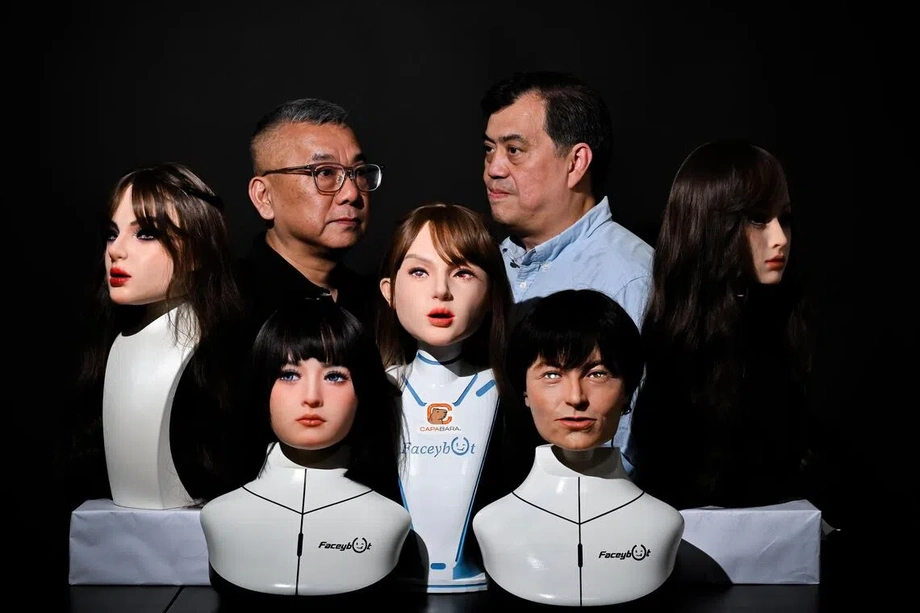
Humanoid training systems often feature rigid plastic structures that limit emotional expression and realism. FaceyBot consists of a head and an armless torso driven by tiny motors positioned beneath a medical-grade silicone face. This material allows the artificial skin to move in ways that closely mimic human muscular contractions and micro-expressions. Wang Quan Sheng, chief executive of Shenzhen Xiaoquan Technology Culture, explained that the system currently manages more than a dozen major expressions, including worry, anger, and surprise. It can also display hundreds of subtler reactions, such as a faint smile or a raised eyebrow.
The underlying software, known as Capabara, uses artificial intelligence models to simulate specific personas, such as an irate customer or a confused patient. Straits Interactive prices its robotic systems starting at $10,000, a fee that covers artificial intelligence application customisation and systems integration. Strict guardrails are incorporated into the training software to limit database access, restrict data collection, and log every interaction for administrative review.
Why Physical Presence Matters in Professional Training
Virtual avatars displayed on computer monitors have long been used for remote learning and basic simulations. Kevin Shepherdson, founder of Straits Interactive, argued that a three-dimensional humanoid creates a distinct psychological environment that flat screens cannot achieve. He noted that human actors can tire or break character and thus alter the training experience, whereas a machine maintains consistent behavior throughout a session.
Straits Interactive founder Kevin Shepherdson stated:
A physical face creates real emotional pressure that a monitor cannot replicate. Physical presence also trains someone's body language, not just words to say.
The physical presence of a moving face forces trainees to manage their own non-verbal reactions. Eye contact, posture, and tone of voice are all influenced by the immediate visual feedback of a reacting counterpart.
Preparing Executives for Complex Corporate Discussions
Media training firms are already exploring how the technology can assist high-level professionals. Sharon Tong, who runs media training firm The Media Consultants, noted that corporate executives often struggle to find appropriate sparring partners for high-stakes panel discussions. Colleagues are frequently roped in to stand in as other panellists, but they may lack the expertise and knowledge of senior corporate executives to tackle complex global and technical issues, leaving little room for the senior executive in training to spar with. FaceyBot can be programmed to act as a sceptical or long-winded panellist, allowing executives to practise handling difficult questions and conversational interruptions before facing real audiences.
Medical and Caregiver Training Applications
Specialised sectors such as healthcare require staff to recognise subtle physical indicators of distress. Jochen Wirtz, vice-dean of MBA programmes at the NUS Business School, noted the clinical value of these detailed simulations. He explained that highly realistic facial expressions add value when trainees practise recognising distress, confusion, dementia behaviours, fear, pain, or disengagement.
Academic experts have highlighted specific operational requirements for deploying these machines in clinical environments. Zheng Yuanjin, from the School of Electrical and Electronic Engineering at Nanyang Technological University, pointed out that the first uses could be in supervised caregiver and nursing training. Trainees require repeated exposure to non-verbal cues such as a grimace to signal pain. Zheng also noted that the hardware must stand up to routine cleaning and deliver expressions and speech reliably across local languages and accents.
Addressing Technical Challenges and Multilingual Capabilities
Demonstrations of the technology have revealed areas requiring further engineering refinement. When demonstrated on Nov 13 at Straits Interactive's office, the robot's lips fell out of step with its words. Developers are currently resolving these synchronisation issues while securing local partners to pilot the technology ahead of its commercial rollout.
When officially deployed in 2027, the units will support both English and Mandarin. The dual-language capability is intended to serve Singapore's multilingual workforce across various service sectors. Engineers are actively testing the speech recognition and facial movement alignment to ensure seamless interactions during extended training modules.
The Competitive Landscape in Humanoid Robotics
The market for expressive robotic platforms involves several international firms developing advanced hardware. Competitors in the space include Shenzhen-based robotics company UBTech, whose full-sized humanoid robots come with eye cameras, chest sensors, and listening microphones. Another industry participant is Shanghai-headquartered AheadForm, whose expressive humanoid robot performed a song at a robot gala in February.
Straits Interactive selected the Shenzhen Xiaoquan technology after evaluating its performance at industry exhibitions. The manufacturer won a robotics innovation award at an artificial intelligence trade show in Shenzhen in August, distinguishing itself through fluid facial movements and responsive silicone skin mechanics.
Psychological Impact and Proper Deployment
Human beings are evolutionarily wired to interpret facial cues to assess safety and intent. Kevin Shepherdson emphasised that this innate psychological response is what makes physical robots uniquely persuasive compared to text-based or screen-based tools. He noted that when a lifelike face turns towards a person and responds with expression, human defences drop and trust builds quickly, which is what makes the robot such a persuasive and effective tool, and also why it should only be used in specific scenarios.
To maintain ethical boundaries, the deployment will be strictly confined to professional education environments. By limiting the operational scope, developers aim to harness the psychological benefits of robotic interaction while preventing misuse in unmonitored settings.
At a Glance
The upcoming rollout of training robots in Singapore involves several key developments and specifications:
- FaceyBot is a silicone-faced robot head and torso designed to simulate tough conversations for customer service and eldercare trainees.
- Commercial deployment is scheduled for the first quarter of 2027 by Straits Interactive in partnership with Shenzhen Xiaoquan Technology Culture.
- Pricing for the robotic systems starts at $10,000, including artificial intelligence customisation and system integration.
- Human actor fees for similar training start at $500 for a full day, creating significant cost-saving potential for repeating exercises.
- Initial language support will include English and Mandarin upon release.