A new base for building AI in Singapore
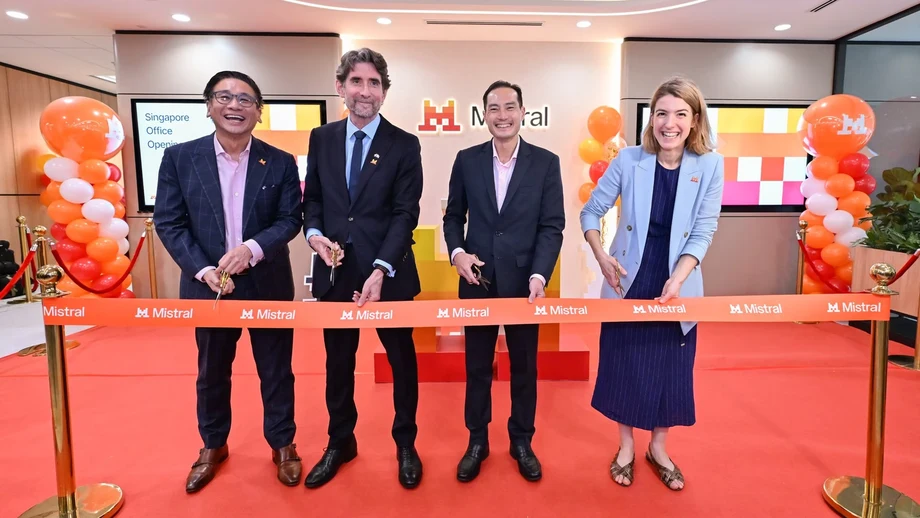
French artificial intelligence company Mistral AI opened its Asia Pacific headquarters and a research hub at Asia Square Tower 1 in Singapore on Nov. 20, 2026. The company plans to grow its regional workforce from about 100 people to 200 by 2027, with most new hires expected to work in Singapore.
Contents
The new hub will develop AI models and tools for public services, robotics and high tech manufacturing. Mistral says governments and companies should be able to control the AI systems they depend on, including where their data is stored and how models are adapted. This approach is often called sovereign AI: the ability to shape and operate AI for local needs rather than rely entirely on a service controlled elsewhere.
For Singapore, the investment means more researchers and engineers working on advanced AI in the city state. For Mistral, it provides a local base to build models for Asia Pacific and to support customers putting them into day to day use. The company already works with Singapore public agencies and businesses, and plans to expand into other regulated fields, including finance.
Mistral cofounder and chief executive Arthur Mensch described the goal as giving governments and businesses greater control over their technology and expertise.
Our ambition is to establish Singapore as a strategic location for empowering governments and enterprises across Asia-Pacific to retain ownership of their infrastructure and intelligence, and translate these into lasting economic value and industrial competitiveness.
What will the new jobs involve?
Mistral expects to hire across research, applied AI, engineering and robotics. More than 70 percent of its Singapore team is expected to work in forward deployment, a term for engineers and scientists who work directly with customers to adapt AI systems and build tools around them.
That work goes beyond handing a customer a model. A team might help a company connect AI to its own software, create a workflow for staff, or adjust a model to handle information specific to that organisation. Mistral plans to hire both engineers, who build those tools and workflows, and scientists, who work on models tailored to particular needs.
Geoff Soon, Mistral's vice-president of revenue for Asia Pacific, has said the company plans an even split between local and international hires. Mistral had about 40 staff in Singapore in May 2026 and had earlier aimed to reach 100 there by the end of the year. Its new regional target of 200 by 2027 includes staff across Asia Pacific, with most of the growth based in Singapore.
At the office opening, Singapore Senior Minister of State for Digital Development and Information Tan Kiat How said the value of the presence would come from skills and experience built around it, including researchers tackling harder problems and engineers working with advanced AI models. He also described resilience as a mix of local capability and international cooperation.
For a small and open economy, resilience does not come from trying to be self-sufficient in everything. That's not practical and not technologically and technically achievable. Resilience comes from being able to work with many strong partners while building deep capabilities based in Singapore.
How the public safety partnership works
Mistral's work with Singapore's Home Team Science and Technology Agency, or HTX, began before the new hub opened. HTX develops technology for public safety agencies, including the police and other Home Team departments. On May 26, 2025, the agency signed a contract with Mistral and Microsoft to develop AI models and platforms for its operations.
Under the agreement, Mistral is helping HTX fine tune its large language models and build a model series for Home Team use, codenamed Phoenix. Microsoft is working with HTX to adapt its smaller Phi-4-multimodal model and support the technology platform and infrastructure. A language model is software trained to process and produce text; a multimodal model can also work with other kinds of information, such as images or audio.
HTX's May 2025 media release says Phoenix was pretrained on material relevant to Singapore and the Home Team, including content in 10 major Singapore languages. Mandarin, Bahasa Melayu and Tamil are among them. The agency plans to make the models available in stages as a chatbot for officers and through an application programming interface, or API, that developers can use to build other tools.
An API is a way for one piece of software to request information or services from another. HTX also plans a shared platform to host its language models and vision language models, which can interpret both pictures and text. The agency says it is building the ability to train models from scratch as well as manage how they are deployed.
HTX chief AI officer Ang Chee Wee said the partnership could help staff use technology for routine work and focus their time on more critical public safety duties.
This collaboration with industry leaders Mistral AI and Microsoft will allow us to fast track our progress to empower the Home Team with AI.
Why does local control matter?
Open weight models, the kind Mistral develops, make the trained model's internal parameters available for customers to download or use in their own systems, subject to the model's terms. That can let an organisation run a model on its own servers and adapt it, instead of sending every request to an outside service. The approach can help customers keep sensitive data in house, though it still takes computing power, staff and technical work to operate a model.
That control matters to public agencies handling sensitive information and to companies protecting business records or manufacturing designs. It also matters when governments and businesses worry that decisions made in another country could affect access to the technology they use. New United States rules that took effect on Nov. 19, 2026 require licences for exports of certain advanced AI chips to Singapore and four other countries. Such rules affect access to the hardware used to train and run AI, not just access to software.
Singapore is also building its own AI capabilities and adopting models from different providers. Its SEA-LION research model has been built using Alibaba's Qwen, while OCBC has put more than 30 internal banking tools on open models, including DeepSeek. Mistral is entering a market where organisations already have options, and where hands on technical support may be part of its pitch.
The company has described its Singapore relationships as part of a longer effort in the region. Mistral's work with HTX and DSO National Laboratories, Singapore's defence research organisation, helped it develop models for individual customers. HTX and Mistral also agreed in November 2025 to deepen cooperation on video AI, AI that works with physical systems, and cybersecurity.
Partners across finance, government and industry
Beyond public safety, Mistral has worked with Singtel, NCS and ST Engineering. On April 27, 2026, Singtel Digital InfraCo's RE:AI sovereign AI cloud business and Mistral announced a strategic partnership aimed at expanding AI use in financial services, defence, shared government services and healthcare. The RE:AI partnership announcement said the initiative aligns with Singapore's National AI Strategy 2.0.
Mistral says it expects demand from regulated sectors such as finance and the public sector, where organisations may face tighter rules on data and operations. It also plans to seek partners in Singapore's financial industry, with details to be announced later.
In high tech manufacturing, models could be trained to examine images of components on a production line and flag possible defects. Such a system would need to fit the factory's own equipment and standards. The aim is to help workers identify irregularities, not simply produce text in response to a question.
Singapore's Economic Development Board has said the expansion will create opportunities for local talent to work on advanced AI research and development. Its executive vice-president Pee Beng Kong said the investment would support AI work in key industries and help strengthen Singapore's position as a hub for frontier AI.
Robotics moves AI into the physical world
Mistral's research plans also include robotics and physical AI, a broad term for AI systems that interact with the real world through machines, sensors or robots. The company released Robostral Navigate in July 2026. The model has 8 billion parameters and is designed to help robots find their way through unfamiliar buildings using a single ordinary colour camera. Mistral says it trained the model entirely in simulation, where a computer represents places and situations for a robot to practise in.
The Singapore hub will build on this work. Mistral has described possible research into humanoid robots navigating complicated buildings with multiple floors and security checks. That task requires a system to interpret its surroundings and choose where to move, rather than only answer questions or create digital content.
Manufacturing research presents a related challenge. A model may need to recognise a faulty part from images, while working with the conditions and rules of a particular production line. This kind of customer specific development is one reason Mistral is hiring scientists and engineers who can work closely with local organisations.
Funding, infrastructure and the next steps
Founded in Paris in 2023, Mistral has become one of Europe's most heavily funded AI companies. Chip equipment maker ASML led a 1.7 billion euro funding round in September 2025 that valued Mistral at about 11.7 billion euros. The company's expansion in Singapore extends its effort to serve customers seeking alternatives to technology providers based in the United States or China.
Growth will also depend on access to computing infrastructure. Soon has pointed to the need for more data centres and chips to run experiments and build more advanced AI tools. Models that serve many customers or run for long periods can require substantial computing resources, even when an organisation controls the software and data itself.
The opening marks a new stage in Mistral's regional plans, but the company has not provided a detailed hiring calendar or named the financial sector partners it hopes to add. It has set the regional target of 200 staff by 2027, with most new hires in Singapore. Its stated areas of work are public services, robotics and high tech manufacturing, alongside interest in regulated industries such as finance.
Key Points
- Mistral opened its Asia Pacific headquarters and research hub in Singapore on Nov. 20, 2026.
- The company plans to grow its regional workforce from about 100 to 200 by 2027, with most new hires in Singapore.
- More than 70 percent of the Singapore team is expected to work directly with customers on AI development and deployment.
- HTX, Mistral and Microsoft are developing AI for Singapore's public safety agencies, including the Phoenix model series.
- The hub will work on public services, robotics and high tech manufacturing, as well as opportunities in regulated industries.