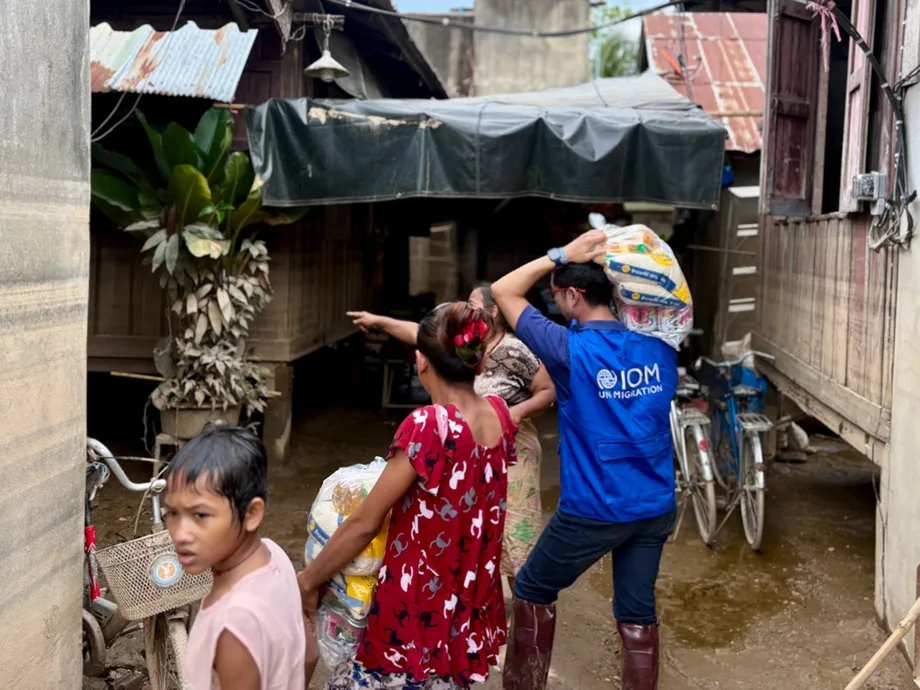
Fifteen years in Khulna, but no local address on her identity card
Beauty Akter left Koyra after Cyclone Aila and moved to Khulna city. Fifteen years later, she still cannot change the address on her national identity card, or NID, because she lacks documents proving permanent residence. River erosion swallowed most of her family's ancestral land, and salt in the soil made the rest difficult to farm.
Contents
- Fifteen years in Khulna, but no local address on her identity card
- Why does an address matter?
- Millions of disaster related movements
- How many migrants live in Khulna?
- Ward 31 shows the size of the gap
- What does voter registration require?
- Coastal districts show a changing pattern
- Measuring the human cost of displacement
- What local planners say is missing
- Key Points
Beauty lives with her husband and two sons in a slum in Banda Bazar, Ward 31. Her husband earns money as a day labourer. Their older son left school after Class VI to work in a mechanical workshop. Beauty says repeated attempts to update her card have failed.
Beauty described the gap between living in the city and being recognised as one of its residents.
I could not become a citizen of this city despite staying here for 15 years.
Her experience points to a practical problem for people displaced by cyclones, river erosion and salinity: without an NID showing a local address, migrants say it is harder to access health care, government support, training and other city services.
Why does an address matter?
Laily Akter, who moved from Assasuni in Satkhira district after Aila, has faced a similar barrier. She has lived in Khulna since marrying in 2018, but says she cannot complete an address change because she has no permanent residence document for the city.
Laily said that when she seeks government assistance, officials ask for an NID with a local address. She says the missing document has also kept her from support and training opportunities.
Laily described the difficulty of being unable to return to the place she left.
Sometimes I feel like going back. But where would I live? I have no home there anymore.
For families like hers, an identity card is more than proof of who someone is. The address on it can affect whether local offices recognise a person as part of the community they serve. When displaced residents cannot update their records, their needs can be harder to include in service planning.
Millions of disaster related movements
Bangladesh has recorded more than 21 million disaster displacements since 2008. An Internal Displacement Monitoring Center assessment published in July 2026 puts the total at more than 21 million between 2008 and 2025, and records 105,000 new disaster displacements in 2025. The figures count movements, so they describe instances of people being displaced rather than a total number of different people who moved.
A separate IDMC assessment published on 10 February 2026 covers 2008 to 2024 and also counts more than 21 million disaster displacements. Its risk assessment uses an updated model to estimate the likelihood and scale of future displacement under more optimistic and more pessimistic climate scenarios. It maps areas of risk by considering hazards, people's exposure and their vulnerability.
Khulna is a destination for people leaving disaster affected coastal areas. Many settle in crowded informal neighbourhoods, where access to drinking water, sanitation, health care, schooling and steady work is limited, according to the account of conditions in the city.
How many migrants live in Khulna?
No comprehensive survey gives a reliable count of climate migrants in Khulna. Estimates suggest they make up 15 to 20 percent of residents in many of the city's slums. A 2023 study in the journal Climate Change, drawing on Bangladesh Bureau of Statistics data, identified 1,134 slums within Khulna City Corporation.
The 2022 Population and Housing Census counted 718,735 people in the city corporation area. It did not record how many had moved because of climate related hazards. That leaves a gap between the official census count and the larger population estimate used by local officials.
Khulna City Corporation Administrator Nazrul Islam Monju estimates that 1.5 million to 1.6 million people now live in the city, nearly twice the 2022 census figure. He said many migrants remain registered at permanent addresses elsewhere and are therefore missing from local records.
Abirul Jabbar, the corporation's chief planner, said the city uses an estimated population of 1.5 million for planning. He said displaced residents who do not update their registration are not fully reflected in official figures or calculations of demand for services.
Ward 31 shows the size of the gap
Ward 31, where Beauty lives, offers a local example of how quickly the population can change. The 2022 census recorded 42,881 residents there. Former ward councillor Md Arif Hossain Mithu estimates that about 90 percent came from disaster affected parts of Khulna, Bagerhat and Barishal.
Mithu said the city needs a current count of its slums and a dependable record of climate migrants.
Khulna needs an updated survey of its slums and a reliable database of climate migrants.
The estimate for Ward 31 is not a census count of people displaced by climate events. It does, however, underline why a citywide total is difficult to establish: residents may have moved from several districts, while their official address remains elsewhere.
What does voter registration require?
Raju Ahmed, additional regional election officer in Khulna, said any Bangladeshi citizen can register as a voter, but registration must be in a place where the person, a parent or a spouse has permanent residence. For migrants who have lost land or cannot produce the necessary papers, meeting that requirement can be difficult.
The rule helps explain why years of living in Khulna may not be enough to change an NID address. Beauty and Laily say they lack the documents that would show permanent residence in the city. Their accounts connect that paperwork barrier with difficulties seeking services that require a local address.
Coastal districts show a changing pattern
Census figures from 2001, 2011 and 2022 show uneven population change in coastal areas near the Sundarbans. Khulna and Satkhira districts continued to grow, while some disaster exposed upazilas saw population declines or slower growth during parts of the period. Migration to larger urban centres, including Khulna, is one part of the movement from these areas.
Mongla's population fell from about 149,000 in 2001 to 136,588 in 2011, then rose to 158,470 in 2022. Dacope declined from around 157,000 to 152,316 between 2001 and 2011, before reaching 159,362 in 2022.
Koyra changed little from about 193,000 residents in 2001 to 193,931 in 2011, then reached 220,092 in 2022. Shyamnagar had modest growth before its population reached 365,953 in 2022. Assasuni's population also grew, though its growth rate slowed in the latest census period.
The figures show changing populations, but they do not identify which residents moved because of climate pressures. The census recorded where people lived, not the reason they left their previous homes.
Measuring the human cost of displacement
An IDMC analysis published in July 2026 estimates that disaster displacement in Bangladesh has cost about 89,000 years of life, valued at roughly $1.7 billion. The measure is designed to count lasting effects on people's lives, including harm to housing, livelihoods, health and wellbeing that can continue after they move.
The analysis uses a framework set out in IDMC's methodological note, published on 9 July 2026. The method adapts approaches from public health and disaster economics, converting estimated impacts into years of life lost and then into a monetary value. The note says the framework can help inform policy and investment decisions.
The estimate offers a way to describe costs that are difficult to capture in a simple count of people who moved. In Khulna, the difficulty is also visible in daily paperwork: a family may have left a home damaged by erosion or salinity, yet still be treated in official records as belonging somewhere else.
What local planners say is missing
Hasan Mehedi, executive director of the Coastal Livelihood and Environmental Action Network, said identity documents are a barrier to services beyond housing and jobs. He said displaced residents may live in the city for years without establishing residency in official records, leaving their needs out of urban planning.
Mehedi said the lack of proper identity papers can make it harder to access health care, social support programmes, civic services and other basic facilities. When residents are absent from population figures, planners have less complete information about who needs those services and where they live.
Khulna City Corporation's population estimate of 1.5 million is already more than twice the 2022 census count of 718,735. A better survey of slums and displaced residents could help clarify that gap, though the sources do not give a date for such a survey or a decision on a citywide migrant register.
Key Points
- Beauty Akter and Laily Akter say they cannot update their NID addresses because they lack documents proving permanent residence in Khulna.
- Bangladesh recorded more than 21 million disaster displacements between 2008 and 2025, according to an IDMC assessment published in July 2026.
- The 2022 census counted 718,735 residents in Khulna City Corporation, while the city administrator estimates the current population at 1.5 million to 1.6 million.
- A 2023 study identified 1,134 slums in Khulna City Corporation; estimates put climate migrants at 15 to 20 percent of residents in many slums.
- Local officials and a former councillor say updated surveys and better records are needed to account for migrants in city services and planning.