A home in Cumilla with two countries at its entrance
After more than 14 years working in Singapore, a Bangladeshi worker named Sumon welcomed his Singaporean employer to a house in his home village that cost about 25 million Bangladeshi taka, approximately S$258,000. Named Hossain Villa, the property brings together the place where he earned his living and the place where he wanted his family to live.
Contents
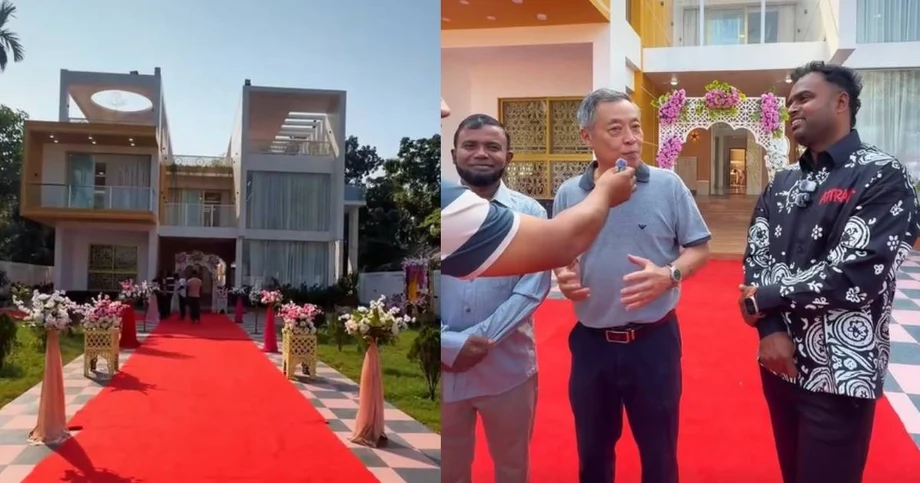
At the entrance to the house in Cumilla, a sign displays the flags of Bangladesh and Singapore. Beyond it are landscaped grounds, large glass windows and a spiral staircase connecting three floors. The house has five bedrooms, with interiors inspired by homes Sumon encountered through his work in Singapore.
A house tour shared on Facebook on November 16 drew millions of views, turning a personal celebration into a widely watched story about work abroad, family and the meaning of coming home. Sumon personally showed his employer around the property, giving him a chance to see what years of work had helped make possible.
Sumon says in the video that he is still working in Singapore. His achievement is therefore a milestone within his working life abroad, rather than the conclusion of it.
Why Sumon chose his village
Sumon faced a question during the tour that gets to the heart of his decision: why spend so much on a house in a rural village when the money could have bought property in a city?
The presenter raised that alternative after learning the construction cost. Sumon, the homeowner, explained that his choice came from a longstanding personal ambition.
I wanted to have a house in my village. That's why I invested the money here. I've always dreamed of having a house like this.
The setting is part of the appeal. Open fields and greenery surround the property, giving the house a very different outlook from the Singapore homes that influenced its interiors. Sumon chose to bring those design ideas back to a place where he already had family ties.
His relatives also shared a connection to Singapore. During the visit, Sumon identified three other men with him as relatives and said all four had spent time there. The house tour brought together several people whose lives had crossed between the two countries.
Singapore inspired the rooms inside
Sumon's work on interior projects in Singapore helped shape his ideas for his own home. Rather than copying only the outside appearance of a building, he adopted features that affected how the rooms looked and felt.
Explaining the inspiration to the presenter, Sumon described how seeing houses abroad had given him a goal for his village property.
We lived in Singapore, and after seeing the houses there, I got inspired. I felt that I wanted something similar back home.
Large windows running from floor to ceiling and extensive glass panels allow daylight into the living spaces. Curtains provide a way to control light and privacy. Sumon described the use of glass as being "mainly inspired by Singapore".
The tour also shows a digital door lock, pink sofas made to order and a stone staircase that curves between floors. A red carpet covers the approach to the front door, while a landscaped garden adds greenery around the house.
Some features serve ordinary family routines. A small kitchen near the main bedroom allows tea or coffee to be prepared without going downstairs. Alongside the five bedrooms, the house has five bathrooms, giving the family more room to share the property.
How much did Hossain Villa cost?
Sumon put the cost at about 25 million taka, with a more detailed description placing it slightly above that figure. The equivalent given was approximately S$258,000. He described using his savings to bring the project to life.
The cost gives a sense of the scale of his commitment, but the financial details remain limited. His salary, construction schedule and any other sources of household income were not disclosed, so readers cannot calculate how much he saved each year or what share of his earnings went into the house.
The building's size also needs careful explanation. An initial description puts the property at 2,500 square feet, while Sumon gives individual floor areas of about 204 square metres for the ground floor, 232 square metres for the second and 167 square metres for the third. Those floor figures add up to approximately 603 square metres. The precise area covered by the smaller description is unspecified.
For Sumon, the tour focused less on measurements than on what the money had created: a house in his village with space for his family and design choices he had wanted to bring home from Singapore.
A first visit to Bangladesh for his employer
Sumon's employer, whose name is not given in the video, said this was his first trip to Bangladesh. His visit gave the celebration a personal dimension, allowing him to see his employee in the surroundings where he had chosen to invest his savings.
Asked about the location, the employer commented on the countryside and the farming around the property.
"I think it is a very good area, it is a rural area. And then there is a lot of farming here," his employer said.
He also suggested that the setting could suit a resort, saying: "If you can do a resort here, I think it is the best." The suggestion came during his conversation about the area; Sumon's stated purpose for the property was to fulfil his dream of a village home.
The employer congratulated Sumon and said he was happy to see him reach a goal he had worked towards for years. He praised the space available to bring the family together and encouraged Sumon to help less privileged people in his community when he could.
Millions watched a private milestone
The Facebook page Al Amin Grameen Blog, which features homes in Bangladesh, shared the tour. The video attracted more than 4.7 million views and about 168,000 reactions as its audience grew.
Viewers congratulated Sumon and his family, praised his design choices and celebrated the result of his years of work. Much of the response focused on the personal achievement behind the property, rather than its size or fittings alone.
The tour gives that achievement a concrete form. Viewers can follow the entrance walkway, see the rooms and hear Sumon explain why he wanted to build there. His employer's presence also connects the house directly to his working life in Singapore.
What the house changes for his family
Hossain Villa provides something specific: a large family home in the village Sumon chose, with five bedrooms, five bathrooms and shared living spaces across three floors. His employer's praise centred partly on that capacity to bring relatives together.
Sumon's experience also shows how working abroad can carry ideas as well as earnings across borders. The money helped pay for construction; the interiors he encountered in Singapore helped him decide what to build.
The two flags at the entrance capture those connections simply. Bangladesh is where Sumon wanted his dream home. Singapore is where he has spent more than 14 years working, and where he continues to earn a living. For his family, the result is now a place they can use, rather than a plan he describes from overseas.
Key Points
- Sumon built Hossain Villa in his village in Cumilla after more than 14 years working in Singapore.
- The house cost about 25 million Bangladeshi taka, approximately S$258,000.
- The three floors contain five bedrooms and five bathrooms, with interiors inspired by homes in Singapore.
- His Singaporean employer visited Bangladesh for the first time and congratulated him during the tour.
- The Facebook video attracted more than 4.7 million views and about 168,000 reactions.
- Sumon says he continues to work in Singapore.