A mountain transport plan with a price and a visitor limit
Yamanashi Prefecture has set out a draft plan to carry 2.3 million visitors a year to Mount Fuji's fifth station, with return fares expected to stay within 10,000 yen and most other vehicles barred from the Fuji Subaru Line once the service opens.
Contents
- A mountain transport plan with a price and a visitor limit
- How the journey to the fifth station would work
- Why replacing ordinary road traffic matters
- What kind of tram is being considered?
- A return fare approaching three times the bus price
- Construction costs have risen from the earlier estimate
- From a mountain route to a prefectural network
- How the proposal reached this stage
- A new name, with wider ambitions
- Key Points
Governor Kotaro Nagasaki presented the Fuji Tram draft on November 18, 2026. Initial investment is estimated at 77.3 billion to 96.5 billion yen, depending on the vehicles and equipment selected. The proposal combines a new mountain transport service with a much wider ambition: a public transport network connecting Mount Fuji, the planned Linear Yamanashi Station and destinations across the prefecture.
The annual visitor target matches roughly the number who visited in 2012, the year before Mount Fuji received World Cultural Heritage status. Yamanashi wants to protect the mountain while keeping enough visitors to support local businesses and jobs.
For passengers, the biggest changes would be practical. Buses, private cars and taxis would generally give way to a managed tram service on the mountain road. Visitors would pay more than the current bus fare, while departure times and service frequency would become the main tools for controlling how many people reach the fifth station.
The plans remain drafts. Vehicles, an operator and the detailed business arrangements have yet to be selected, and no firm opening date has been announced. The prefecture wants the service running by the opening of the Linear Chuo Shinkansen, the railway powered by magnetic levitation that is intended to connect with the wider network.
How the journey to the fifth station would work
The Fuji Tram would use the existing Fuji Subaru Line, a road running about 30 kilometers up Mount Fuji's northern slopes. Its destination is the fifth station, about 2,300 meters above sea level on the mountain, which rises to 3,776 meters. The fifth station serves both climbers heading higher and tourists visiting for the views.
The leading candidate for the station at the foot of the mountain is a site west of Fujisan Parking, near the Fujiyoshida interchange on the Chuo Expressway. From there, the uphill journey is expected to take about 52 to 67 minutes, depending on the vehicle selected.
Trams would run every six to 15 minutes according to demand. During the summer climbing season, the first departures could be as early as 4 a.m. The draft assumes about 13,000 visitors a day during July and August, making those months a major test of the system's ability to handle crowds.
Services are envisaged from the middle of April to the middle of January. Winter operation would depend on safety conditions. Extending service beyond the main climbing season is also intended to support tourism businesses and employment for more of the year.
Yamanashi also wants people to arrive at different times and spend more of the day at the destination. A service used across the day would spread demand more evenly than one dominated by a short morning rush.
Why replacing ordinary road traffic matters
Yamanashi's central proposal is to manage access through the transport timetable. Once the tram operates, buses, passenger cars and taxis would in principle be prohibited from entering the Fuji Subaru Line. Exceptions are being considered for emergency vehicles and vehicles carrying supplies, while access to facilities along the route would be maintained.
A controlled service gives the operator a direct way to regulate arrivals: the number of departures and the capacity of each vehicle determine how many passengers can travel uphill. The prefecture's earlier assessment identified this ability to manage visitors as a major reason for choosing the tram approach.
The 2.3 million annual target also reveals the balance Yamanashi is trying to strike. It seeks a level of tourism comparable with 2012 rather than a large reduction that could damage the local economy. Environmental protection and continued visitor spending are both built into the proposal.
The practical effect would be a shift from access by several kinds of vehicle to a journey organized around a single main service. Maintaining emergency access and deliveries would therefore be part of the operating design, alongside passenger transport.
What kind of tram is being considered?
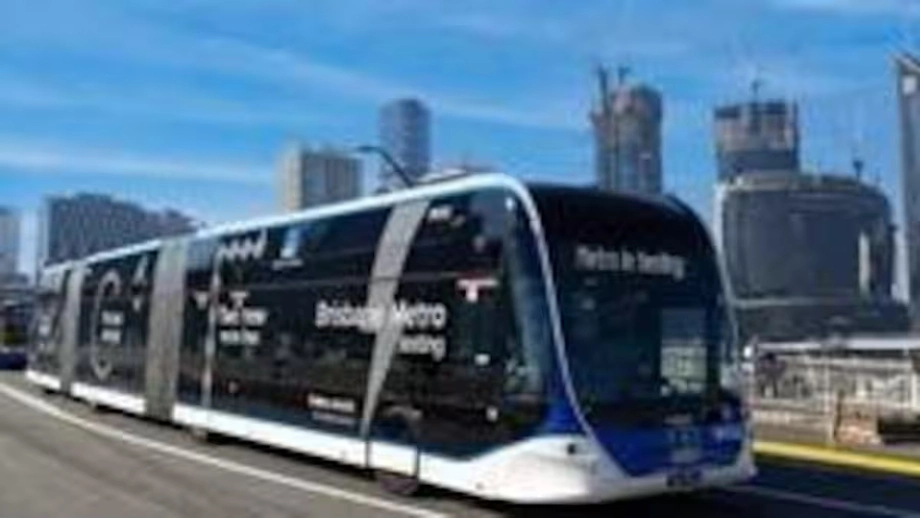
Yamanashi's earlier technical assessment favored vehicles running on rubber tires and guided by magnetic markers embedded in the road. Sensors on the vehicle detect the markers and help it follow the route. Unlike a conventional railway, this approach does not require two steel rails along the road.
The prefecture compared five options: magnetic guidance, guidance using painted road lines, light rail transit, the Translohr system using rubber tires and a central guide rail, and conventional buses. Its criteria included handling steep slopes and sharp bends, preserving emergency access, avoiding overhead wires and producing no exhaust emissions during operation.
Guidance using painted lines was rejected because of its vulnerability to poor weather and snow. The magnetic system was judged strongest for managing visitor flows, as well as meeting the mountain route's operating requirements.
The November 2026 draft lists vehicle candidates from China, Switzerland and Sweden. The earlier focus on a Chinese vehicle came under review amid worsening relations between Japan and China. The final choice will affect journey times, infrastructure requirements and costs.
The 2025 study envisaged two connected carriages with 120 seats, operating up to 10 times an hour to carry 1,200 passengers an hour. It also considered four intermediate stations. Those figures describe the earlier technical concept, while the newer draft allows a range of journey times and equipment choices.
The earlier study proposed batteries combined with hydrogen fuel cells, which generate electricity from hydrogen. It also envisaged future automatic operation, with a conductor aboard to respond to emergencies or disasters on the mountain route.
A return fare approaching three times the bus price
The proposed return fare ceiling of 10,000 yen compares with the current bus fare of 3,400 yen. At that ceiling, a passenger would pay 6,600 yen more, or about 2.94 times the bus price. The final fare has not been set, and discounts for Yamanashi residents may be considered.
The prefecture says the fare level is intended to cover construction and operating costs, reducing reliance on prefectural taxes. Payments from domestic and international visitors would be the main source of revenue.
The draft estimates that the project could be profitable from its first year. That is a forecast within a business plan still being developed. The financial result will depend on the selected equipment, actual fares, visitor demand and the eventual division of costs between the operator and the prefecture.
For visitors, the fare is one of the clearest consequences of the proposal. A more tightly managed trip to the fifth station would come at a higher price than today's bus journey. For the prefecture, the same ticket revenue is central to paying for the new system.
Construction costs have risen from the earlier estimate
The latest estimated initial investment of 77.3 billion to 96.5 billion yen covers vehicles, stations and other infrastructure. The earlier magnetic guidance proposal carried an estimate of 61.8 billion yen, compared with 134 billion yen for light rail transit. The figures come from different stages of planning, with the latest range depending on the equipment chosen.
The earlier assessment also identified a tradeoff between construction and running costs. Annual maintenance was estimated at 4.9 billion yen for the magnetic guidance system, against 3.3 billion yen for light rail. The magnetic option was cheaper to build but more expensive to maintain under those assumptions.
Yamanashi estimated that the magnetic system's annual maintenance cost could fall to 3.8 billion yen by 2030 if hydrogen prices declined as envisaged by the national government. Fuel prices therefore formed an important part of the earlier financial calculation.
A private sector led structure is favored. Options include a company jointly backed by public and private investors, often called a third sector company in Japan, or a private finance initiative. Under a private finance initiative, private businesses take on agreed roles in financing, building or operating public infrastructure.
The prefecture would retain some responsibility for construction and operations. It also expects to recover its initial contribution over a period through project revenue and other income, although the draft does not specify that period.
From a mountain route to a prefectural network
The long term vision has three stages. The first connects the mountain foothills with the fifth station. The second connects the foothills with Linear Yamanashi Station. The third extends the network to major destinations across the prefecture.
Connections to Lake Yamanaka and Narusawa Village could be developed earlier. Transport types would be chosen according to passenger numbers and local road conditions, allowing different parts of the network to use different systems.
Yamanashi wants consistent vehicle design, transfer information, reservations and payment arrangements. For passengers, that would mean a network that is easier to recognize and navigate, even where a journey requires changing vehicles.
The planned Linear Yamanashi Station would act as a gateway to Mount Fuji and other destinations. The economic aim is to encourage visitors to travel beyond a single attraction, spreading spending across more communities. Residents could also gain additional choices for commuting and school travel.
The prefecture's official naming announcement, published on November 18, says the project now needs a name reflecting its intended role as a core public transport network, rather than only a service to Mount Fuji.
How the proposal reached this stage
Yamanashi has moved from a railway proposal toward vehicles using the existing road. The sequence explains why the latest draft contains both a preferred technical direction and choices that remain open.
- November 2024: The prefecture announced that it was dropping the rail based light rail proposal in favor of a tram running on rubber tires.
- June 5, 2025: Yamanashi outlined its assessment favoring magnetic guidance after comparing five transport options.
- June 2025: Survey details described a capacity of 1,200 passengers an hour, possible intermediate stations and a proposed combination of batteries and hydrogen fuel cells.
- November 18, 2026: Governor Nagasaki presented the draft basic plan and wider network vision, including the 2.3 million annual visitor target and expected return fare ceiling.
- November 24, 2026, at 5 p.m.: The public submission period for a new network name closes.
Nagasaki, the governor leading the project, described his intended pace at the June 5 news conference:
We want to advance the plan as swiftly as possible,
He also addressed the organizational decisions needed to turn the proposal into an operating service:
We will promptly clarify the type of business entity and business model to pursue.
The November draft still leaves those arrangements under development. Selecting the operator and vehicle will be central to settling the detailed business plan.
A new name, with wider ambitions
The naming consultation runs from November 18 to November 24, 2026, at 5 p.m., and is open to people both inside and outside Yamanashi. Participants can vote for a proposed name or submit their own suggestion.
The three listed choices are YAMANASHI METRO, YAMANASHI e-LINE and Yamanashi Niko Niko Line. The prefecture says the name should suggest Yamanashi's future, be easy to understand and say, and feel familiar as a transport network connecting its regions.
The prefecture will consider both voting results and free submissions when choosing the name. Meanwhile, the larger decisions concern the service itself: which vehicles to buy, who will run them, how public money will be committed and how the mountain route will connect with the rest of Yamanashi.
Key Points
- The draft targets 2.3 million annual visitors to the Fuji Subaru Line fifth station, roughly matching 2012.
- Return fares are expected to stay within 10,000 yen, compared with the current bus fare of 3,400 yen.
- Most buses, private cars and taxis would be barred from the mountain road once the service opens.
- Initial investment is estimated at 77.3 billion to 96.5 billion yen. Vehicles and an operator remain unselected.
- The wider network would connect Mount Fuji with Linear Yamanashi Station and other prefectural destinations.
- No firm opening date has been announced. The naming consultation closes on November 24, 2026, at 5 p.m.