Bigger budgets have yet to deliver matching gains
Philippine agricultural development appropriations rose from P89 billion in 2015 to P278 billion in 2026, yet access to affordable, nutritious food has not improved in proportion to that increase, according to the Philippine Institute for Development Studies (PIDS). Its assessment calls for a change in how government judges success: from the money allocated and activities completed to what families can actually afford and eat.
Contents
- Bigger budgets have yet to deliver matching gains
- Where the food security money goes
- Food security involves more than supply
- School feeding expands sharply
- Agencies differ in how much they pay out
- Why responsibility extends beyond agriculture
- Measure yields, prices and diets together
- Development targets add pressure for results
- The dates behind the assessment
- Key Points
The increase amounts to P189 billion, taking the agricultural development budget to more than three times its 2015 level. PIDS describes the average annual increase as about 11%. Despite that expansion, the Philippines ranked below average in a 2022 food security index cited in the assessment.
The immediate concern extends beyond farm production. PIDS found that spending remains concentrated on increasing domestic food availability, while nutrition, reliable access to food and fair access across communities continue to face gaps. Several agencies share responsibility, but their budgets and reporting systems do not consistently show how their work contributes to common goals.
The institute's October 28 statement sets out the scale of the challenge: agricultural interventions received P231.5 billion in the 2026 budget, while social protection programs related to food security received P68.9 billion. The researchers want a coordinated system for tracking results incorporated into preparations for the 2028 National Expenditure Program.
Where the food security money goes
PIDS Senior Research Fellow Roehlano M. Briones and Supervising Research Specialist Agnes Kristine A. Quilinguing examined spending trends from 2015 to 2025, then assessed the 2026 budget alongside selected food security indicators. Their work separates the question of how much government provides from the question of what that spending achieves.
Agricultural interventions represented roughly 3.4% of the national budget in 2026. Food security related social protection accounted for 1.01%. Using the peso amounts, the P231.5 billion allocated to agricultural interventions was about 3.4 times the P68.9 billion for those social protection programs.
PIDS separately reports P278 billion in agricultural development appropriations when describing growth since 2015. Its statement does not explain the difference in coverage between that figure and the P231.5 billion total for agricultural interventions. Each amount therefore belongs to the category under which the institute presents it.
Input subsidies, irrigation and roads connecting farms to markets dominate agricultural development allocations. These measures support production by helping farmers obtain supplies, water their crops and transport their harvests. The broader food security effort also includes supplementary feeding, meals at school, nutrition supplementation and other programs addressing hunger.
For households, the connection between these activities matters. More food reaching markets can improve supply, while feeding and nutrition programs address needs among people who may still struggle to obtain an adequate diet. PIDS argues that budgets should be assessed against both kinds of results.
Food security involves more than supply
The researchers' food security paper, published on July 30, 2026 as Discussion Paper DP 2026-15, assesses four dimensions: availability, accessibility, utilization and stability. Together, these describe whether food exists, whether people can obtain it, whether it supports their health and whether access lasts.
Availability concerns the supply of food. Accessibility concerns people's ability to obtain it, including whether they can afford it. Utilization covers the nutritional value and safe use of food. Stability concerns whether those conditions hold over time rather than disappearing during a disruption.
PIDS found progress in availability and accessibility, alongside persistent gaps in utilization, stability and equity. Equity means whether improvements reach different groups fairly. A national improvement can leave some communities facing much greater difficulty obtaining nutritious food.
The paper traces a shift from an early concentration on food availability, especially rice, toward nutrition and social protection interventions from the 1990s onward. Agricultural development nevertheless continues to dominate allocations. The authors also identify inefficiencies in nutrition and social protection programs associated with implementation on a large scale and responsibilities spread across different levels of government.
School feeding expands sharply
The school feeding program received P25.7 billion in 2026, more than double its previous allocation, according to PIDS. It was among the fastest growing items examined, placing greater demands on the institutions responsible for turning budgets into services.
PIDS describes the school feeding allocation as more than half of social protection program allocations. However, P25.7 billion is about 37% of the P68.9 billion total it gives for food security related social protection. The statement does not identify the narrower grouping behind its description of more than half.
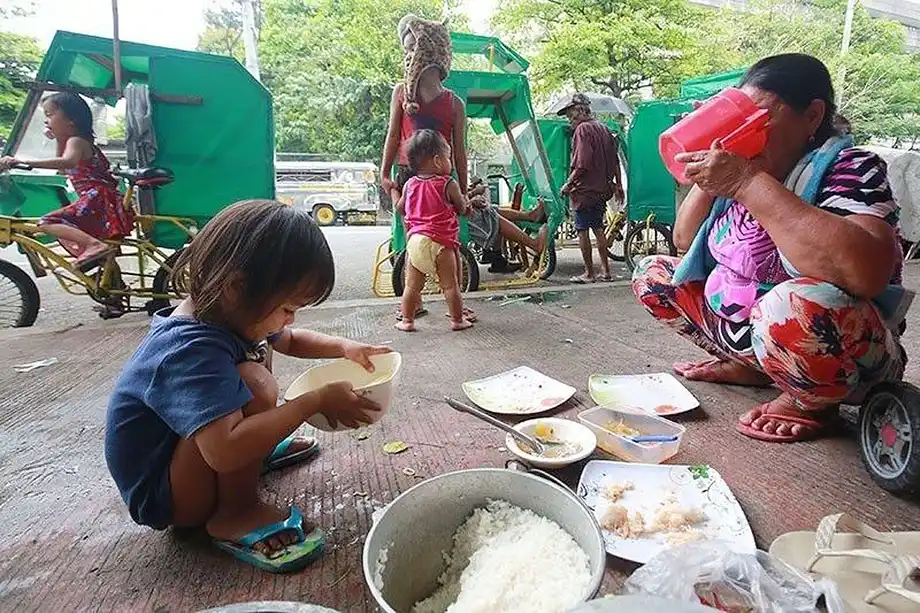
For children, the relevant result is access to nutritious meals. For budget managers, the task is to connect the additional money with service delivery and changes in nutrition. A larger allocation creates room to provide more support, while execution and results tracking show what children receive.
The researchers recommend following spending through several stages: the resources committed, the services delivered, the changes experienced by recipients and the lasting effects. Applied to feeding programs, this means connecting expenditure and meals provided with evidence about children's diets and nutrition.
Agencies differ in how much they pay out
Budget execution varied widely among the agencies covered by the study. In 2024, the Department of Social Welfare and Development disbursed 88.1% of the appropriations examined, while the Department of Education disbursed 86.2%.
The Department of Agriculture recorded a disbursement rate of 62.5%. The Department of Agrarian Reform recorded 64.1%, and the National Nutrition Council recorded 61%. These figures apply to appropriations covered by the analysis, rather than necessarily every part of each agency's budget.
The difference between the social welfare and agriculture departments was 25.6 percentage points. Put simply, for every P100 allocated within the spending examined, the social welfare department paid out P88.10, compared with P62.50 at the agriculture department.
An appropriation gives an agency authority to spend; a disbursement is money actually paid. Tracking both helps reveal how far funding has moved toward delivery. PIDS wants that financial record connected with evidence about services, food prices, production and nutrition, so officials can follow the entire process from allocation to results.
Why responsibility extends beyond agriculture
National agencies and local government units deliver different parts of the food security effort. PIDS identifies coordination and accountability as central problems because spending is spread across institutions whose work contributes to the same household needs.
Quilinguing, the PIDS supervising research specialist, described the shared responsibility for improving diets:
Increasing access to nutritious food is not solely the responsibility of the Department of Agriculture (DA).
Her recommendations begin with mapping the agencies involved. That would identify who funds and delivers each intervention, making it easier to connect agricultural programs with feeding, nutrition and other support.
Quilinguing also proposes a food security budget tag. A tag is a label attached to relevant budget items so spending directed toward the same objective can be identified across agencies. It would help officials see the combined effort rather than examining each department in isolation.
A unified results framework would then give those agencies common objectives and measures. The proposed point for using that framework is the 2028 National Expenditure Program, the executive branch's proposed national budget submitted to Congress. The recommendations set a planning target for reform; PIDS presents them as proposals.
Measure yields, prices and diets together
Enrique Dela Cruz, an executive assistant at the Department of Agriculture, called for evidence at the program level that connects actual spending and unit costs with agricultural yields, food prices and diets. Unit costs mean the amount spent for a defined item or service, allowing officials to compare expenditure with what was delivered.
Dela Cruz summarized his argument about choosing useful measures:
You will only get what you are willing to measure.
He warned that annual tracking of obligations and disbursements can obscure results that take longer to emerge. An obligation is a commitment to pay; a disbursement is the payment itself. Both are useful financial measures, while changes in production and nutrition require their own evidence.
Dela Cruz also urged policymakers to examine investment in vegetables, fruits, legumes, fish and other nutritious foods, rather than concentrating primarily on rice and calorie availability. Calories measure energy from food. A nutritious diet also requires a range of nutrients, making the mix of foods available and affordable part of the assessment.
Briones similarly called for policies that improve productivity, support farm incomes and keep food affordable. He recommended balancing domestic production with imports where necessary, while supporting commodities in which Filipino farmers can compete. His approach connects decisions about production and trade with the prices households face and the earnings farmers receive.
Development targets add pressure for results
Novel Bangsal, executive director of the Budget and Tax Research Bureau of the House of Representatives' Congressional Policy and Budget Research Department, urged stronger connections between public spending and development targets.
Bangsal said 212 of the Philippine Development Plan's 534 targets, about 40%, were off track. He cited that broader national performance measure while discussing the need to connect budgets with intended results.
PIDS recommends a monitoring and evaluation system covering inputs, outputs, outcomes and eventual impacts. Inputs are the money, staff and other resources used. Outputs are the goods or services delivered. Outcomes are changes experienced by people, while impacts are the lasting effects.
Under that approach, a program would be assessed through a chain of practical questions: how much was spent, what was delivered, who benefited and what changed in food access or nutrition. The paper places these recommendations in the context of fiscal consolidation, when pressure to control public finances makes the effectiveness of each allocation more consequential.
The dates behind the assessment
The spending review covers more than a decade, while the proposed coordination reforms look toward the 2028 budget. The main dates show how the financial comparison, research findings and planning recommendations fit together.
- 2015: Agricultural development appropriations stood at P89 billion, the starting point for the spending comparison.
- 2022: The food security index cited in the assessment placed the Philippines below average.
- 2024: Agency disbursement rates examined by the study ranged from 61% to 88.1%.
- 2015 to 2025: The period covered by the review of government spending trends.
- 2026: Agricultural development appropriations reached P278 billion; the researchers also assessed the year's food security allocations.
- July 30, 2026: PIDS published Discussion Paper DP 2026-15 by Briones and Quilinguing.
- October 28, 2026: PIDS issued its statement on the findings presented at an institute webinar.
- 2028 National Expenditure Program: The proposed planning point for a unified results framework.
The next practical task identified by PIDS is to connect agencies and their budgets around measurable improvements in food availability, affordability, nutrition and reliable access. Families would experience success through food they can obtain and diets that better support their health.
Key Points
- Agricultural development appropriations rose from P89 billion in 2015 to P278 billion in 2026, more than tripling.
- PIDS found that food security improvements have not matched the increase in spending.
- The 2026 budget allocated P231.5 billion to agricultural interventions and P68.9 billion to food security related social protection.
- School feeding received P25.7 billion, more than double its previous allocation.
- Agency disbursement rates in the 2024 analysis ranged from 61% to 88.1%.
- Researchers recommend shared targets, a food security budget tag and stronger coordination for the 2028 budget proposal.
- The proposed assessment would track spending through to changes in food access, prices, diets and nutrition.