Four factories on a faster timetable
SK Hynix plans to bring forward completion of its four semiconductor factories in Yongin, South Korea, to 2033 from 2045, accelerating a project involving 600 trillion won, approximately $449 billion, in planned investment. The first factory is scheduled to open its initial cleanroom in February 2027, with commercial wafer shipments planned for the fourth quarter of that year.
Contents
- Four factories on a faster timetable
- What opens in 2027?
- Construction reaches beyond factory walls
- Why AI memory is driving the expansion
- Trinity Fab tackles the testing bottleneck
- A test line built to resemble production
- Who pays and who runs the facility?
- Financial support extends beyond testing
- Nearby suppliers and a practical gas example
- Key Points
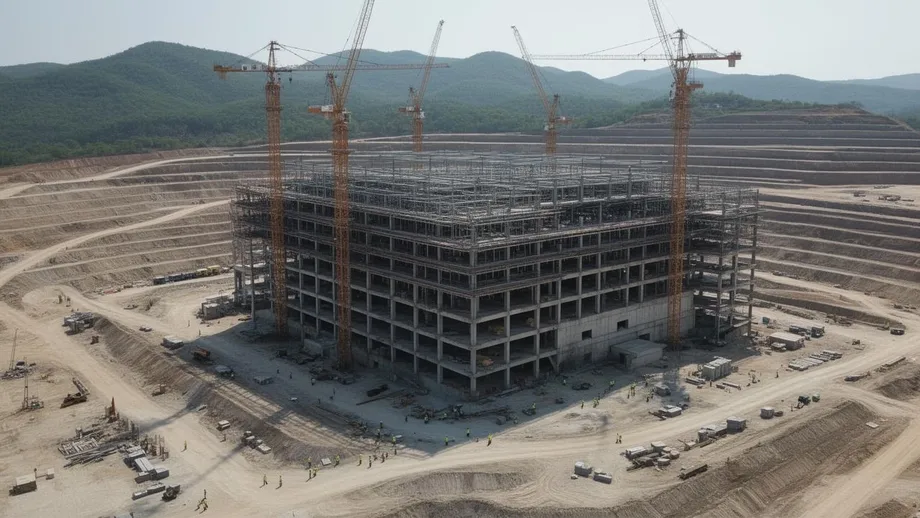
The development in Wonsam-myeon, Cheoin-gu, in Gyeonggi Province covers 4.15 million square meters, about 1.4 times the area of Seoul's Yeouido. Around 20,000 workers are being deployed daily as SK Hynix prepares a major production base for memory used in artificial intelligence systems.
Alongside the factories, an 874.6 billion won testing center called Trinity Fab will help smaller suppliers prove that their materials and equipment can work on commercial production lines. SK Hynix also says it will spend 1.4 trillion won over five years supporting domestic semiconductor suppliers, connecting the expansion of its own factories with efforts to strengthen the companies supplying them.
The project therefore addresses two connected needs: more memory production and faster qualification of the materials, parts and machines required to make that memory. A completed factory needs reliable equipment and supplies before it can deliver chips consistently.
SK Hynix expects demand for memory to continue exceeding supply as AI investment grows. Bringing the Yongin cluster forward by 12 years would give the company more production space sooner, although the first cleanroom opening, initial shipments and completion of all four factories are separate milestones.
What opens in 2027?
The first factory, known as Y1, will contain six cleanrooms. These are tightly controlled spaces where air is filtered to prevent tiny particles from damaging chips during manufacturing. Its first cleanroom is now scheduled to open in February 2027, three months earlier than the previous May target.
SK Hynix then plans to bring in production equipment, set it up and complete certification before shipping its first commercial wafers in the fourth quarter of 2027. Wafers are thin discs on which many chips are manufactured together before being separated.
Y1's second construction phase is scheduled to finish in June 2028. Work on the second factory, Y2, has also begun. The main milestones are:
- February 2027: Y1's first cleanroom is scheduled to open.
- May 2027: Trinity Fab's own cleanroom is scheduled to open inside Y1.
- October 2027: Trinity Fab plans to begin demonstration and evaluation services.
- Fourth quarter of 2027: Y1 plans to ship its first commercial wafers.
- June 2028: Y1's second construction phase is scheduled for completion.
- 2033: Target completion of the four factories, brought forward from 2045.
Equipment installation and process checks explain the months between opening a cleanroom and shipping products. A building can be ready to receive machines while engineers still need time to make those machines work together reliably.
Construction reaches beyond factory walls
Roads, water supply, drainage and power infrastructure across the Yongin site were 96% complete at the end of October. The wider Y1 construction update put progress at 89%; a more detailed assessment placed its first phase at 85.58% in early November, with structural work fully complete.
The first phase's wastewater treatment facility and underground reservoir were more than 99% complete, while the central utility building was about 90% complete. Supporting facilities also include gas and steam supply buildings. The government is supporting the development through water and electricity provision and regulatory easing.
Water treatment, cooling, electricity and specialty gases are central to semiconductor manufacturing. Chips pass through many carefully controlled steps, and a disruption in one supporting system can interrupt production. Yongin's construction programme therefore involves much more than erecting factory buildings.
SK Hynix is also preparing the surrounding supplier complex while factory work continues. Building these facilities together is intended to place production, testing and supply close enough for companies to move more quickly between development and delivery.
Why AI memory is driving the expansion
Yongin is intended to become a production base for high bandwidth memory, or HBM, and advanced dynamic random access memory, known as DRAM. DRAM temporarily holds information that processors need while carrying out tasks. HBM stacks memory chips and connects them so large amounts of data can move quickly.
AI systems need both powerful processors and fast access to data. If memory cannot deliver information quickly enough, a processor spends more time waiting. HBM helps address that problem, making it an important component in servers used to train and run AI models.
SK Hynix competes with Samsung Electronics and Micron in this market. Earlier production at Yongin could help it meet customer demand sooner and expand its position in memory for AI servers.
Industry estimates suggest a completed factory could gradually reach capacity of around 300,000 wafers a month. SK Hynix has not provided a confirmed schedule for reaching that level at each Yongin factory. Actual output will depend on equipment installation, the products being manufactured and yield, the share of chips that meet quality requirements.
The scale of the investment also matters for memory prices. More production can ease shortages, while large expansions can leave suppliers exposed if demand slows. Yongin's phased opening means new capacity will enter the market over time rather than arrive all at once.
Trinity Fab tackles the testing bottleneck
Trinity Fab will sit inside Y1, on the northwest side of its third floor. Its roughly 3,305 square meter cleanroom will give smaller materials, parts and equipment companies access to conditions resembling a commercial semiconductor line.
Smaller suppliers often face a difficult step after developing a promising product: obtaining enough factory data to persuade a chipmaker to use it. Their own laboratories may lack the equipment or operating conditions needed, while access to a working production line depends on schedules dominated by customer orders.
Yang Ji-dong, head of SK Hynix's Yongin planning team, described the difficulty of obtaining that evidence:
Even when a good technology has been developed, the process of sufficiently validating it in a mass-production environment and securing reliable data is extremely difficult.
Trinity Fab aims to reduce the average period from development to production qualification from 18 months to 12 months. That is a saving of six months, or about one third. Production qualification means checking that a product works consistently enough for use in commercial manufacturing.
A test line built to resemble production
Trinity Fab will have about 800 pyeong for shared production readiness evaluation and 200 pyeong for companies testing their own equipment. A pyeong is a Korean area unit equal to roughly 3.3 square meters. The rental section will contain 15 separate spaces to help keep competing companies' work apart.
The facility will use wafers measuring 300 millimeters, also called 12 inches, across. Its planned equipment includes tools for lithography, etching, deposition, cleaning and inspection. These processes draw patterns, remove material, add thin layers and check whether manufacturing is proceeding correctly.
Plans call for 51 tools, with 33 core tools installed initially and further equipment added in stages. Lithography will use argon fluoride immersion equipment. Technologies requiring further assessment with extreme ultraviolet lithography can be evaluated on SK Hynix's actual production lines.
Trinity Fab will share central utilities with Y1, including air handling, ultrapure water and specialty gas systems. Its structure includes the production cleanroom and supporting equipment levels, helping reproduce conditions that a laboratory alone may struggle to match. SK Hynix engineers will support evaluations.
Lee Jae-ho, vice chairman of semiconductor equipment maker TES, gave an example of the potential benefit across a longer equipment development cycle:
Normally it takes about five years for equipment to go through development and evaluation before mass-production adoption, but with Trinity Fab that time should shrink by nearly a year.
His estimate covers development and evaluation together, while the 18 to 12 month target concerns the qualification process. Both point to the value of obtaining usable factory data sooner.
Who pays and who runs the facility?
Trinity Fab's 874.6 billion won budget combines support from SK Hynix, the central government and local authorities. SK Hynix will contribute about 443.3 billion won, including the cleanroom and specialized personnel. The central government will provide 373.6 billion won, and Gyeonggi Province and Yongin City will provide 57.7 billion won.
Those figures put roughly half the project cost with SK Hynix and the other half with public authorities. The company's contribution includes facilities and staff rather than consisting entirely of cash.
An independent nonprofit foundation will run the facility, with an operating committee reviewing participation. Protecting intellectual property and commercially sensitive information is part of that arrangement, particularly because suppliers may be testing equipment near competitors.
The center is scheduled to open its cleanroom in May 2027 and spend about five months setting up equipment before evaluation services begin in October. Sharing Y1's location and utilities gives participating companies access to a manufacturing environment while providing dedicated space for tests.
Financial support extends beyond testing
SK Hynix says its 1.4 trillion won supplier programme over five years covers research and development, testing, mass production and sales. The aim is to address several points where a smaller company can run short of money or technical support before securing regular orders.
Under the R&D Challenge Compensation Program, SK Hynix will advance up to 50% of initial development costs. Suppliers may also receive compensation for work based on technical achievements and contribution to the supply chain, including when development fails or does not lead to a purchase.
Lee Hyun-chul, the SK Hynix vice president responsible for purchasing strategy, explained the approach:
This is a program run on the premise that SK Hynix absorbs the costs incurred if development fails.
SK Hynix and financial institutions also plan about 2 trillion won in financing over five years backed by the Korea Trade Insurance Corporation. Four commercial banks are participating. The financing arrangement provides another route for suppliers to obtain funds alongside the company's spending programme.
A delivery payment support fund is being doubled from 50 billion won to 100 billion won. Eligibility is expanding beyond direct suppliers to companies further down the chain, including those supplying the suppliers. Other support includes loans at low interest rates and technical consulting.
Nearby suppliers and a practical gas example
A supplier complex of about 450,000 square meters is being built roughly a two minute walk from Trinity Fab. Around 50 companies are expected to move in, including Jusung Engineering, ASML Korea and PSK. The site has been fully sold.
The layout is intended to create a short route from development to testing and then commercial supply. A company could develop materials or equipment nearby, evaluate them at Trinity Fab and, after qualification, supply the main SK Hynix factory.
Specialty gas maker TEMC offers a concrete example of what supplier development can deliver. Joint research with SK Hynix helped it produce neon domestically in 2022, when rare gas prices rose following Russia's invasion of Ukraine. The change reportedly saved SK Hynix about 30 billion won in neon purchasing costs.
TEMC has since expanded its customer base to semiconductor companies in Taiwan, the United States and Japan. It also plans to recover and recycle neon used at Yongin. The example connects supplier development with purchasing costs, access to materials and opportunities to sell beyond South Korea.
Yongin's first commercial shipments and Trinity Fab's evaluation services are both scheduled for the fourth quarter of 2027. Those milestones will mark the first practical results of a project combining more chip production with support for the businesses needed to keep it running.
Key Points
- SK Hynix plans 600 trillion won in investment for four Yongin factories, targeting completion in 2033 instead of 2045.
- Y1's first cleanroom is scheduled to open in February 2027, with initial commercial wafer shipments in the fourth quarter.
- The 874.6 billion won Trinity Fab plans to begin evaluation services in October 2027.
- The testing center aims to cut average production qualification time from 18 months to 12 months.
- SK Hynix plans 1.4 trillion won in supplier support over five years, alongside a 2 trillion won financing arrangement.
- About 50 suppliers are expected to occupy a nearby complex connected to Yongin's production and testing facilities.