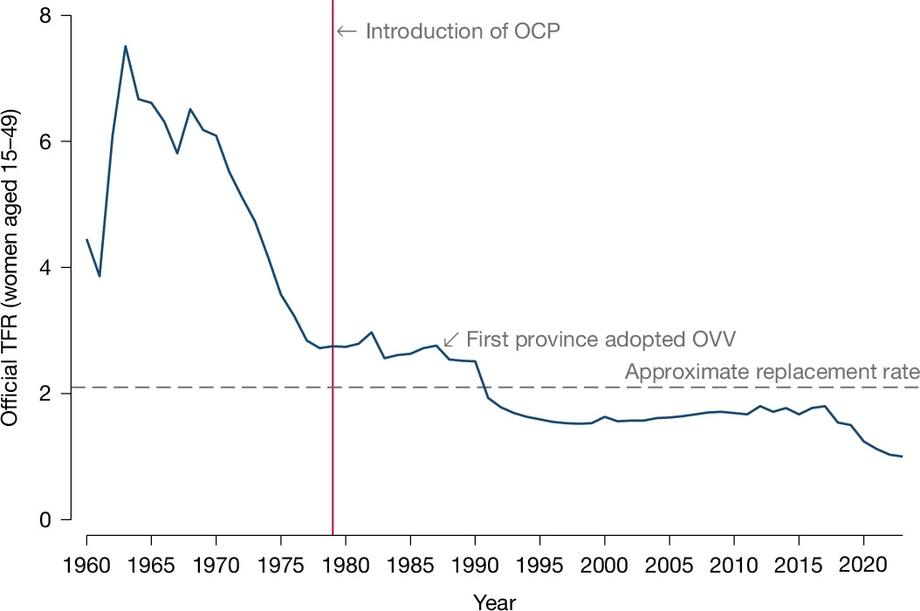
The birth limits became tougher when careers were at stake
China introduced its one-child policy in 1979 and 1980, yet its total fertility rate changed little during the following decade. The sharp decline came later: fertility fell by more than one-third in the early 1990s, after population targets became tied more tightly to the careers of local officials.
Contents
- The birth limits became tougher when careers were at stake
- What the one vote veto changed
- The official documents behind the veto
- How the researchers traced the effect
- The dates behind the delayed decline
- Fewer second births, with unequal effects
- Contraception shows how enforcement reached households
- What nearly half of the decline means
- How the findings were checked
- Why relaxing restrictions has not reversed the trend
- Key Points
Research by Hongbin Li, Lingsheng Meng, Grant Miller and Hanmo Yang identifies the "one vote veto" system as a major reason for that delayed effect. Under this system, missing a priority population target could cancel out an official's other achievements, block promotion and even lead to removal from office.
The National Bureau of Economic Research's May 2025 working paper, numbered 33741, estimates that the system explains 46% of China's fertility decline between 1987 and 1999. The detailed analysis puts the contribution at about 48% between 1987 and 1999, equivalent to approximately 0.48 fewer births per woman. Both estimates place stronger enforcement at close to half of the decline.
The original study, Bureaucratic Incentives and Effectiveness of the One Child Policy in China, puts the 46% estimate at 0.42 births per woman out of a total decline of 0.91 between 1987 and 1999. That estimate therefore covers the same period as the 48% figure, rather than a separate period confined to the 1990s. The supplied study material does not explain the difference between the two estimates.
The findings offer a concrete explanation for a puzzle in China's population history: a strict national rule had a much larger effect once local officials faced stronger personal consequences for missing its targets. They also help explain why removing birth restrictions has not simply restored the births that earlier enforcement discouraged.
What the one vote veto changed
Local officials were responsible for carrying out population policy. The one vote veto made family planning a priority that could outweigh success in other areas. An official could meet several government objectives and still lose the chance of promotion because a population target had been missed.
The researchers describe the career restriction in their working paper:
strictly prohibited career promotion for adherence failure
For officials seeking advancement, the incentive was direct: meeting birth targets protected their careers. The study finds that fertility fell more strongly after provinces introduced this system, consistent with officials putting greater effort into enforcing existing birth limits.
The official documents behind the veto
The study identifies the CCP Central Committee and State Council's 1991 Decision on Strengthening Birth Planning Work to Strictly Control the Growth of the Population as a central document behind the system. At a central government meeting that year, Premier Li Peng emphasized local officials' accountability for population control. Following the resulting central report, provinces revised their enforcement policies and adopted the veto at different times. The researchers also identify the National Population and Family Planning Commission's 2001 Compilation of Documents on the Assessment of the National Target Management Responsibility System for Population and Family Planning as a source for provincial adoption dates.
In Guangdong, the provincial party and government offices' March 30, 1998 notice reaffirming strict implementation, numbered 粤委办[1998]19号, cites the earlier Notice on Implementing the Family Planning "One Vote Veto" System Throughout the Province, 粤办发〔1991〕13号, and the Supplementary Notice on Issues Concerning Implementation of the Family Planning "One Vote Veto" System, 粤函字〔1992〕27号. The 1998 notice required recommendations for awards to include the family planning department's review of whether the unit had completed its population targets and whether its staff had violated family planning rules.
Jiangmen's discipline inspection commission, party organization department and population and family planning bureau issued more detailed veto and accountability rules, numbered 江计育发〔2008〕9号. The document is dated February 27, 2008 and says the rules take effect from issuance; the government webpage separately lists June 3, 2008 as the issue date. The rules cover collective awards, personal honors, comprehensive rewards, and the promotion, appointment and assessment of staff in government bodies, public institutions and state-controlled enterprises.
Under those rules, a provincial or Jiangmen assessment carrying a "reminder to pay attention" or "yellow card warning" could trigger the veto, as could births outside policy among staff in the covered institutions. Township and subdistrict leaders receiving the first rating could not receive awards or promotion for a year and generally could not transfer at the same rank. A yellow card warning also barred same-rank transfers, withheld the full year's bonus and prevented an excellent or competent annual assessment. Two consecutive yellow card warnings, three consecutive reminders, or two reminders plus one yellow card warning resulted in an incompetent annual assessment and a reduction of one position level.
The Jiangmen rules also assigned enforcement responsibilities across government departments, provided for accountability after leaders left office and required public spending on population and family planning to reach 22 yuan per person, including the migrant population, by 2010.
The central change was therefore in how the government made its policy count at the local level. The one-child rule had already been announced nationally. The veto system increased the personal cost to officials when implementation fell short, bringing administrative pressure closer to decisions about pregnancy and contraception.
How the researchers traced the effect
The study combines provincial implementation dates collected from official records with women's pregnancy, birth and contraceptive histories. Those histories came from China's 2001 National Family Planning and Reproductive Health Survey, provided by the China Population and Development Research Center.
The survey covered approximately 45,000 women. The analysis included more than 63,000 pregnancies and 44,000 live births from 1980 to 2001, allowing the researchers to examine family formation across the years before and after the veto system took effect.
Provinces introduced the system at different times. The researchers used that variation to compare changes in childbirth around implementation, rather than relying solely on a national comparison before and after a single date. Their models examined whether women's annual probability of giving birth changed when stronger incentives began.
The team then used fertility life tables to translate those changes into estimates of births per woman. In simple terms, these tables follow the chances of moving from no children to one child, from one to two, and onward. The researchers compared estimated fertility under the veto system with a calculated alternative in which it had not been introduced.
The dates behind the delayed decline
China's fertility history in the study stretches across more than two decades. Keeping the dates separate helps explain why announcing a policy and enforcing it more forcefully can produce different results.
- 1979 and 1980: China introduced the one-child policy.
- The following decade: The country's total fertility rate declined little after the policy's introduction.
- 1982: Five counties in Hunan's Changde prefecture first adopted the veto; all other counties in the prefecture followed within a year.
- After 1988: Hunan implemented the system provincewide after Changde submitted a report on its experience to the provincial government.
- Before 1990: Hebei, Liaoning, Jiangxi and Shandong also adopted the system.
- The early 1990s: Fertility fell by more than one-third and dropped below replacement level.
- 1987 to 1999: The original study attributes 46% of the fertility decline, or 0.42 births per woman, to the veto; the detailed estimate cited above is approximately 48%, or 0.48 fewer births per woman, for the same period.
- 2001: The national survey collected the reproductive histories used in the research.
- May 2025: NBER issued Working Paper 33741.
- 2026: The research appeared in Nature.
The study uses differences in provincial implementation dates, so the enforcement change is examined as a process unfolding across China rather than as a single nationwide event.
Its provincial timing record covers 30 mainland provinces and excludes Tibet, which never adopted the veto. The supplied material identifies the adoption periods above but does not give exact implementation dates for every province.
Fewer second births, with unequal effects
The veto system reduced women's annual probability of giving birth, with the strongest effects on second and subsequent births. That pattern fits the purpose of a policy designed to restrict family size: much of its effect came through preventing families from having another child.
Provinces with higher fertility before implementation experienced larger effects. The decline was also greater among rural women, Han women and women with less education. These differences show that the national estimate combines experiences that varied substantially across places and groups.
For a family considering another child, stronger enforcement could change whether that pregnancy happened at all. Across many families, fewer second and later births reduced the average number of children born per woman. The study's findings therefore concern both the national birth rate and the distribution of reproductive restrictions within the population.
The researchers also examined whether women simply postponed births. Their results indicate that the decline mainly reflected fewer births over a lifetime, rather than a shift in when women had children. This helps explain why the effect could persist after the period of most intensive enforcement.
Contraception shows how enforcement reached households
Intrauterine devices, or IUDs, provide another part of the explanation. An IUD is a small contraceptive device placed in the uterus to prevent pregnancy. The working paper describes it as the most prevalent form of modern contraception in China during the period studied.
Use of IUDs described as "recommended" by party officials rose by 133% under the veto system. That means the increase was greater than the previous level of use itself. The relative increase was more than four times the increase in use described as voluntary.
Officially recommended IUD use rose soon after implementation, while voluntary use increased later. The timing connects the change in officials' incentives with a specific form of contraception, alongside the study's finding that pregnancies declined.
Female sterilization generally did not change. The response was therefore concentrated in some reproductive outcomes and contraceptive methods, rather than spread evenly across every measure the researchers examined.
The survey categories distinguish recommended from voluntary IUD use. The degree of pressure experienced by each individual woman is not specified. The broader pattern, however, places official involvement close to the beginning of the contraceptive response, followed later by an increase in voluntary use.
What nearly half of the decline means
Total fertility rate is an estimate of how many children a woman would have if the birth rates recorded for different ages in a particular period continued throughout her reproductive life. It is a way to compare fertility across time, rather than a count of the children already born to every woman.
Replacement fertility is the level at which a generation has enough children to replace itself over time, before accounting for migration. China's fertility fell below that level during the early 1990s. The researchers calculate that stronger bureaucratic incentives contributed substantially to that crossing.
The estimate of approximately 0.48 fewer births per woman between 1987 and 1999 is large. Applied to a hypothetical group of 100 women, that average would amount to about 48 fewer births over their reproductive lives under the model's assumptions.
Economic changes and other background forces account for the rest of the decline in the researchers' interpretation. The central finding is that population policy contributed through the intensity of enforcement, as well as through the existence of legal or administrative birth limits.
The original study also suggests that the decline around 1990 in its calculated fertility rate without provincial veto adoption may reflect comprehensive policy efforts at all levels of government, not just the provincial level. This explains a feature of the counterfactual fertility trend, rather than the difference between the 46% and 48% estimates.
How the findings were checked
The researchers tested alternative statistical models and compared their findings with census and population survey data. They also assigned randomized implementation dates as a check on whether the apparent effect depended on the actual timing of the veto system.
Another set of checks examined possible trends that existed before implementation. This matters because provinces might already have been moving toward lower fertility when they adopted stronger enforcement. The researchers report that their checks support the main findings.
The estimates still depend on reconstructing what fertility would have looked like without the veto system. Provincial timing and detailed reproductive histories give the researchers a way to make that comparison, while the checks test whether the result holds under different analytical choices.
The authors reported receiving no grant funding and no financial support from parties with an interest in the research. Hanmo Yang disclosed that a family member had recently retired from China's National Health Commission. The working paper states that its conclusions are those of the authors rather than NBER.
Why relaxing restrictions has not reversed the trend
China's fertility remains far below replacement, and relaxing the one-child policy has not reversed the trend. The study's historical findings help explain why changing the formal rule is only part of the story: earlier enforcement reduced the number of children women ultimately had, while economic and other forces were also pushing fertility downward.
The research examines the consequences of incentives designed to limit births. Whether career incentives aimed at encouraging births would produce a comparable response is unresolved. Families now make reproductive decisions in a different setting, after decades of low fertility.
The clearest lesson from the period studied concerns government implementation. National targets gained force when they became personal career priorities for the officials responsible for carrying them out. For women and families, that administrative change was associated with fewer pregnancies, greater IUD use and fewer second and later births.
Key Points
- The one vote veto tied officials' promotion prospects to population and family planning targets.
- The research attributes close to half of China's fertility decline during the study period to stronger enforcement incentives; the original study's 46% estimate covers 1987–1999 and equals 0.42 births per woman.
- The largest effects involved second and later births, with greater declines among rural, Han and less educated women.
- IUD use recommended by officials increased by 133%, rising sooner and faster than voluntary use.
- The decline mainly reflected fewer lifetime births rather than delayed childbirth.
- China's fertility remains below replacement despite the relaxation of birth restrictions.