Taiwan brings the final chapter forward
Dune: Part Three will open in Taiwan on Tuesday, December 15, 2026, one day earlier than previously announced, with a second round of advance ticket sales beginning Friday, November 13. The distributor announced the change on November 10, alongside plans for limited promotional posters for qualifying ticket purchases.
Contents
- Taiwan brings the final chapter forward
- What happens on November 13?
- IMAX adds film cameras and a taller picture
- A 107 metre sandworm beside the actors
- The spacecraft that needed a crane every two days
- Paul's victory becomes the next crisis
- Chani and Irulan stand at the heart of the conflict
- New arrivals change the balance around Paul
- A finale following $1.14 billion at the box office
- Key Points
The release brings Denis Villeneuve's trilogy to its conclusion with a production that includes a sandworm model measuring 107 metres and a spacecraft set weighing 55 tonnes. Returning star Timothée Chalamet plays an emperor confronting the consequences of his own rule, while Robert Pattinson joins the series as Scytale.
Taiwan's revised opening comes three days before the listed United States release on December 18. The earlier Taiwan date was December 16. December 15 screenings are also listed by IMAX at selected cinemas in Britain, Belgium, the Czech Republic and France, putting Taiwan among several markets with screenings that day.
Audiences in Taiwan will be offered 2D, IMAX, 4DX, MX4D, Dolby Cinema and Dolby Vision Atmos presentations. The ticket launch also coincides with the return of the first two Dune films to Taiwan cinemas, where screenings will include a preview of the third instalment.
What happens on November 13?
November 13 serves two purposes for the Taiwan release campaign: it opens the next round of ticket sales for Part Three and gives viewers another chance to see Dune and Dune: Part Two in cinemas before the conclusion arrives.
A report on the distributor's November 2 announcement confirmed that both films would return on November 13, with preview footage of Part Three shown during the reissue run. That announcement listed December 16 as the Taiwan opening date for Part Three, before the revised date described above.
The distributor has announced several limited poster designs tied to advance purchases. Participating cinemas will provide the purchase conditions, including which screenings and ticket types qualify. The promotion gives buyers a chance to receive a poster, rather than promising one with every ticket.
The returning films will be shown across a wider advertised selection of formats, including 2D, IMAX, 4DX, ULTRA 4DX, MX4D, SCREENX, Dolby Cinema and Dolby Vision Atmos. Viewers will need to check individual cinema schedules for the formats actually offered at each location.
The main dates in the release campaign are:
- March 2026: The first teaser and character posters introduced the concluding film and its expanded cast.
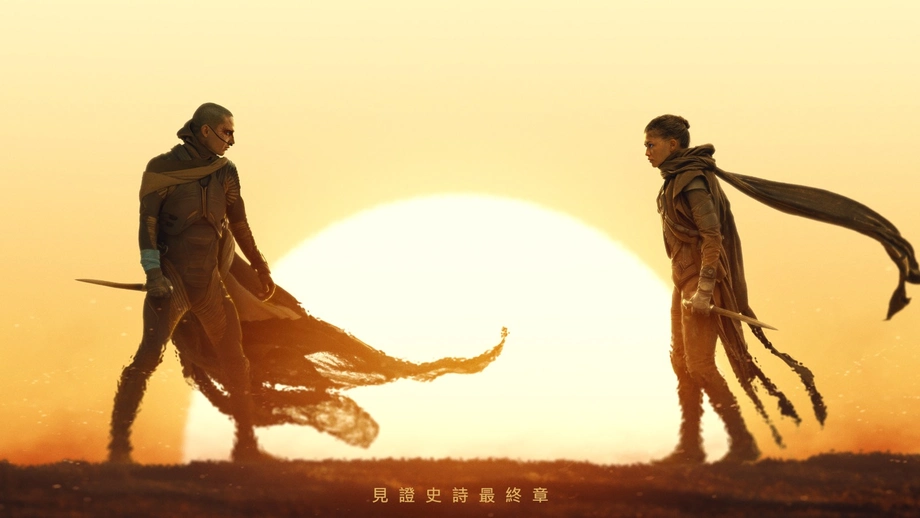
- July 9: A further trailer showed Paul and Chani confronting each other, Jason Momoa's return and another sandworm sequence.
- November 10: The distributor announced Taiwan's move to December 15 and the next advance ticket sale.
- November 13: Taiwan presales resume, while the first two films return to cinemas with a Part Three preview.
- December 15: Part Three opens in Taiwan, with selected European IMAX screenings also listed that day.
- December 18: The film's listed United States opening follows.
IMAX adds film cameras and a taller picture
IMAX says Part Three is the first film in the franchise to be shot partly with IMAX film cameras. Its official film listing names Villeneuve and cinematographer Linus Sandgren and promises more than an hour in the company's expanded aspect ratio.
An aspect ratio describes the shape of a picture. An expanded ratio can show more image vertically on a compatible screen, giving scenes extra height as well as width. IMAX's announcement therefore identifies a specific presentation feature: more than 60 minutes designed to use that expanded image.
Villeneuve describes the approach in a statement published by IMAX:
"Dreamed, designed, and shot" for IMAX.
IMAX also says the sound and score were optimised for its audio technology. Together, those details explain the production's emphasis on a cinema presentation, from how the images were photographed to how music and effects are played back.
The company is selling tickets for selected IMAX 70mm film presentations. Its December 15 listings include London's BFI IMAX and Science Museum, Manchester's Vue Printworks, Kinepolis Brussels, Cinema City IMAX Prague and Pathé Odysseum in Montpellier. Availability varies by country and cinema.
A 107 metre sandworm beside the actors
Robert Pattinson's introduction to the Dune set included a spacecraft mounted on a moving platform, enormous dunes and a sandworm model stretching 107 metres. The physical scale was part of Villeneuve's preference for giving performers substantial surroundings to work with before visual effects extend the finished image.
Pattinson described filming inside the spacecraft while the platform moved beneath it. Such equipment lets a set shift during a scene, giving actors a physical response to the motion their characters are supposed to experience.
The desert environment created its own demands. Pattinson said performers had to work through heat and exposure to the sun while completing scenes among large practical structures. His account places the challenge in both the setting and the machinery surrounding the cast.
Villeneuve's approach combines constructed objects, real locations and digital work. A large model provides surfaces, shadows and a shared point of reference for actors and cameras; visual effects can then extend the creature or landscape beyond what was built.
The spacecraft that needed a crane every two days
A battle on black sand opens Part Three, according to the production team's description. For that sequence, the crew built a spacecraft weighing 55 tonnes, designed so cameras could move around it, and buried the structure in sand.
Artificial rain made the scene more complicated. Water accumulated inside the ship during filming, and the crew had to bring in a large crane every two days to lift the structure and drain it before work could continue.
The arrangement connects the film's visual ambition to a very practical problem. A ship partly buried in wet sand had to look convincing from different angles while remaining usable through repeated filming. Moving the whole structure became part of maintaining the set.
Villeneuve also asked the team to avoid repeating designs from the first two films. That instruction extended to the music, with Hans Zimmer creating a new score. The black battlefield, large spacecraft and revised musical approach are presented as parts of the same effort to give the conclusion its own identity.
Paul's victory becomes the next crisis
Part Three adapts Frank Herbert's Dune Messiah, with Villeneuve and Brian K. Vaughan sharing screenplay duties. The story moves beyond Paul's rise to power and follows him as an established emperor facing rebellion, conspiracy and the human cost of his rule.
A Taiwan report on the distributor's November 2 reissue announcement places the story 19 years after his accession, while English descriptions give intervals of 17 and 12 years. Warner Bros.' official German synopsis places the story almost two decades after Paul Atreides took power over the universe. The exact interval remains unresolved in the release descriptions, but all place the central action years into Paul's reign.
Paul's forces have carried out a brutal holy war against worlds outside his control. A holy war is a conflict fought in the name of religious belief; here, Paul's political authority is bound to the Fremen belief that he is their promised deliverer. Javier Bardem's Stilgar remains a devoted supporter.
Chalamet, who plays Paul, described Herbert's purpose in writing the second novel:
Frank Herbert wrote Messiah to correct the perception that Paul was the hero of the first book.
The earlier films already planted this turn. Paul repeatedly foresaw war and death associated with his rise, then secured his imperial claim through a political marriage that helped drive Chani away. Part Three brings those warnings and decisions into the centre of the story.
Villeneuve has said that familiar characters will return with changed attitudes in a transformed world. His description also points to a different rhythm for the concluding film, as Paul tries to find a way out of violence that his own power has helped sustain.
Chani and Irulan stand at the heart of the conflict
Zendaya returns as Chani, whose relationship with Paul now connects an intimate betrayal to a much larger struggle over the empire. Taiwan's plot descriptions place her in the resistance, setting her against the man she once supported.
The July trailer showed the pair moving between affection and confrontation. It also showed a sandworm pursuing Chani. Those images put her at the centre of both the emotional conflict and the film's large action sequences.
Florence Pugh returns as Irulan, the princess Paul married to strengthen his claim to the throne. Her position gives her proximity to imperial power while placing her inside a dangerous network of political and religious loyalties.
Irulan's fear and involvement in betrayal add another source of pressure on Paul. His marriage may have helped secure the throne, but the household surrounding that throne is now part of the struggle over his future.
Chani's departure at the end of Part Two also gives this adaptation a different starting point from the novel. Villeneuve developed her objections to Paul's rise across the earlier films, making their disagreement part of the story's political argument as well as its romance.
New arrivals change the balance around Paul
Robert Pattinson plays Scytale, a new figure connected to the conspiracy surrounding the emperor. The character is a shapeshifter, introducing a threat built around deception and identity rather than military strength alone.
Jason Momoa returns as Hayt, a clone of Duncan Idaho, the fighter who died protecting Paul in the first film. His return brings a familiar face into Paul's changed world under a new identity. Momoa has described both psychological confrontations and intense physical scenes with Chalamet.
Anya Taylor-Joy takes on the fuller role of Alia Atreides, Paul's sister, following her brief appearance in a vision in Part Two. Rebecca Ferguson returns as Lady Jessica, and Josh Brolin is listed as Gurney Halleck.
Charlotte Rampling returns as Gaius Helen Mohiam, while Isaach de Bankolé plays Farok. Nakoa-Wolf Momoa and Ida Brooke also join the cast. The ensemble combines the family and political figures established in the earlier films with characters central to Dune Messiah's conspiracy.
The United States release is listed as PG-13 for strong violence and bloody images, some strong language and suggestive material. That classification belongs to the American release; Taiwan viewers should check the local rating when choosing screenings for children.
A finale following $1.14 billion at the box office
The first two films earned more than $1.14 billion worldwide between them. The individual totals given for the films are about $411 million for Dune and $715 million for Dune: Part Two.
Using those figures, the second film earned roughly $304 million more than the first, an increase of about 74 percent. The comparison shows how much the audience grew between the opening instalment and its sequel, creating a substantial commercial base for the conclusion.
The films also collected 15 Academy Award nominations and eight wins. Dune received 10 nominations and won six awards, including cinematography, editing, production design, sound, visual effects and original score. Part Two added five nominations and wins for sound and visual effects.
Part Three's United States opening is scheduled against Avengers: Doomsday on December 18. That places two major releases on the same date, while Taiwan's earlier opening gives local audiences access before that American box office contest begins.
Collectors should also distinguish between the Taiwan poster campaign and IMAX's separate filmstrip promotion. The IMAX offer applies to qualifying 7 p.m. screenings at participating locations during December 17 to 20, with one collectible filmstrip per ticket purchase while supplies last. Pickup is in person at the ticketed screening.
For Taiwan viewers, the immediate decisions are more straightforward: whether to revisit the first two films on November 13, which presentation to choose for the finale, and whether a particular cinema's advance ticket package includes the poster they want.
Key Points
- Dune: Part Three opens in Taiwan on December 15, 2026, one day earlier than previously announced.
- The second Taiwan presale begins November 13, with limited promotional posters tied to qualifying purchases.
- The first two films return to Taiwan cinemas on November 13 with a preview of Part Three.
- IMAX confirms partial filming with IMAX film cameras and more than an hour of expanded aspect ratio footage.
- The production includes a sandworm model measuring 107 metres and a spacecraft set weighing 55 tonnes.
- The story adapts Dune Messiah and follows Paul confronting rebellion and the consequences of imperial rule.
- The listed United States release is December 18; selected European IMAX cinemas also list December 15 screenings.