A Viral Hit Returns With New Faces and More Clothes
INMU KING, the Japanese meme song that drew nearly 30 million YouTube views before its removal, returned in a revised version on November 8, 2026. The new video changes sensitive lyrics, puts shirts on previously bare chested dancers and gives two familiar Taiwanese characters a larger role: Jie Ge and A Wei, from an educational film about sexual assault.
Contents
- A Viral Hit Returns With New Faces and More Clothes
- From an August Release to an October Removal
- What Changed in the Revised Video?
- Why Jie Ge and A Wei Matter to Taiwanese Viewers
- The Educational Film Began in 2010, Not 2013
- Taiwanese Officials Had Already Warned About Remixes
- Can the New Upload Stay Online?
- Key Points
The creator, known as Yajuman or YAJU-MC and using the account @yjmnsub3, released the revision after the original was removed on October 22. The stated reason for the removal was a violation of YouTube's rules on nudity or sexual content. The replacement attracted more than 400,000 views within its first day.
The Taiwanese characters appear alongside Yaju Senpai, the central figure in the Japanese meme culture behind the song, at the headquarters of O-Bank in Taipei's Neihu district. Their appearance brings together two internet traditions with very different beginnings: Japanese memes drawn from adult entertainment and a Taiwanese classroom film intended to help young people recognize sexual abuse.
The revised video also rearranges appearances by political leaders, changes vehicles and adds a resurrection scene. Its central tune and much of its structure remain intact. The creator's challenge is to preserve the elements viewers recognize while changing material that may attract another removal.
Yajuman has put the chance of the revised upload being removed at about 50%. That is the creator's personal estimate; YouTube has given no public assessment of the replacement video's prospects in the information accompanying its return.
From an August Release to an October Removal
INMU KING first appeared in August 2026 and spread through its repetitive melody, dance sequences and dense collection of internet references. Its imagery draws on memes associated with the Japanese adult video series A Midsummer Night's Lewd Dream, often referred to through the term Inmu.
Yaju Senpai, whose name is commonly translated as Beast Senior, became a recurring character in that meme culture. INMU KING places him in increasingly exaggerated scenes, combining familiar figures, dance routines and political imagery. Recognizing every reference is not necessary to follow the music, which helps explain how a song built around a specific Japanese internet community could reach viewers elsewhere.
Before its removal, the video had accumulated nearly 30 million views and appeared in the top 20 of Oricon's Japanese YouTube ranking for five consecutive weeks. Those figures show both a large audience and sustained attention beyond a brief burst of sharing.
The main dates trace a relatively short rise, interruption and return:
- August 2026: The original INMU KING video was uploaded.
- October 22, 2026: YouTube removed the original video.
- November 8, 2026: Yajuman released the revised version.
- Within the first day: The replacement passed 400,000 views.
The original's nearly 30 million views were accumulated over a much longer period than the replacement's opening day. The immediate question for its audience is whether the revised upload can stay available long enough to build on that early interest.
What Changed in the Revised Video?
Yajuman made changes to both the soundtrack and the animation. A Japanese lyric referring to rape is now censored, and beeps cover another expression associated with adult videos. The chorus remains substantially unchanged, preserving the most recognizable part of the song.
The dancers have also been altered. Muscular figures who previously appeared partly undressed now wear T-shirts and jeans. These edits address the sexual language and exposed bodies that the creator believes could attract moderation, while leaving the dance sequences in place.
Several changes are less about reducing explicit content than refreshing the spectacle. The car at the beginning changes from a Toyota Crown to a Toyota Century. A figure known as KBTIT disappears, while other meme characters, including Ippan Tsuuka Jii and NSOK, are added.
A dance sequence at a scramble crossing joins the revised imagery. Another new scene places Yaju Senpai in a coffin before he rises again, turning the video's return into part of its own story. For viewers familiar with the original, the replacement offers both recognizable material and new details to spot.
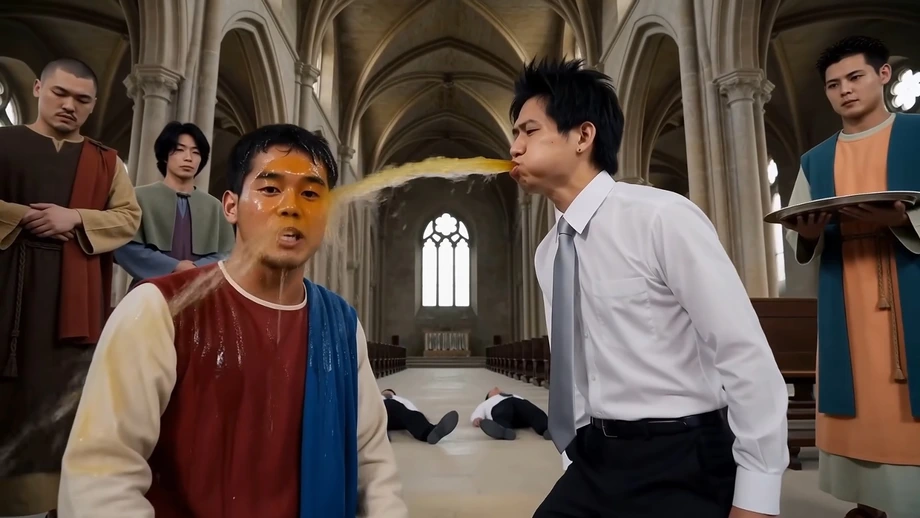
The political scenes have been reorganized, too. An earlier sequence involving leaders from Japan, the United States and North Korea gives way to a crowd dancing in Shinjuku. Those leaders still appear elsewhere, gathered in a church enthronement sequence. South Korean President Lee Jae-myung is among the additions, while another new figure appears to depict Taiwanese President Lai Ching-te.
Why Jie Ge and A Wei Matter to Taiwanese Viewers
Jie Ge and A Wei come from the Taiwanese educational short If Only I Had Known Boys Could Also Be Sexually Assaulted. The film became widely recognizable online through a line in which A Wei asks Jie Ge to stop. That plea later circulated as the Jie Ge Don't meme, detached in many remixes from the film's educational setting.
The revised INMU KING gives the pair a more prominent appearance. Previously treated as background references, they now appear alongside Yaju Senpai at O-Bank's headquarters in Neihu. The Taipei location makes the Taiwanese connection visible through both the characters and a specific place.
The combination follows the video's broader approach: take figures that an online audience already recognizes and place them together in an unexpected scene. A viewer familiar with the Taiwanese film may recognize Jie Ge and A Wei immediately, while a Japanese viewer may first recognize Yaju Senpai.
The characters' origins also make their appearance more complicated than a routine cameo. Their fame began with a film about a boy being sexually assaulted, created to teach students about danger, respect and seeking help. The meme preserves the characters' names and faces while giving them a very different setting.
The Educational Film Began in 2010, Not 2013
Taiwan's Ministry of Education commissioned the National Academy for Educational Research to produce the short for gender equality education. Although the film is often associated with 2013, a July 13, 2013 account of the ministry's response to its online popularity dates its origin to 2010, or year 99 in Taiwan's calendar.
Coverage published on July 14, 2013 also recorded the production timeline. Guo Gongbin, then chief secretary of the National Academy for Educational Research, said production of the gender equality education film series had begun three years earlier and that the films had been distributed on discs to junior and senior high schools as teaching materials. He said the film's online popularity was unexpected and that teachers should follow a screening with 20 to 30 minutes of discussion to convey a complete understanding of gender equality.
That timing matters because the educational film was already in use before its dialogue became a widely shared internet reference. Its classroom purpose came first; its later popularity brought a new audience that might encounter a joke or remix before seeing the complete story.
Liu Zhongcheng, then director of the ministry's Department of Student Affairs and Special Education, explained that the film addressed a basic point: males can also experience sexual harassment and assault. He said it encouraged victims to face what had happened, seek help and use the support channels identified in the film.
Liu also described the teaching requirements in place at the time under Taiwan's Gender Equity Education Act. Students in junior high school and below were required to receive at least four hours of gender equality education each semester. At senior high and vocational schools, the teaching was incorporated into the health and physical education curriculum.
Taiwanese Officials Had Already Warned About Remixes
Huang Hsin-fa, then deputy director of the Ministry of Education's K-12 Education Administration, addressed the film's internet popularity in 2013. He said experts and scholars had reviewed the educational video and that it was designed to teach children to protect themselves and respect others.
Huang's concern was that online adaptations could move away from that purpose. Young viewers encountering altered versions might come away with a mistaken impression of the original story. His warning now has renewed relevance as the characters appear in a music video drawing on another country's meme culture.
The ministry's explanation was broader than a message aimed only at boys. Officials described sexual violence prevention as a matter affecting people of every gender, with assistance available through government agencies and civil society organizations.
For an audience discovering Jie Ge and A Wei through INMU KING, that history supplies an essential part of the reference. The original film's subject was a victim's experience and access to help. Its later internet fame developed around a short, memorable line from that story.
Can the New Upload Stay Online?
Yajuman's revision targets two visible features of the removed version: sexual wording and partially undressed bodies. The creator has described those changes as an attempt to avoid problems with YouTube's automated review, but the precise process behind the October removal has not been publicly explained.
YouTube can use automated systems and user reports to identify content for moderation. An upload may attract attention through its audio, images or the context in which they appear. For the creator, replacing a lyric or adding clothing is a practical response to that uncertainty.
The continuing appearances by political leaders also clarify what the revision preserves. Those figures have largely been moved or expanded rather than removed. The new video retains its exaggerated political spectacle while making more direct changes to sexual language and clothing.
The replacement's first 400,000 views show that an audience was ready to return. Its longer life on the platform will determine whether those viewers can continue sharing the creator's revised upload. For Taiwanese viewers, the new version also brings an old educational film into another international wave of internet attention, carrying its characters much farther than the classroom setting for which they were created.
Key Points
- INMU KING returned on November 8, 2026, after YouTube removed the original on October 22.
- The original approached 30 million views and spent five consecutive weeks in Oricon's Japanese YouTube top 20.
- The revision censors sexual language, adds clothing to dancers and rearranges political cameos.
- Taiwanese characters Jie Ge and A Wei receive a larger role in a scene at O-Bank's Taipei headquarters.
- Their educational film originated in 2010 and became widely discussed online in 2013.
- The revised upload passed 400,000 views in its first day; the creator estimates a 50% chance of another removal.