A Taiwan studio at the centre of Weta's expansion
Weta FX plans to acquire a significant stake in Taiwan's Moonshine Studio as part of a partnership with the Taiwan Creative Content Agency (TAICCA) that combines visual effects investment, artificial intelligence development and training for Taiwanese filmmakers.
Contents
- A Taiwan studio at the centre of Weta's expansion
- What the Moonshine investment would change
- Three connected parts of the partnership
- Why Weta chose Taiwan
- Clients are changing their demands on AI
- What Weta says AI will do inside production
- Taiwan's language and the origins of AI images
- Internships and a route into international production
- A cultural ambition beyond supplying effects
- Key Points
The New Zealand company behind visual effects for The Lord of the Rings and Avatar is conducting due diligence on the proposed investment. Moonshine, founded in 2012 by Lin Chia Chi, has worked on Taiwanese productions including 96 Minutes, Incantation and The Bridge Curse.
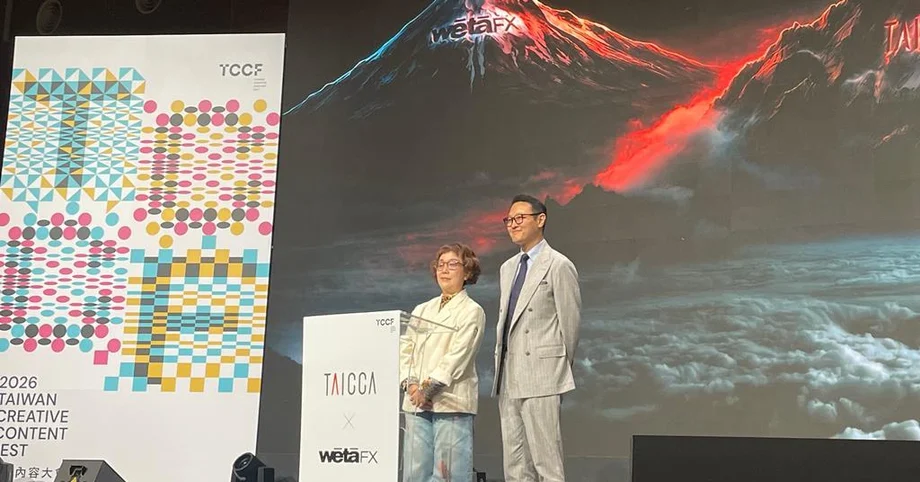
Weta FX chief executive Daniel Seah and TAICCA chair Sue Wang signed a memorandum of understanding at the opening of Taiwan Creative Content Fest (TCCF) in Taipei on November 6, with Culture Minister Li Yuan attending. The festival ran from November 6 to 9 at Nangang Exhibition Center, Hall 2.
The agreement sets out an ambition to make Taiwan an AI hub for Asia's content industries. Its practical foundations are broader than AI alone: a local studio investment, a platform supporting Taiwanese film and television, and opportunities for young filmmakers to work with Weta's international teams.
The investment amount, ownership percentage, financial commitment from the government and completion date were not disclosed. Due diligence is the examination of a company's finances and operations before an investor completes a deal.
What the Moonshine investment would change
Moonshine is intended to become Weta's Taiwan outpost, connecting an established local effects company to a network that includes Wellington, Melbourne and Vancouver. Weta also envisages a representative office in London and has mentioned Singapore, Thailand and South Korea as possible future locations in Asia.
Seah said discussions about investing in Moonshine had been underway for about six months. During that process, Lin travelled to Wellington and met director James Cameron to introduce his company.
Wang described Moonshine as Taiwan's leading visual effects house and spoke about the financial pressure on its team. Her concern connected the investment to a practical problem: how a studio with strong creative work can earn enough to sustain and develop its business.
For Moonshine, the proposed relationship would bring access to Weta's production experience, technology and industry connections. For Weta, it would provide a base with an existing team and credits in Taiwanese cinema, rather than requiring it to build a local operation from the beginning.
Three connected parts of the partnership
Weta and TAICCA have outlined three strands: investment in Moonshine, AI research and training, and support for Taiwanese content and talent across production, postproduction and visual effects.
A planned joint venture platform would identify Taiwanese projects and help bring their technical execution to the standards expected of leading international films and television. The partners also hope to establish a brand for joint productions, invest in individual projects and use Weta's global relationships to reach wider audiences.
TAICCA wants Taiwan's film and television businesses to gain the scale needed to compete internationally. The proposal connects money, production tools and professional development, giving projects support at several stages rather than concentrating solely on a finished film's effects.
The sequence described by the partners is:
- About six months before the signing: discussions began over an investment in Moonshine.
- During preparations: Moonshine founder Lin Chia Chi visited Wellington and introduced his studio to James Cameron.
- November 6: Seah and Wang signed the memorandum at the opening of TCCF in Taipei.
- After the announcement: Weta continued due diligence, while the partners outlined plans for technology development, exchanges and eventual project investment.
Why Weta chose Taiwan
Seah pointed to Taiwan's combination of semiconductor production, engineers, creative talent and government backing. Taiwan's location also places it within a few hours' flight of many cities in the region, making it a practical base for exploring East Asian business.
Seah, who was born in Malaysia and grew up in New Taipei's Yonghe district, explained why those strengths mattered to Weta's plans.
Taiwan really benefits from its technology and the success of its semiconductor industry," Seah explained. "With the government's endorsement, and the level of talents that we have in Taiwan, both engineers and storytelling creatives, we felt this was the perfect spot for exploring the East Asian market.
Taiwan's chip industry supplies the computing foundations on which AI depends. The partnership aims to connect that technical capacity with people who write stories, build digital environments and produce films. Weta would contribute the experience of turning creative ideas into work delivered for international productions.
Government investment provides another part of the setting. Taiwan's content industries are receiving a second National Development Fund tranche of NT$10 billion, approximately US$303 million. Wang called the Weta agreement one of TAICCA's biggest alliances in the content sector.
That NT$10 billion supports the wider content industries. The budget for the Weta partnership itself remains undisclosed.
Clients are changing their demands on AI
Seah said Weta's search for an AI partner had accelerated as major studios and streaming platforms changed their requirements. Clients that had initially prohibited generative AI began allowing it with advance approval, then asked suppliers to explain their AI strategies and potential savings.
Generative AI creates material, such as images or text, from patterns learned during training. In film production, the questions extend beyond what a tool can create to whether its use meets a client's production requirements and approval process.
Seah described the latest shift in client expectations as a direct business pressure on suppliers.
Now it's like, if you don't have an AI strategy, we don't want to work with you. That's why in the last couple of months we've been looking for a partner to pick up the pace as soon as possible.
His account helps explain why Weta's plans combine a studio investment with technology research. The company is seeking a production base while also responding to customers who increasingly expect AI to form part of how their work is delivered.
What Weta says AI will do inside production
Weta chief technology officer Kimball Thurston said the company's internally developed AI models and tools from outside suppliers are mainly being used to improve production workflows and assist filmmaking that captures performances and physical environments.
Thurston described a focus on helping artists record and work with the three dimensional world, building on Weta's longstanding attention to physical accuracy. Capturing more information about a scene can give artists more material to adjust when constructing the final image.
Thurston said storytelling remains the central task for people, even as the methods used to make images change.
"Humans tell stories, and that's always core to us. But we do see workflows changing," Thurston said.
He said the tools are chiefly intended to support employees rather than replace them. His description places AI within a larger production process: people capture performances and environments, artists make creative decisions, and technical systems help them carry out the work.
The training component of the Taiwan partnership follows that approach. Filmmakers would need to understand how to use new tools alongside existing production skills, while continuing to make decisions about the story and the images an audience sees.
Taiwan's language and the origins of AI images
Wang connected the partnership's AI ambitions to Taiwan's efforts to develop sovereign AI models. These are models developed under local direction to reflect local priorities, including language and culture.
She said Taiwan is developing models that use traditional Chinese characters, rather than the simplified characters used in mainland China. Wang linked that work to preserving Taiwan's cultural diversity, while acknowledging that Chinese AI models were already mature and that Taiwan faced obstacles.
Weta is also examining how to track the images used to train AI systems. Thurston said the company had launched an open source project to record model training and understand where training images come from.
The technical term is provenance: a record of an image's origin and history. For a creative business, knowing which images went into training a model gives artists and clients a clearer account of the material behind the tool.
Thurston said Weta is also exploring alternatives to data centres that consume large amounts of electricity. Together, those research interests show that the proposed AI work includes the information used to build models and the computing resources required to operate them.
Internships and a route into international production
Seah described talent development as the part of the partnership he values most. Taiwanese professionals already work at Weta in Wellington, and the company aims to offer internships at its locations around the world.
The proposed programme would allow young Taiwanese filmmakers to take part in exchanges and projects with Weta, with possible opportunities for later employment. The scope reaches beyond AI specialists to people working across production, postproduction and visual effects.
For participants, the opportunity would be direct exposure to how an international effects company organises projects, applies its technology and delivers work for clients. For Taiwanese productions, the intended benefit is access to people who can bring that experience into local work.
Seah used Wellington as an example of what a sustained production industry can mean for a place. He said Weta's employees account for around 2% of the city's population and credited government support with helping the company develop.
Seah, Weta's chief executive, argued that Taiwan could build on a similar combination of people, technology and public support.
Over the past 30 years, Weta turned Wellington from a political capital into such an important global production base," Seah said. "We think Taiwan has even more of that opportunity.
A cultural ambition beyond supplying effects
Culture Minister Li Yuan brought a personal history to the signing. He recalled joining Wang Film Productions at 37 with hopes of making original animation, then abandoning that ambition two or three years later when much of Taiwan's animation business centred on producing work for others.
Li said cultural technology and AI would be priorities for the Ministry of Culture over the next four years. His remarks placed the Weta partnership within a longer effort to help Taiwanese creators make their own work and gain access to international production opportunities.
The project combines two ambitions: strengthening a Taiwanese company that already supplies visual effects, and supporting Taiwanese stories through investment, technical development and wider distribution opportunities. Its next practical steps are the completion of investment discussions and the development of the proposed programmes.
Key Points
- Weta FX plans a significant investment in Moonshine Studio, with due diligence underway.
- Weta and TAICCA signed a memorandum on November 6 at Taiwan Creative Content Fest in Taipei.
- The partnership covers studio investment, AI development, Taiwanese content and talent training.
- Moonshine is intended to become Weta's Taiwan outpost within its international network.
- Planned exchanges and internships would give Taiwanese filmmakers access to Weta's teams worldwide.
- The investment value, ownership percentage and completion date have not been announced.