Two digital banks move toward a wider Apple Pay market
KakaoBank and Toss Bank are preparing to bring their debit cards to Apple Pay in South Korea, potentially opening the service beyond Hyundai Card for the first time since its March 2023 launch. KakaoBank could move first, while Toss Bank is pursuing a launch during 2026 after previously putting its plans on hold.
Contents
- Two digital banks move toward a wider Apple Pay market
- A merchant notice offered a glimpse of the preparations
- Approval has repeatedly come before a delay
- What customers would gain
- KakaoBank already has a large debit card business
- How a small fee becomes a large business decision
- Samsung's much larger payment base shapes the debate
- Compatible checkout equipment remains another cost
- Regulators are watching consumer costs
- Key Points
The Financial Supervisory Service completed its review of Toss Bank's Apple Pay terms in January 2026. KakaoBank's review is nearing completion, and both banks have reportedly finished technical preparations. Their entry would allow customers to add eligible bank debit cards to Apple Wallet rather than obtain a Hyundai Card specifically to use the service.
Neither bank has publicly committed to a firm launch date. KakaoBank says it is reviewing the possibility of introducing Apple Pay, while Toss Bank says it cannot officially confirm details. Earlier preparations at other financial companies have stretched well beyond regulatory approval, making the remaining commercial decisions central to the timetable.
The attraction is straightforward: easier payments for iPhone users and a chance for banks to win more everyday spending. The difficulty is equally concrete. Apple reportedly collects about 0.15% of each transaction from participating card companies, and the industry fears that wider adoption could prompt Samsung to seek domestic transaction fees too.
For customers, the outcome could be more choice at the checkout, accompanied by pressure on the points, discounts and cashback that help determine which card they use.
A merchant notice offered a glimpse of the preparations
KakaoBank's work became visible when Toss Payments sent a notice to merchants served through KB Kookmin Card, which processes KakaoBank debit card payments. The notice said KakaoBank debit cards would become available for registration in Apple Pay and specified November 6 as a start date.
Toss Payments later withdrew the notice, describing the work as a technical test and saying there had been confusion over the timing. Toss Payments, the payment processing company involved in the notice, is separate from Toss Bank, which is preparing its own Apple Pay service.
The merchant instructions reveal a practical task behind the expansion. Toss Payments asked businesses to check whether their payment systems contained special rules that automatically handled every Apple Pay transaction as a Hyundai Card payment. Those rules may need updating when another issuer joins.
KakaoBank's connection with KB Kookmin Card also explains why preparations can involve several companies. A customer sees a bank's name on the card, but another company may handle the merchant side of the payment. Launching a wallet service requires those systems to work together.
Approval has repeatedly come before a delay
Toss Bank's earlier pause shows how far a launch can travel before being stopped. The bank applied for a review in November 2025 and received approval in January 2026, but reportedly deferred a planned March launch for business reasons. More recent preparations point to a renewed effort to introduce the service.
Shinhan Card has faced a longer wait. It received approval in December 2024, yet its launch has been delayed for more than a year while it considers timing and profitability. It has also reportedly submitted revised terms. KB Kookmin Card and BC Card are pursuing their own preparations, with descriptions of KB's review ranging from ongoing to completed as those plans developed.
The sequence of regulatory and commercial milestones helps explain why expectations have repeatedly risen without another provider beginning service:
- December 2022: Hyundai Card completed the regulatory review of its Apple Pay terms.
- March 2023: Hyundai Card launched Apple Pay in South Korea.
- August 2024: KB Kookmin Card advertised for staff to build its Apple Pay service, then removed the listing.
- December 2024: Shinhan Card received approval for its terms.
- November 2025: Toss Bank applied for its terms review.
- January 2026: Toss Bank received approval, before later postponing its planned launch.
Regulatory review covers the service's terms. Financial companies must still settle contracts, payment processing arrangements, equipment investment and the business case for opening the service to customers.
What customers would gain
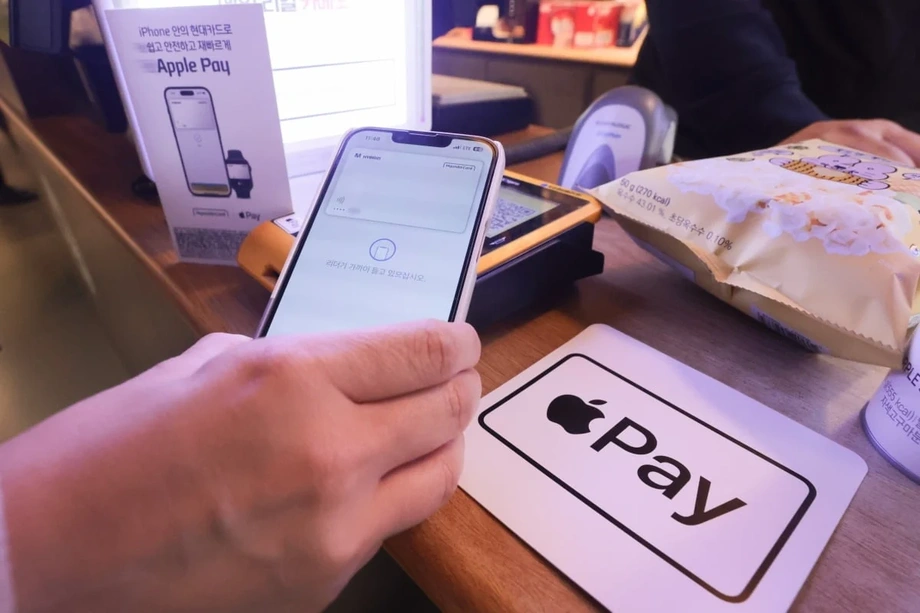
Eligible KakaoBank and Toss Bank debit card customers would be able to register their cards in Apple Wallet and make payments with an iPhone or Apple Watch. At a compatible terminal, they could pay without taking out the physical card or opening a separate payment app.
A debit card draws money from its linked bank account, making the proposed expansion relevant to customers who prefer spending their existing balance rather than using credit. The banks are particularly interested in people in their 20s and 30s, an audience they see as strongly attracted to iPhones.
Overseas spending is another incentive. Apple Pay can be used at compatible contactless terminals abroad. Hyundai Card recorded 3.9379 trillion won in overseas credit card sales in 2025, placing it first in the industry for a third consecutive year. Rivals see access to that spending as one reason to join.
Hyundai Card has continued to compete through its own products, including a debit card offering 10% cashback on Apple Pay purchases. The arrival of more issuers would shift competition toward the combination of wallet access, rewards and account services, rather than access alone.
KakaoBank already has a large debit card business
KakaoBank would bring an established payment base to Apple Pay. Its debit card spending reached a quarterly record of 6.3 trillion won in the second quarter cited in its expansion plans, while cumulative spending reached 154.8997 trillion won by the end of that first half.
The bank's Friends debit cards had passed 31 million cumulative issuances by the end of 2024. That total includes replacements and multiple cards issued to the same person. KakaoBank has said those counting issues are a reason it no longer separately publishes the cumulative issuance figure.
For the bank, making an existing card easier to use could encourage customers to keep more of their daily spending money in its linked account. More debit card spending could also generate additional fee income, although Apple Pay would add costs to those transactions.
KakaoBank's product expansion includes The Check Card, launched on October 14, and preparations for a foreign currency debit card targeted for December. Apple Pay fits that effort to make payments a larger part of the bank's business alongside lending.
How a small fee becomes a large business decision
Apple's reported Korean transaction fee of about 0.15% would amount to 30 won on a purchase of 20,000 won. International card network charges can add to the expense. An illustrative estimate puts the combined cost at about 60 won, or 0.3% of that purchase.
Rep. Kim Yong-man of the Democratic Party of Korea has also cited a fee of 1,000 won for each card registered and security processing costs of about 29 won per transaction. The exact bill for a participating company would depend on its contracts and the charges applying to its cards.
The reported Apple rate in Korea is three times the 0.05% rate cited for China. Card companies are weighing those expenses while facing pressure from lower merchant fees and higher funding costs. An industry representative said more than 90% of merchants receive preferential processing rates, leaving little room to absorb another charge on some purchases.
Earlier financial figures illustrate why sales volume matters differently from profit. Hyundai Card led eight major card companies with 14.32 trillion won in credit sales in January 2025. A separate financial snapshot put its cumulative net income through the third quarter of the preceding year at 240.1 billion won, below Shinhan Card's 552.7 billion won, Samsung Card's 531.5 billion won and KB Kookmin Card's 370.4 billion won. Each issuer must weigh the revenue from additional spending against its own costs.
Samsung's much larger payment base shapes the debate
Samsung has not charged Korean card companies domestic transaction fees for Samsung Pay, now part of Samsung Wallet, since the service began in 2015. Its arrangements began with fee free agreements involving 10 card companies and the Korea Credit Finance Association, before shifting to individual company contracts.
Samsung has announced no official decision to introduce domestic transaction fees. Card companies nevertheless worry that paying Apple while Samsung remains free could change negotiations with the Korean technology company.
Figures attributed to the Bank of Korea and Samsung Electronics put South Korea's simplified payment market at about 350 trillion won in 2024, including 88 trillion won through Samsung Pay. Using those figures, Samsung Pay represented roughly a quarter of the total, making even a small percentage charge commercially important.
Applying a hypothetical 0.15% fee to 88 trillion won produces 132 billion won a year, close to the industry estimate of 130 billion won for a possible Samsung charge. A broader industry estimate puts potential combined costs from Apple Pay and Samsung Pay above 1 trillion won annually. That larger projection covers a wider fee scenario than the estimate focused on Samsung's existing payment volume.
Toss Bank also depends on relationships beyond its own balance sheet. Both its debit card and its affiliated Toss Bank Hana credit card use Hana Card's payment network. Decisions about wallet support therefore involve the interests of a partner as well as those of the bank.
Compatible checkout equipment remains another cost
Apple Pay requires terminals with near field communication, or NFC, that meet the EMV international payment standard. NFC lets a phone or watch exchange payment information with a nearby reader. Merchants need compatible equipment for the tap to work.
An earlier industry estimate put the share of Korean card merchants with NFC terminals at only about 10%. That estimate describes the infrastructure at the time it was made; the practical issue for an expanding service is how many businesses customers can actually pay at.
Hyundai Card helped deploy NFC terminals at major franchises and large merchants when it introduced Apple Pay. Potential entrants reportedly face expectations to support infrastructure investment on a comparable scale, adding an expense before new transaction revenue arrives.
South Korea's mobile payment spending has been growing. Average daily payments rose from 799.1 billion won in 2022 to 923.2 billion won in 2024, an increase of about 15.5%. More issuers could compete for that expanding activity, but useful coverage at everyday shops will remain part of the calculation.
Regulators are watching consumer costs
Financial Supervisory Service Governor Lee Chan-jin has warned that new charges to card companies could ultimately reach consumers. Card companies could respond through reduced points, smaller discounts or less generous cashback, affecting customers even if no separate wallet fee appears on their statement.
The regulator has discussed the issue with payment officials from eight dedicated card companies and described Samsung Pay as close to a public utility because of its widespread use. Samsung's pricing remains a commercial matter, and financial authorities have said their ability to intervene directly is limited.
Lee Chan-jin, the Financial Supervisory Service governor, described the review under way:
We are examining specific issues related to fees and will consult with the FSC once our review is complete.
Financial Services Commission Chairman Lee Eog-weon has also acknowledged limits on intervention in negotiations between companies, while pledging to seek ways to improve payment convenience.
At an October 22 National Assembly audit, Rep. Kim Yong-man, a Democratic Party lawmaker, drew a comparison with neighboring markets:
More than 200 financial firms in Japan and over 100 in China offer Apple Pay, but Hyundai Card is the only one in Korea. The service remains limited here.
KakaoBank and Toss Bank could widen that access. Their commercial terms, merchant readiness and decisions about customer benefits will determine how useful and affordable the expansion becomes for the people using it.
Key Points
- KakaoBank and Toss Bank are preparing Apple Pay services that could end Hyundai Card's position as South Korea's sole participating issuer.
- Toss Bank received approval for its terms in January 2026 but previously postponed a planned launch. KakaoBank's review is nearing completion.
- Eligible debit cards would let customers pay through Apple Wallet using an iPhone or Apple Watch at compatible terminals.
- Apple's reported transaction fee is about 0.15%, with other processing costs potentially adding to the bill.
- Samsung has announced no domestic transaction fee, but card companies are concerned about possible future charges.
- Regulators are examining whether higher payment costs could lead to reduced rewards or other burdens for consumers.