A village teacher finds a classroom again
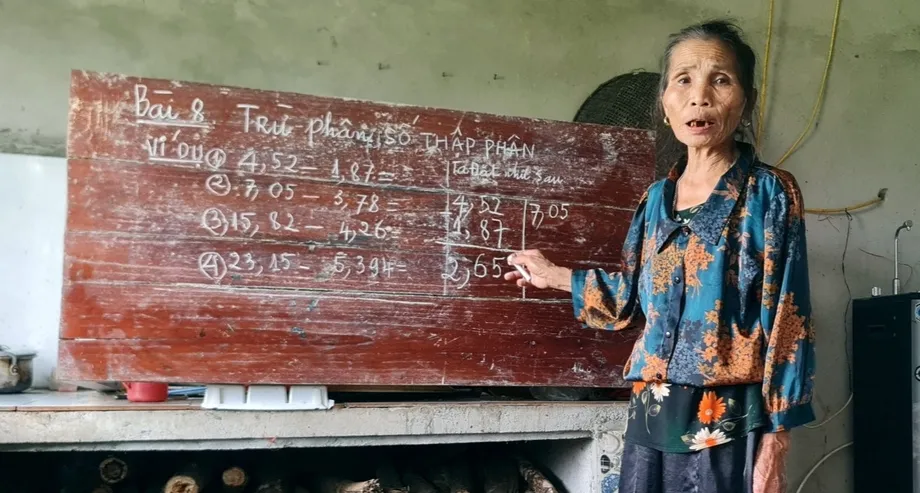
Bùi Thị Mỹ, a 74-year-old former teacher from Vietnam's Mường ethnic community, is giving free maths lessons from a kitchen in Xuân Tiến village, Xuân Du commune, Thanh Hóa province. Her board is a wooden tabletop turned upright. Her youngest son records her with a phone. Some videos have attracted hundreds of thousands of views, and one has exceeded 3 million.
Contents
The lessons last a full 45 minutes, much like a school period. Mỹ writes with chalk, explains each step and imagines pupils sitting beyond the phone. More than three decades after leaving formal teaching in 1990 because her family could not manage financially, she has found another way to stand before a class.
Her son, Bùi Văn Dũng, born in 1995, uploads the recordings to a Facebook account named "Bùi Mỹ". The project began as a way to preserve his mother's lessons and share them with people they knew. Nearly two months into filming, the audience had grown far beyond their village.
Mỹ does not use social media herself. She uses a telephone to make and receive calls, leaving the recording and posting to Dũng. Her reason for teaching again is simpler than the viewing figures suggest: she misses the work, the children and the familiar rhythm of explaining a problem until it makes sense.
A phone on a plastic box
Dũng's recording equipment consists of a phone propped on a plastic box. He stands the old tabletop in a corner of the kitchen, where his mother can write on it. A small speaker sits nearby, while firewood shares the space with the makeshift classroom.
Mỹ, explaining how the kitchen became a teaching space, described her son's solution:
There is no blackboard at home, so my son stood a wooden tabletop upright and put it in the kitchen corner for me to write on with chalk and teach.
Mỹ usually begins around 8 a.m., depending on her health and household responsibilities. She sometimes teaches barefoot. There are no rows of desks or pupils waiting to raise their hands, but she follows the classroom routine she remembers.
Dũng initially recorded the lessons for enjoyment and as a keepsake. Only a small circle watched at first. As the recordings spread, a private family activity became a public return to teaching, with Mỹ supplying the knowledge and her son handling the technology.
What she teaches, step by step
Mỹ's lessons cover adding and subtracting fractions, subtracting decimals, solving linear equations with one unknown, and familiar algebraic identities. A linear equation with one unknown is a problem in which a learner works out the value of a missing number. Algebraic identities are rules showing that two expressions have the same value.
One widely watched recording deals with adding fractions by finding a common denominator, a topic taught in Grade 6. The denominator is the number below the fraction line. Making denominators match allows a pupil to add amounts expressed in equal sized parts.
Mỹ writes out the changes before completing the addition. Her usual sequence is to introduce an example, revisit earlier knowledge and then move to the new material. The lesson unfolds through the working, rather than jumping straight to the answer.
Mỹ, explaining why she gives each lesson the time of a full school period, put her approach plainly:
If you do it carelessly, pupils cannot understand the lesson.
Her teaching also draws on memory. She says the knowledge has stayed with her so strongly that standing before the board brings it back without a written lesson plan. For viewers, the appeal includes both the mathematical explanation and the familiar sight of a teacher patiently writing and speaking at the same time.
A growing audience brings a concern
Mỹ and Dũng were surprised by the attention. Videos that began with a few familiar viewers reached hundreds of thousands of views, with one passing 3 million. The growing audience also made them anxious about how lessons learned decades ago fit today's schools.
Dũng, who records and publishes the videos, explained their concern about changes to the curriculum:
Both my mother and I are worried. Education has changed now, and we do not know whether her lessons are still suitable and accurate for the current curriculum.
Mỹ has also told viewers that she is revisiting the knowledge she learned and taught in the past. Her purpose is to remember her working life and enjoy teaching again. The family has not given a fixed timetable for future recordings; sessions depend on her health and work at home.
Bùi Thị Tuyết, the head of Xuân Tiến village and one of Mỹ's former pupils, says children still find her explanations helpful even when her approach differs from their current lessons. Her assessment comes from years of watching village children turn to their former teacher for help, long before the videos attracted a large audience.
From teacher training to the classroom
Mỹ was born in 1952. Her father died when she was young, and her mother raised her and supported her schooling. After completing Grade 7, she entered the Ngọc Lặc 7+3 teacher training school in 1972, specialising in mathematics and physics.
The programme's name described its structure: students who had finished Grade 7 received another three years of subject instruction and training in how to teach. Mỹ graduated in 1975 and was assigned to Cát Vân lower secondary school in the former Như Xuân district. She later transferred to the lower secondary school in Xuân Du.
Mỹ describes her classroom career as lasting 15 years, consistent with the period from graduation in 1975 to leaving in 1990. Her service at Xuân Du has also been described as lasting 18 years, leaving the precise length of that posting uncertain.
The main stages of her journey are:
- 1952: Mỹ was born and later grew up with her mother after her father's death.
- 1972: She entered teacher training at Ngọc Lặc after completing Grade 7.
- 1975: She graduated in mathematics and physics and began teaching in Như Xuân.
- 1990: She left formal teaching and took a single departure payment because of family hardship.
- More than three decades later: She and Dũng began recording lessons at home, with the project running for nearly two months when it drew widespread attention.
Why she had to leave teaching
Mỹ's monthly teaching salary during Vietnam's period of rationing and state subsidies was 45 đồng. She had to walk to Yên Cát town to collect rice and ration coupons, which were used to obtain basic necessities.
Her husband, a former soldier, was frequently ill. Her family is described as having seven children, while Mỹ recalled having five children when she left teaching in 1990. Feeding and caring for the household required work beyond her school duties.
Mỹ sometimes carried a knife when she went to school so she could gather firewood in the forest after lessons. At home, she bundled wood, cooked and prepared teaching plans, sometimes staying up until 10 p.m. or midnight. She carried wood to market to exchange it for rice, sweet potatoes and maize.
By 1990, the household's needs had become too difficult to meet on her salary. She applied to leave and receive her departure benefits in a single payment so she could concentrate on earning a living.
Mỹ, recalling what she missed after leaving, described the loss through the voices of her pupils:
I missed the pupils, missed the days standing before the class, and the times when they asked me questions.
She sometimes dreamed that she was back at school teaching. Each year, she looked forward to November 20, Vietnam's Teachers' Day, as an opportunity to visit former colleagues. She also remained involved with the association for former teachers.
Village children never stopped coming
Tuyết says Mỹ was once a well known maths teacher locally. After leaving her school post, she continued helping children in the village without charging them. Pupils brought problems to her home, keeping a small but steady connection between the former teacher and the classroom.
Sometimes, Tuyết recalled, children arrived just after Mỹ had returned from catching crabs. Before she had time to change her clothes, she would begin explaining their schoolwork. Teaching fitted around the tasks needed to keep the household going.
Tuyết, speaking as village head about the help children receive, described why they still seek Mỹ out:
There are problems the children do not understand, so they run over to ask her to explain. Although her way of teaching is somewhat different from today, many children still find it easy to understand.
For Tuyết, the recordings also bring back her own schooldays. The voice and the way Mỹ stands at the board are familiar. The teacher now seen by a large online audience is the same person village families have continued to rely on for years.
Recognition alongside continuing hardship
Mỹ's household still faces serious financial difficulty. According to Tuyết, the family moved from the near poor category in the previous year to the poor household category in the current assessment. Mỹ is also caring for a young grandchild whose father died from illness and whose mother has left.
The village head says Mỹ continues teaching children without payment despite those pressures. Her online lessons extend that habit of sharing knowledge freely, although the recordings began primarily as a way for her to enjoy her profession again.
Mỹ's return has changed the reach of her teaching more than its basic method. A tabletop replaces a school board, a phone replaces the pupils in front of her, and Dũng carries the lesson to viewers. She still begins with an example, writes out the steps and gives learners time to follow.
For former pupils, the videos restore a familiar teacher to view. For Mỹ, the reward she describes is being able to teach at all. A career interrupted by the need to support her family now continues from the same home where those responsibilities remain.
Key Points
- Bùi Thị Mỹ, 74, gives free maths lessons from her kitchen in Thanh Hóa, using an upright wooden tabletop as a board.
- Her youngest son, Bùi Văn Dũng, records and posts the lessons on Facebook. One video has exceeded 3 million views.
- Lessons last about 45 minutes and cover fractions, decimals, equations and algebraic identities.
- Mỹ left formal teaching in 1990 because of family hardship but continued helping village children without payment.
- She and her son caution that her teaching reflects training from decades ago, while the school curriculum has changed.
- Village head Bùi Thị Tuyết says Mỹ's household remains poor and she is caring for a young grandchild.