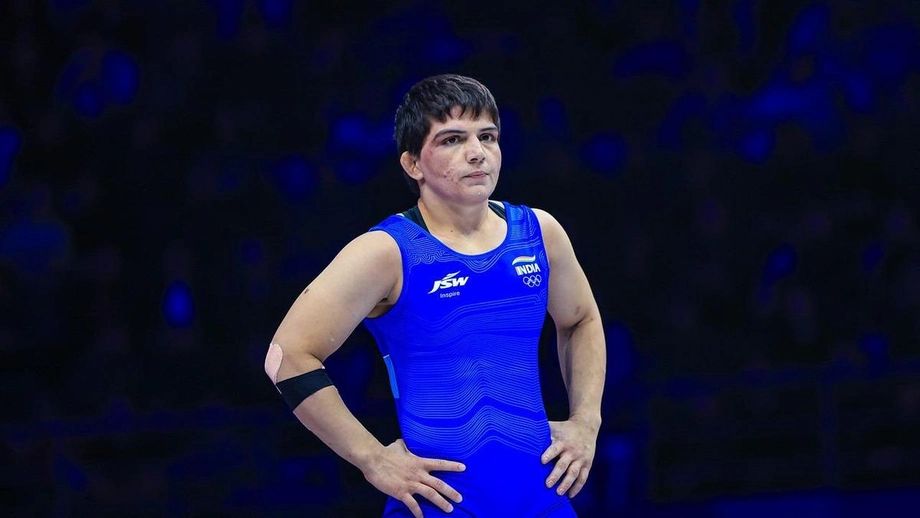
Six points behind, then a place in history
Manisha Bhanwala was trailing Abigail Nette 6-0 in the women's 59kg final at the World Wrestling Championships in Astana, Kazakhstan, on October 30, 2026. By the time only 27 seconds remained, the Indian wrestler had turned that deficit into an 8-6 lead. She protected it to become India's first woman to win a senior world wrestling title.
Contents
- Six points behind, then a place in history
- How the final turned around
- The plan was to use every minute
- Ten days to respond to Asian Games disappointment
- A father's encouragement, carried onto the mat
- From a Haryana hostel to the senior team
- Three world campaigns without a medal
- Why the Olympic target is 57kg
- A breakthrough shared by four medallists
- Key Points
The 29-year-old from Haryana joined Sushil Kumar as only the second Indian wrestler to claim a senior world crown. Kumar won the men's 66kg freestyle title in 2010, making Bhanwala's victory the country's first in 16 years.
Her gold also completed a breakthrough for the Indian women's team. Neelam Sirohi in 50kg and Kajal Dhochak in 76kg had won silver on October 29. For the first time, three Indian women contested finals at the same World Championships. Tanu Sharma added bronze in 72kg, taking the women's medal total to four.
Bhanwala celebrated with a white T-shirt carrying a photograph of her father, Suresh Bhanwala, who died in 2022. He had introduced her to wrestling and supported her ambition long before a world title seemed within reach.
The victory followed an Asian Games campaign that ended without a medal and left her with only 10 days to prepare for the World Championships, according to Bhanwala. Her response brought together years of conditioning, a deliberate change of weight category and a plan to make the final last all six minutes.
How the final turned around
Nette, the American Pan American champion, seized control early. She attacked Bhanwala's right leg, maintained her grip despite the Indian's resistance and completed a throw near the edge of the mat for four points.
Nette moved into a 5-0 lead before a caution against Bhanwala extended the advantage to 6-0. Bhanwala recovered one point by forcing her opponent out of the competition area, reaching the interval 6-1 behind.
The second period changed the match. When Nette attacked a leg again, Bhanwala moved behind her for a takedown. The American corner challenged the decision, arguing that the referee had already stopped the action. The unsuccessful challenge gave Bhanwala another point.
Bhanwala then used a gut wrench to level the score at 6-6. In that move, a wrestler grips an opponent around the waist while they are on the mat and rolls them, exposing their back to score points. Nette still held the advantage under the rules used to separate wrestlers with equal scores.
Bhanwala needed one more scoring action. A move worth two points put her ahead 8-6 with 27 seconds left. After spending much of the bout trying to recover, she now had to stop Nette from scoring. She held her lead until the finish.
The score changed from 6-0 to 6-1 before the interval, then from 6-1 to 6-8 during the final three minutes. Bhanwala scored eight unanswered points across that recovery.
The plan was to use every minute
Chief coach Virender Dahiya said the Indian team had studied Nette's approach and expected her to tire late in the contest. The strategy depended on Bhanwala staying in the match long enough to use her endurance.
Dahiya explained the thinking behind the plan:
We had studied her style of wrestling. We knew she gets tired by the fifth minute and decided that the bout needed to last the full six minutes. If that happened, Manisha always had the advantage.
The team also wanted Bhanwala to stay close to Nette. The American preferred attacking from a distance, so maintaining contact was intended to reduce the space available for those attacks.
During the 30-second interval, Dahiya reminded Bhanwala that she still had 180 seconds to recover. He recalled telling her:
I told her wrestling can change in one second and you have 180 seconds to turn it around.
Bhanwala described her own approach as making the contest last and drawing Nette into the kind of wrestling that suited her strengths. She said training regularly included situations in which she had to score within 30 seconds or defend a lead for a short period. The final required both skills.
Ten days to respond to Asian Games disappointment
Bhanwala arrived in Astana after losing 3-0 to Japan's Akari Fujinami in the 57kg quarterfinals at the Aichi-Nagoya Asian Games. Fujinami, the Paris 2024 Olympic champion, then lost her semifinal, closing Bhanwala's route back into contention for bronze.
Wrestling's repechage system gives certain defeated competitors another chance to pursue bronze when the wrestler who beat them reaches the final. With Fujinami missing the final, Bhanwala's Asian Games campaign was over.
Bhanwala said the result was frustrating because she had expected more from herself. Her coach kept her attention on practice, recovery and the next competition rather than allowing the disappointment to dominate the short preparation period.
She moved from 57kg to 59kg for the World Championships, won the national trials and resumed preparation in Rohtak. With little time between competitions, the higher category reduced the pressure to bring her weight back down immediately.
Her route through the world tournament included victories over Canada's Laurence Beauregard and Mongolia's Bolortuya Khurelkhuu, whom she beat 6-0 in the quarterfinals. In the semifinal, she built a 10-0 lead against Kazakhstan's Altyn Shagayeva before winning by fall.
A fall ends a wrestling match when a competitor holds both of an opponent's shoulders against the mat. Bhanwala's semifinal victory secured her first appearance in a senior World Championships final.
A father's encouragement, carried onto the mat
Suresh Bhanwala died in April 2022, around the time his daughter was due to travel to Mongolia for her first senior Asian Championships. Her brother Rinku recalled that the family had to persuade her to continue with the journey after their father's death.
Bhanwala went to Mongolia and won bronze. Her mother and brother have described how close she came to losing heart, and how the family encouraged her to keep pursuing the sport her father had helped her enter.
Bhanwala, who calls him "father sahab", explained how his death changed the meaning of her career:
Before 2022, I was wrestling for myself. But after my father passed away, everything changed. I wanted to show him that I was doing well and that I would make him proud.
His photograph has remained her WhatsApp display picture for four years. In Astana, the T-shirt bearing his image made that private connection visible during the celebrations.
Bhanwala said her father's advice still shapes her determination to complete what she starts:
My father taught me that either you do not get involved in any work, or you finish it completely. That is in my blood.
Her family watched the final on a phone, according to Rinku. For a household that had supported her through bereavement and repeated sporting disappointments, the victory was a shared moment of pride.
From a Haryana hostel to the senior team
Bhanwala comes from a farming family in Siwaha village in Haryana's Jind district. Rinku played kabaddi, and watching him compete helped develop her interest in sport. Her sister-in-law, Mamta Sihag, is also a wrestler.
Her father initially sent her to a hostel to improve her fitness. Watching senior wrestlers train and seeing Indian athletes win medals gradually gave her a different ambition: to represent the country herself.
Her early involvement in wrestling dates to 2013, while her training at Khel School Nidani began in 2015. She later developed her career at Chhotu Ram Stadium in Rohtak, where she also works as a junior coach.
Bhanwala says her ambitions became more focused after the 2020 lockdown. She joined the senior team in 2022 at 25, having missed the junior achievements that often bring young wrestlers early recognition.
Coach Mandeep Saini, who has worked with her in Rohtak, described consistent effort as a central part of her progress:
She trains very well and practises with a strong mindset. She has worked hard for so many years, and now she knows that she has to give her maximum. She trains with that commitment.
Her development also included support from the Inspire Institute of Sport and technical work with Japanese coach Kosei Akaishi. Bhanwala has credited the Wrestling Federation of India with supporting her career.
Three world campaigns without a medal
Astana was Bhanwala's fourth senior World Championships appearance. Saini said she had competed every year since 2023 without reaching the podium.
Her closest previous opportunity came in Tirana, Albania, in 2024. Competing at 65kg, she reached a bronze medal bout but lost 8-2 to Japan's Miwa Morikawa and finished fifth.
Continental results gave her a more encouraging record. She won medals at the senior Asian Championships in every year from 2022 through 2025, including the 62kg title in Amman in 2025.
Her progress across those seasons shows how much changed before the world gold:
- April 2022: Her father died around her departure for the Asian Championships in Mongolia, where she won bronze.
- 2023: She began a run of four consecutive senior World Championships appearances.
- 2024: She finished fifth at the World Championships in Tirana after losing the 65kg bronze medal bout.
- 2025: She won Asian Championships gold at 62kg in Amman.
- 2026 Asian Games: She lost in the 57kg quarterfinals to Akari Fujinami.
- October 30, 2026: She beat Abigail Nette 8-6 to win the world 59kg title in Astana.
The world title therefore followed both sustained success in Asia and three unsuccessful attempts to win a world medal. Her fourth appearance brought her straight to the top of the podium.
Why the Olympic target is 57kg
Bhanwala's world title came at 59kg, a category that is not part of the Olympic wrestling programme. Her target for Los Angeles in 2028 is 57kg, requiring another carefully managed change in weight.
She has represented India across four categories: 65kg, 62kg, 59kg and 57kg. Moving between them requires adjustments to food, conditioning and recovery while preserving the strength and stamina needed to wrestle.
Saini said reducing her weight had been difficult, but her height had left her at a disadvantage against some opponents in heavier divisions. Bhanwala has described weight management as a continuing part of planning rather than a single adjustment before a tournament.
She intends to move gradually towards 57kg. She also believes experience against opponents at 59kg will help because some of those wrestlers will seek Olympic places in the lighter category.
The National Championships, the Pro Wrestling League and further preparation in the national camp are among the next steps she identified. Coaches and support staff will decide which international tournaments to enter. No exact schedule for her permanent move to 57kg was given.
Bhanwala's ambition is gold in Los Angeles, but she must first earn an Olympic place. At 29, she argues that preparation matters more than age:
Everything is in the mind. There is no real difference between being young and old if your diet, sleep, habits and support system are good. Age doesn't matter, practice does.
A breakthrough shared by four medallists
India's women finished with one gold, two silvers and one bronze. Bhanwala supplied the title, while Sirohi, Dhochak and Sharma made the campaign broader than a single wrestler's achievement.
Anshu Malik had reached a World Championships final in 2021 without winning gold. In Astana, three Indian women reached that stage together, and Bhanwala became the first to finish as champion.
Sirohi said she had competed at the World Championships since 2022 without winning a medal before taking 50kg silver. Sharma's 72kg bronze fulfilled an ambition that began with simply wanting to wear an India jersey.
Bhanwala wants more Indian wrestlers to follow her to the top. She has also drawn inspiration from athletes outside wrestling, including Cristiano Ronaldo, whose approach to making the most of limited time she admires.
Her own final supplied a precise example: three minutes to recover from a five-point deficit at the interval, then 27 seconds to defend a world title.
Key Points
- Manisha Bhanwala beat Abigail Nette 8-6 in the 59kg final in Astana on October 30, 2026.
- She recovered from 6-0 down and defended her winning lead for the final 27 seconds.
- She became India's first woman senior wrestling world champion and its second senior champion after Sushil Kumar.
- India's women won four medals: Bhanwala's gold, silver for Neelam Sirohi and Kajal Dhochak, and bronze for Tanu Sharma.
- Bhanwala celebrated with a photograph of her father, Suresh, who died in 2022.
- Her next major ambition is the 57kg category at the Los Angeles 2028 Olympics, for which she must qualify.