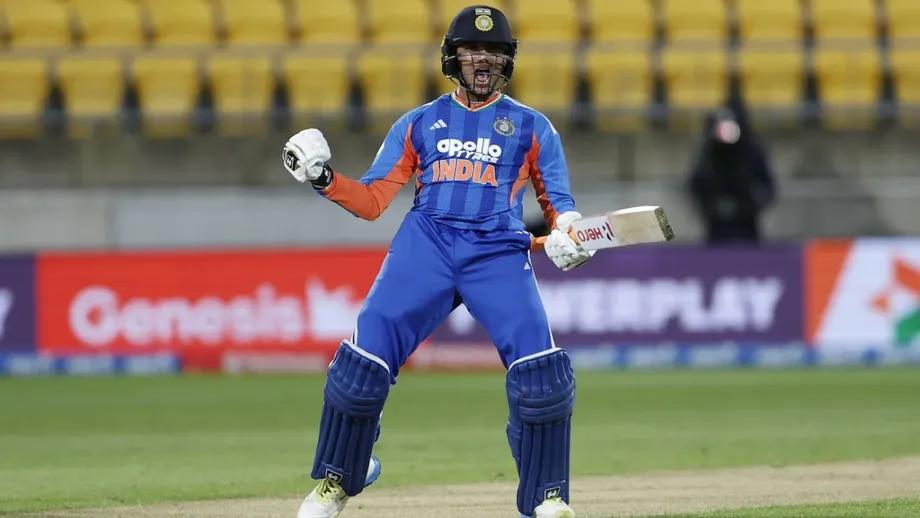
India turn a chase of 199 into a record rush
Abhishek Sharma smashed 113 from 38 balls as India chased 199 in just 13.2 overs in Wellington on October 27, 2026, beating New Zealand by six wickets and securing an unbeatable 3-0 lead in the five match T20I series.
Contents
- India turn a chase of 199 into a record rush
- How the openers took control
- Abhishek explains the plan
- A change of position pays off for Sooryavanshi
- Where the innings sits in the record books
- Mitchell gives New Zealand a platform
- India's bowling adjustment mattered too
- The chase in six steps
- A series secured before the final two games
- Key Points
India finished on 199 for four with 40 balls remaining after Abhishek and Vaibhav Sooryavanshi added 133 for the opening wicket in only 7.1 overs. Their 118 without loss in the first six overs set a men's Twenty20 international powerplay record, turning a demanding target into a comfortable finish.
New Zealand had made 198 for three, led by Daryl Mitchell's unbeaten 89. Kyle Jamieson took two wickets for 45 runs during India's reply, but the opening assault left the hosts defending a rapidly shrinking target rather than controlling the chase.
Abhishek reached fifty from 15 balls and his fourth T20I century from 35. Sooryavanshi contributed 45 from 19 deliveries after being promoted to open ahead of Sanju Samson, giving India a successful change at the top of the batting order.
How the openers took control
Sooryavanshi began with a four from the first ball of India's innings and a six from the third. Abhishek quickly joined the attack, and New Zealand struggled to find a delivery or field setting that could slow either batter.
India reached 50 after 2.2 overs, meaning two completed overs and two further legal deliveries, or 14 balls. The opening pair brought up 100 at the end of the fifth over and finished the sixth on 118 without loss.
The powerplay covers the first six overs of a T20 innings, when only two fielders can stand outside the inner fielding circle. Abhishek and Sooryavanshi used those restrictions and Wellington's short square boundaries to attack before New Zealand could spread its field.
By the end of that opening phase, India had scored more than 59% of the 199 runs required. The remaining task was 81 from 84 balls, less than a run a ball, with all ten wickets still available. The early hitting had transformed the calculation.
Abhishek explains the plan
Abhishek, India's opening batter and the leading scorer in the chase, said the pair had used their time in the field to study the conditions before batting.
When we were fielding we were observing the pitch. There was a bit of extra bounce, and with the dimensions of the ground we could use the power play and the pace of the ball. The plan was just get momentum for the team.
His explanation connected the aggressive batting to specific features of the ground. The square boundaries, reached by shots towards either side of the pitch, were shorter than the straight boundaries beyond the bowler. Extra bounce and the speed of the deliveries gave the openers opportunities to send the ball towards those shorter routes.
Abhishek maintained his scoring rate after Sooryavanshi's dismissal. He completed his hundred with a four off Jamieson and eventually fell for 113, having supplied nearly 57% of India's winning total himself.
A change of position pays off for Sooryavanshi
Sooryavanshi's promotion gave India a different opening combination while moving Samson to number three. The teenager had scored four from eight balls at number three in the second match, making his 45 from 19 in Wellington a sharp improvement.
Ishan Kishan's absence with a mild strain to his right adductor, a muscle near the groin, had created an opportunity for Sooryavanshi in the preceding game. The move to opener then gave him access to the fielding restrictions from the first delivery.
Matthew Fisher ended the opening partnership with the first ball of the eighth over, also his first delivery in T20I cricket. Sooryavanshi attempted a lofted shot towards long-on, the deep fielding position on the leg side beyond the bowler, where Mitchell completed a tumbling catch.
India were already 133 for one. The partnership had produced runs at a rate of approximately 18.6 per over, leaving the middle order only 66 more to find.
Where the innings sits in the record books
India's 118 without loss surpassed the previous men's T20I powerplay best of 116 by Romania against Serbia in 2021. Across men's T20 cricket with detailed delivery records, Sunrisers Hyderabad's 125 without loss against Delhi Capitals in the 2024 Indian Premier League remained higher.
India also reached 150 in 7.4 overs, or 46 legal deliveries. That improved on the previous fastest men's T20 mark of 8.2 overs, set by Sunrisers Hyderabad against Lucknow Super Giants in 2024. Abhishek featured in that innings too. Turkey had held the international mark at 8.3 overs against Bulgaria in 2025.
The 14 balls needed to reach 50 matched the fastest men's T20I team fifty in matches with delivery records. India's hundred after five overs was also exceptionally quick, although Eswatini had reached 100 in 4.5 overs against Mozambique earlier in 2026.
Abhishek's century took him to 11 hundreds across men's T20 cricket, passing Virat Kohli's ten to become India's leading century scorer in the format. Chris Gayle, with 22, and Babar Azam, with 13, remained ahead internationally. Four of Abhishek's hundreds have come for India in T20Is; the wider T20 total also includes domestic and franchise matches.
Mitchell gives New Zealand a platform
Mitchell anchored New Zealand's innings after India captain Shreyas Iyer won the toss and chose to bowl. Arshdeep Singh removed Tim Seifert for six, while Finn Allen provided early attacking momentum with 40.
Nitish Kumar Reddy dismissed Allen with a full, straight delivery, and Axar Patel removed Glenn Phillips for 17. Phillips was playing his 100th T20 international. Those wickets left Mitchell responsible for carrying the innings through its closing stages alongside Bevon Jacobs.
Mitchell finished unbeaten on 89 from 52 balls, while Jacobs made an unbeaten 39 from 23. Their unbroken fourth wicket partnership was recorded as 75 runs; another score listing gives Mitchell 88 and the partnership as 65.
Mitchell scored 35 from his final 26 deliveries. Subtracting those figures from his final innings total means his first 26 balls had brought 54 runs. India's bowlers had reduced his scoring rate during the latter half of his stay, even as New Zealand preserved wickets.
India's bowling adjustment mattered too
Iyer said India's bowlers needed to change their approach after ten overs because deliveries landing short of the batter or slightly fuller were still being hit for large scores. He advised them to bowl more yorkers, deliveries aimed close to the batter's feet.
A well directed yorker gives a batter little room to swing beneath the ball and lift it over the boundary. India's faster bowlers used fuller deliveries and reverse swing, movement through the air as the ball wears, to make the closing overs harder to attack.
Wellington's dimensions shaped both innings. New Zealand's batters could target the shorter square boundaries, but India's bowlers tried to make them play straighter, towards the longer parts of the ground. India's openers later found ways to exploit those same short boundaries far more quickly.
New Zealand had also finished the first two matches with wickets available, losing four in the opener and five in the second. In Wellington, seven wickets remained unused at the end. The hosts needed a faster finish as well as a stable platform against an Indian batting order capable of this pace.
The chase in six steps
India's milestones show how little time New Zealand had to recover. The hosts did take four wickets, but the opening stand had already removed most of the pressure from the chase.
- After 2.2 overs: India reached 50 in 14 legal deliveries.
- After five overs: The opening partnership reached 100.
- After six overs: India stood at a record 118 without loss.
- After 7.1 overs: Sooryavanshi fell for 45, ending the opening stand at 133.
- After 7.4 overs: India reached 150, the fastest mark in men's T20 cricket.
- After 13.2 overs: India completed the chase at 199 for four.
Abhishek departed after reaching his century, while Iyer made five and Samson 18 before both were dismissed near the finish. Those wickets delayed the final result without restoring a demanding scoring requirement.
Among successful chases of targets of at least 190 in men's T20 cricket, India's finish was second quickest. Estonia reached a target of 192 against Cyprus in 13 overs in 2024, two legal deliveries faster.
A series secured before the final two games
Iyer said he had never seen a team score 100 in five overs at international level. He also said the ball was moving off the pitch when he and Samson batted, making the openers' success particularly striking to him.
The captain credited his players for adapting after a long journey and jet lag. India now have an unbeatable lead, while New Zealand must use the remaining matches to seek their first victory of the series.
The fourth T20I is scheduled for Friday, October 30. The Wellington result also gave India their third consecutive T20I series victory in New Zealand.
India had already chased 209 against New Zealand in Raipur on January 23 with 28 balls remaining. In Wellington, they finished with 40 balls unused, an extra two overs to spare against a target ten runs lower. The repeated feature was the ability to remove the pressure of a large chase well before the final overs.
Key Points
- India beat New Zealand by six wickets in Wellington to secure a 3-0 series lead.
- Abhishek Sharma scored 113 from 38 balls, reaching his century in 35 deliveries.
- Vaibhav Sooryavanshi made 45 from 19 balls in an opening partnership of 133.
- India's 118 without loss in the powerplay set a men's T20I record.
- New Zealand made 198 for three, led by Daryl Mitchell's unbeaten innings.
- India reached 199 for four in 13.2 overs, leaving 40 balls unused.
- The fourth match is scheduled for October 30.