A sharp rebound meets a persistent retreat
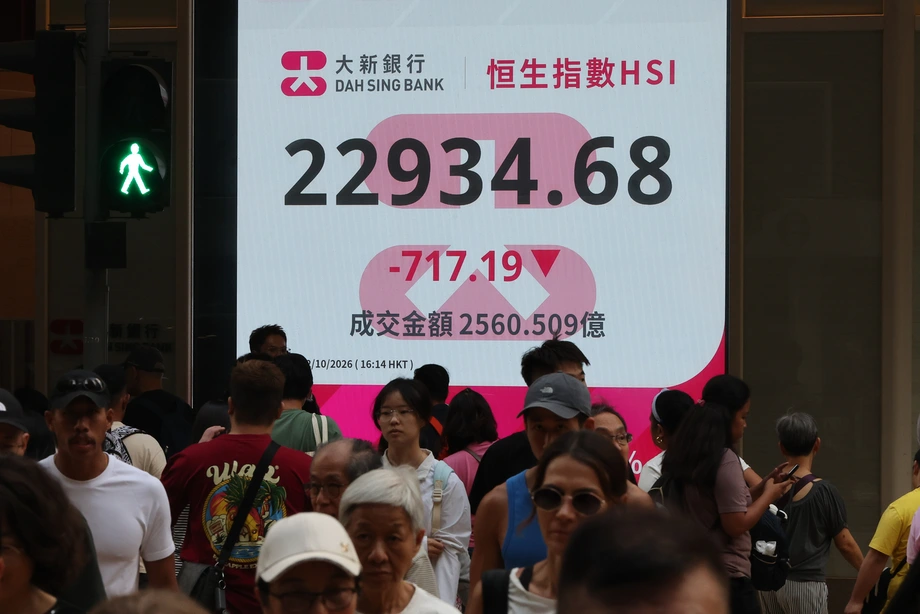
Hong Kong stocks rose sharply on October 30, with the Hang Seng Index gaining 377 points, or 1.64%, to 23,335 at the midday break. Mainland investors continued to withdraw money, however, extending a record run of net selling through Stock Connect to 13 trading days.
Contents
- A sharp rebound meets a persistent retreat
- Mainland selling reaches a monthly extreme
- The index recovery was stronger than the wider market
- Technology shares face spending and cost concerns
- Strategists see further downside risk
- Insurers, banks and consumer shares lift the market
- Earnings produce mixed reactions
- Electric vehicles and takeover targets diverge
- Trading activity shows a market still under strain
- Key Points
The contrast was striking: major Hong Kong shares rallied while an important group of investors kept selling. By midday, mainland investors had sold HK$3.025 billion more in Hong Kong shares than they bought. Their cumulative net withdrawals over the 13 sessions reached HK$36.788 billion.
Hong Kong also moved against the regional trend. South Korean stocks fell more than 4%, Japanese and Taiwanese shares dropped more than 2%, and mainland Chinese shares slipped more than 0.2%. Technology shares had dragged US stocks lower overnight, while US stock futures continued to fall during Asian trading.
The Hang Seng China Enterprises Index, which tracks major mainland businesses listed in Hong Kong, gained 126 points, or 1.63%, to 7,882. The Hang Seng Tech Index rose 1.43% to 3,797. Trading across Hong Kong's market reached HK$107 billion by lunch.
October nevertheless remained a difficult month. The Hang Seng had lost 6.7% through October 29, before the rebound narrowed its monthly decline to about 5%. Investors were weighing weaker enthusiasm for artificial intelligence investments, higher financing costs and pressure on corporate profits.
Mainland selling reaches a monthly extreme
Stock Connect allows eligible mainland investors to trade Hong Kong shares through exchanges in Shanghai and Shenzhen. This activity is known as southbound trading. A net outflow means the value of shares sold exceeds the value bought during the period.
October's net southbound withdrawals stood at HK$27.417 billion at the midday snapshot, the largest monthly amount since July 2021. A subsequent account put the month's total at about HK$28 billion, describing it as the second largest monthly net outflow on record and the largest in five years.
The retreat had accelerated before the rebound. October 29 brought net selling of about HK$3.36 billion, almost 3.2 times more than the preceding session. By then, the selling streak had lasted 12 trading days, with cumulative withdrawals of approximately HK$33.76 billion.
The next morning's HK$3.025 billion outflow was about 9.9% smaller than the previous session's figure, but it extended the streak. Subsequent figures put the October 30 outflow at HK$3.56 billion.
The progression across the reported trading snapshots was:
- Through October 29: monthly net selling was approximately HK$24 billion, while withdrawals across 12 consecutive sessions totalled about HK$33.76 billion.
- October 30, midday: the streak reached 13 sessions, cumulative withdrawals reached HK$36.788 billion and October's net outflow stood at HK$27.417 billion.
- Subsequent October 30 figures: daily net selling reached HK$3.56 billion and the monthly total was approximately HK$28 billion.
Southbound investors had previously provided support during market weakness. Their switch to sustained selling left Hong Kong shares facing additional pressure just as investors were reassessing technology valuations and earnings prospects.
The index recovery was stronger than the wider market
The Hang Seng opened 52 points higher, briefly slipped 10 points below its previous close and then climbed as much as 409 points. Its morning peak of 23,367.99 was its highest level since October 22.
Large companies led the advance. Among the 95 blue chips counted in the market snapshot, 81 rose, 13 fell and one was unchanged. Across the wider market, however, 29.72% of shares rose, 29.15% fell and 41.12% were unchanged.
That gap helps explain the session. A stock index gives greater influence to some companies than others, so strong gains among major constituents can lift the headline number even when many smaller shares struggle. By midday, blue chips accounted for HK$43.509 billion, or 40.66%, of market turnover.
Fresh lows were widespread despite the rally. Fifty three shares touched record lows, while 157 reached their lowest levels in 52 weeks. Tencent, Semiconductor Manufacturing International Corporation, BYD and Geely were among the companies that hit annual lows during the session.
Several recovered from those lows before lunch. Tencent rose 2.07% to HK$385.40 after touching HK$375.20, while Geely gained 1.69% to HK$13.80 after falling to HK$13.15. The movement shows how sharply conditions changed within the morning itself.
Technology shares face spending and cost concerns
The Hang Seng Tech Index rose alongside the broader market, with 20 constituents advancing and 10 declining. JD Health led its gains, rising 5.67% to HK$38.02, while Zhipu fell 4.98% to HK$505.50.
Technology stocks nevertheless remained central to the mainland selling. SMIC, Alibaba and Xiaomi were identified as major targets. SMIC fell 2.45% to HK$43.86 after touching a low of HK$42.26 during the morning.
The technology index had also surrendered nearly all the gains made since Beijing introduced substantial monetary stimulus in September 2024. Its morning rebound therefore came after an extended retreat, rather than from a position near recent highs.
Scarlett Liu, an Asia Pacific equity derivatives strategist at BNP Paribas, identified investor concern that higher capital expenditure could squeeze profit margins. Capital expenditure means money spent on assets such as equipment, infrastructure and computing systems. Those investments can support future business, but they also require substantial funding.
Liu also pointed to rising costs affecting some consumer electronics and electric vehicle companies, including businesses exposed to more expensive memory components. For these companies, the financial challenge is concrete: selling more products may produce less benefit when the cost of making each one rises.
Strategists see further downside risk
Jasmine Duan, senior investment strategist at RBC Wealth Management Asia, said Hong Kong shares might need to fall another 10% to 15% before finding a bottom. She identified movements in US Treasury yields and investment flows as particular sources of market sensitivity.
US Treasury yields are the returns investors receive from holding US government debt. When those returns rise, investors can earn more from bonds, making shares less attractive by comparison. Higher financing costs can also put pressure on businesses that need to borrow or fund expansion.
Mainland investors were also moving toward the domestic bond market as both Hong Kong and mainland equities struggled. That shift offered a destination for money leaving shares and helped explain why a strong morning in Hong Kong did not immediately bring southbound buyers back.
Duan's estimate was a market forecast. The next test for the rally was whether buying would continue beyond the session and whether mainland selling would ease. At the midday snapshot, rising prices and continued net withdrawals were occurring together.
Insurers, banks and consumer shares lift the market
Mengniu Dairy was the strongest blue chip, rising 7.11% to HK$19.44. Lenovo was the weakest, falling 4.34% to HK$21.18. Their opposing moves illustrated the uneven performance beneath the headline index gain.
AIA rose 3.63% to HK$74.25 as investors assessed its Hong Kong business figures. The insurer's value of new business in Hong Kong fell 3% in the third quarter, although August and September together recorded growth of 20% from a year earlier.
Value of new business is an insurance measure estimating the future profit generated by policies newly sold during a period. AIA's figures showed a weaker quarter alongside improvement during its final two months.
Major banks also advanced as several companies were expected to release results as soon as that day. Agricultural Bank of China rose 1.17%, Bank of China gained 0.33%, BOC Hong Kong added 1.09% and China Construction Bank climbed 0.99%. Industrial and Commercial Bank of China rose 1.03% to HK$7.86 after matching its record high of HK$7.865.
Earnings produce mixed reactions
Sinopec rose 4.15% to HK$4.77 after reporting profit of RMB39 billion for the first nine months, up 30%. Its third quarter profit increased 57%. China Merchants Port gained 2.82% to HK$16.78 after profit for the first nine months rose 9.5% to RMB4.2 billion.
COSCO Shipping Ports advanced 8.01% to HK$6.335. Its third quarter profit was broadly unchanged at US$82.59 million, while revenue increased 13%. The share price reaction was stronger than the reported change in profit.
Several companies also rose despite weaker earnings. Haier Smart Home gained 4.49% to HK$19.79 after profit excluding nonrecurring items fell by more than 30% to RMB3.52 billion. Dongpeng Beverage climbed 6.33% to HK$96.65 despite an almost 8% fall in third quarter profit to RMB1.28 billion.
China Unicom rose 1.56% to HK$5.215 even as profit for the first nine months declined 34% to RMB13.3 billion. Earlier in the session, it touched a 52 week low of HK$5.11. Investors were reacting to company results from prices that, in several cases, had already fallen substantially.
Electric vehicles and takeover targets diverge
BYD's third quarter profit increased 28% to RMB10 billion, but profit for the first nine months fell 4.2% to RMB22.3 billion. Its shares slipped 0.51% to HK$68.30 after touching a 52 week low of HK$67.
Geely reported a 28% increase in third quarter profit to RMB4.8 billion and finished the morning higher. BYD Electronic moved in the opposite direction, falling 2.61% to HK$21.66 after profit for the first nine months dropped 69.3%.
Takeover terms also drove large price moves. Evergrande Property Services fell 13.08% to HK$1.03 after trading resumed following PAG's proposed acquisition at a 29% discount to the reference market price.
B&S International rose 8.5% to HK$1.66 after a consortium led by the chairman of Sino Biopharmaceutical agreed to buy a 75% stake for HK$289 million. The consortium also proposed a general offer at a 37% discount to the reference market price. The shares reached a 52 week high of HK$1.88 during trading.
Trading activity shows a market still under strain
Southbound purchases and sales together reached HK$39.117 billion by midday, down 40.86% from the previous session's comparison figure. Their reported share of Hong Kong trading activity nevertheless increased from 17.45% to 18.26%, showing that mainland participation remained substantial even as trading slowed.
Trading in warrants and callable bull and bear contracts rose 19.29% to HK$11.821 billion, accounting for 11.04% of market turnover. These products give investors magnified exposure to price changes, allowing relatively small investments to generate large gains or losses.
The Hang Seng briefly moved above its average closing level over the previous 10 trading days, approximately 23,337.68, before ending the morning just below it. The technology index remained below its corresponding average of 3,886.79.
Hong Kong's rebound therefore left investors with two concrete developments to weigh: a strong advance among major shares and an uninterrupted mainland selling streak. October's roughly 5% index decline, together with the large number of shares touching fresh lows, showed the extent of the weakness that preceded the recovery.
Key Points
- The Hang Seng gained 377 points, or 1.64%, to 23,335 at midday on October 30.
- Mainland investors extended net southbound selling to a record 13 consecutive trading days.
- Cumulative withdrawals across those sessions reached HK$36.788 billion by midday.
- October's subsequent net outflow total was approximately HK$28 billion, the largest in five years.
- Hong Kong outperformed falling Asian markets, but its monthly index loss remained about 5%.
- Technology spending, rising costs and weaker earnings remained concerns, while many shares touched record or annual lows.