Software protection joins a sweeping trade upgrade
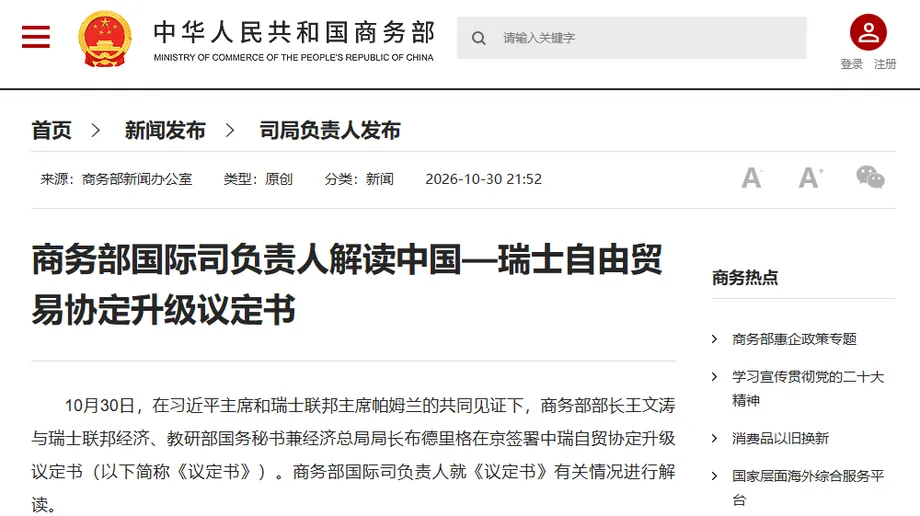
China and Switzerland signed an upgraded free trade agreement in Beijing on October 30, 2026, introducing China's first dedicated source code protection clause in a bilateral trade pact alongside tariff cuts that will eventually cover products accounting for more than 99% of trade between the two countries.
Contents
- Software protection joins a sweeping trade upgrade
- Why source code is at the center
- Tariff exemptions expand sharply
- Agriculture gains more access to Switzerland
- Customs and origin rules get practical changes
- Services commitments reach workers and families
- Investment and competition rules widen
- Environmental cooperation becomes a broader chapter
- Five rounds of talks lead to a signed protocol
- What businesses will need to check next
- Key Points
Chinese Commerce Minister Wang Wentao and Helene Budliger Artieda, Switzerland's state secretary for economic affairs and director of its State Secretariat for Economic Affairs, signed the protocol. Chinese President Xi Jinping and Swiss President Guy Parmelin witnessed the ceremony.
The source code provision sits inside a new digital trade chapter covering electronic transmissions, personal information, customs procedures and cooperation on artificial intelligence. According to China's Ministry of Commerce, the agreement also introduces China's first institutional arrangement with a European country on nondiscrimination in telecommunications infrastructure.
For businesses, the package connects several practical concerns: protecting software, paying less tax when goods cross borders, completing customs paperwork and gaining permission to provide services abroad. It updates eight existing chapters and adds two, on digital trade and trade and sustainable development.
The changes build on a substantial commercial relationship. China's Ministry of Commerce put bilateral trade at $49.04 billion in 2025. Swiss official figures excluding gold and other precious goods put trade at about 33.5 billion Swiss francs, or $40.3 billion. Switzerland is China's seventh largest trading partner in Europe, while China is Switzerland's largest trading partner in Asia.
Why source code is at the center
Source code is the set of instructions programmers write to make software work. It can contain commercially valuable methods, designs and processes, making protection important to companies that sell software or products controlled by it.
The Ministry of Commerce's international department identified the dedicated protection clause as a first for China's bilateral free trade agreements. The ministry's explanation did not spell out its precise obligations, exceptions or enforcement procedures. Those details will determine how the commitment works for software owners and government authorities.
The provision belongs to a wider package of digital commitments. China and Switzerland have agreed not to impose customs duties on electronic transmissions, to strengthen personal information protection and to pursue fully digital customs clearance.
Electronic transmissions allow digital content to move across borders without a physical shipment. The customs commitment addresses another part of the transaction: how traders submit and process information when physical goods enter or leave a country.
The two governments also committed to cooperation on artificial intelligence and electronic bills of lading. A bill of lading is a shipping document that records goods accepted for transport and can serve as evidence of the right to claim them. Electronic versions move that paperwork into digital systems.
The telecommunications infrastructure provision extends the package beyond software and documents. Together, these measures give the upgrade a broader reach than a conventional agreement focused mainly on border taxes.
Tariff exemptions expand sharply
China and Switzerland will each reduce tariffs further on nearly 300 tariff lines, the product categories customs authorities use to calculate import duties. China's Ministry of Commerce said products eventually receiving zero tariffs would account for more than 99% of bilateral trade by value.
For Swiss goods exported to China, full tariff exemptions will ultimately cover 99.8% of exports, compared with 53.6% under the current agreement. That is an increase of 46.2 percentage points, showing how much more existing trade will become eligible for complete tariff removal.
About 77.5% of Swiss goods exports will receive exemptions immediately when the protocol enters into force. Remaining exemptions will be introduced over periods of five to 10 years. Swiss coffee, machine tools and watches are among the products set to move from partial reductions or no preferential reduction to zero tariffs.
The timetable matters for purchasing decisions. Some importers will receive the full benefit at the start, while others will need to check the schedule for their particular product. A tariff cut reduces the tax charged at the border; the final selling price also depends on transport, distribution and other business costs.
Agriculture gains more access to Switzerland
Switzerland had already removed tariffs on all industrial goods under the original agreement, according to China's Ministry of Commerce. The upgrade therefore directs much of the additional Swiss goods market opening toward agriculture.
The protocol covers 97.3% of Chinese agricultural exports to Switzerland, with 80.1% receiving full tariff exemptions. Other products will receive reductions or access through quotas, subject to seasonal restrictions. Quotas limit the amount of a product that can enter under specified terms.
Chinese oilseeds, vegetable oils and pet food are among the products identified for better tariff treatment. Switzerland will use both immediate tariff removal and partial reductions, with the Chinese ministry describing its agricultural commitments as Switzerland's highest level of liberalization in an external trade agreement.
The agricultural changes make customs performance especially relevant. A lower tariff can help a shipment compete on price, while faster clearance can help goods reach buyers before they spoil. The protocol addresses both through its market access and border procedure provisions.
Customs and origin rules get practical changes
China and Switzerland have agreed on new provisions for single windows, the release of goods and expedited clearance for perishable products. A single window lets traders submit required information through one entry point rather than repeatedly sending it to different agencies.
The protocol also introduces a Smart Customs Partnership Program and confirms the application of the World Trade Organization's Trade Facilitation Agreement to bilateral cooperation. These measures address the procedures that can delay a shipment even after its tariff treatment has been settled.
Rules of origin are changing as well. These rules decide whether a product has enough connection to China or Switzerland to qualify for preferential treatment. For some products, the agreement will allow a larger share of materials from other countries.
Some manufacturers will also gain an alternative way to qualify by showing that processing changes the customs classification of their inputs. This gives businesses more options when organizing production and sourcing materials, while keeping eligibility tied to specified manufacturing requirements.
Separate annexes cover cooperation on standards and conformity assessment, the process used to check whether a product meets required rules. The two governments plan to coordinate work in areas of shared interest, addressing technical requirements alongside tariffs and customs paperwork.
Services commitments reach workers and families
Switzerland will make new commitments allowing Chinese specialists in traditional Chinese medicine to undertake education, training and research that do not involve clinical practice. It will also allow short contracts for Chinese personnel in fields including legal consulting, accounting reviews and financial auditing.
Chinese senior executives will gain commitments allowing their spouses and children to enter Switzerland and reside there for extended periods. Switzerland will also expand access in equipment repair and maintenance and waste treatment services.
China's commitments cover services related to manufacturing and professional design, alongside finance, maritime transport and air transport. More specific areas gaining access for Swiss companies include technical testing, financial services, aircraft maintenance and maritime transport.
Both countries will incorporate the WTO Reference Paper on Services Domestic Regulation into the agreement. Its inclusion concerns the regulatory processes businesses encounter when seeking authorization to provide services, with the ministry pointing to greater policy transparency.
The services package changes the agreement's practical reach. A company seeking to sell expertise abroad may need permission for a specialist to travel, approval to operate in a sector and understandable administrative procedures. The upgrade addresses each of those needs through different commitments.
Investment and competition rules widen
China and Switzerland agreed on investment access and administrative rules for sectors outside services. They will use a negative list to specify exceptions to commitments on treatment when investors seek to enter a market. A negative list identifies the areas where reservations apply.
The commitments include national treatment, meaning treatment comparable to domestic investors, and most favored nation treatment, meaning treatment comparable to investors from other trading partners, subject to the agreed exceptions. A positive list separately identifies areas receiving nondiscriminatory market access commitments.
Both sides also committed not to impose specified performance requirements, including local content requirements and forced technology transfer. Local content requirements oblige an investor to use a certain amount of domestic materials or components.
The competition chapter expands to 11 dedicated provisions covering enforcement principles, information exchange, technical cooperation and capacity building. Competition law must be applied without discrimination based on nationality or ownership, according to the ministry's explanation.
The governments may also notify each other at an early stage of enforcement action. These provisions connect market opening with rules governing how companies are treated after they begin operating, a concern for businesses making investments that take years to recover.
Environmental cooperation becomes a broader chapter
The new trade and sustainable development chapter builds on the original agreement's environmental chapter. It covers trade in environmental goods and services, responsible business conduct, sustainable forestry, climate change, biodiversity, fisheries and agriculture.
Clean energy transition and the circular economy are also included. A circular economy aims to keep products and materials in use through repair, reuse and recycling, reducing the need to discard them and extract replacements.
China and Switzerland have included labor and employment cooperation in principle. Their economic and technical cooperation commitments also extend to agriculture, traditional Chinese medicine, supply chains, watches and small and medium enterprises.
At the leaders' talks, Xi called for stronger economic ties with Switzerland and European countries and expressed interest in cooperation on the digital economy, green energy storage and artificial intelligence. Parmelin described the agreement as a new step in bilateral relations that would respond to business needs and create opportunities for economic cooperation.
Five rounds of talks lead to a signed protocol
The upgrade follows more than a decade of operation under the original agreement, which China described as its first free trade agreement with a country in continental Europe. Negotiators completed five rounds before announcing that the upgrade talks had concluded.
The main dates show how the agreement developed:
- July 2013: China and Switzerland signed their original free trade agreement.
- July 1, 2014: The original agreement entered into force.
- September 2024: Negotiations to upgrade the agreement began.
- August 2026: The two countries announced the completion of negotiations after five rounds.
- October 30, 2026: The upgrade protocol was signed in Beijing.
Both countries must now complete their domestic legal approval procedures before the protocol takes effect. No entry date or approval deadline was announced. China's Ministry of Commerce said the text would be published through its free trade agreement information service.
What businesses will need to check next
Exporters face three connected tasks once implementation arrangements are available: identify the tariff schedule for their goods, check whether production satisfies the updated origin rules and prepare the documents needed to claim the preference.
Software companies will be looking at the wording of the source code provision, while service providers and investors will need to examine the sectors and exceptions listed in their respective commitments. The headline percentages describe the scale of opening; individual schedules determine the treatment of a particular product or business activity.
The agreement's commercial value therefore rests on several changes working together. Tariff removal reduces border taxes, origin rules govern eligibility, customs provisions address clearance, and digital and investment rules shape how firms exchange information and operate across markets.
Key Points
- China and Switzerland signed their trade upgrade protocol in Beijing on October 30, 2026.
- The digital chapter includes China's first dedicated source code protection provision in a bilateral free trade agreement.
- Each country will cut tariffs further on nearly 300 product categories, with eventual zero tariff coverage exceeding 99% of bilateral trade by value.
- Full exemptions will eventually cover 99.8% of Swiss goods exports to China, up from 53.6% under the existing agreement.
- The package expands agricultural and services access, updates customs and investment rules, and adds a broader sustainable development chapter.
- Domestic legal approvals are still required, and no date for entry into force has been announced.