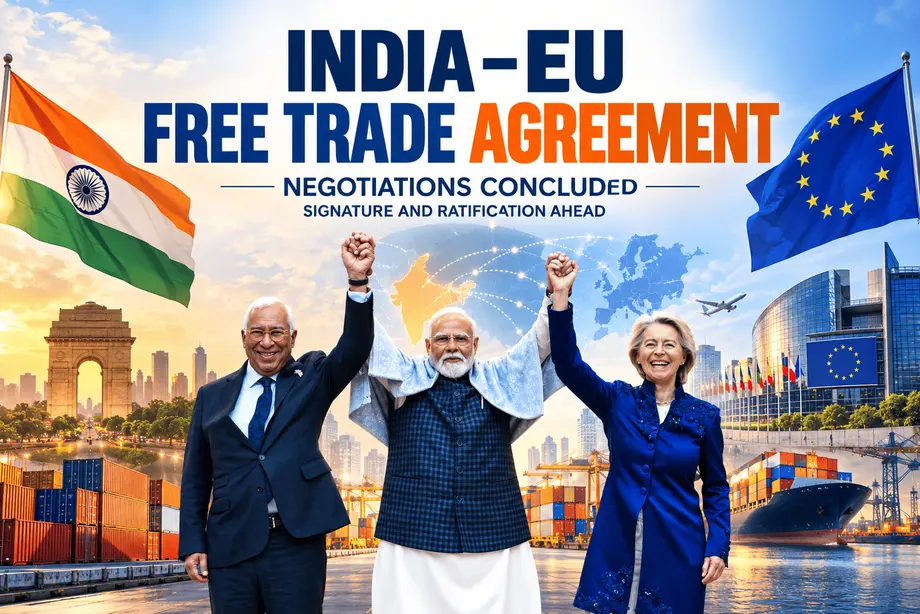
December signing would set up a 2027 trade opening
India and the European Union are aiming to sign their free trade agreement by mid-December 2026, with European Parliament consent expected in spring 2027 and the agreement potentially taking effect by the middle of that year. The timetable would move a deal negotiated on 27 January 2026 from political agreement toward changes in the costs and rules of doing business.
Contents
- December signing would set up a 2027 trade opening
- What Parliament must decide
- Which businesses could gain access?
- A large trading relationship already exists
- Why investment protection remains a separate negotiation
- Regional product names need their own agreement
- Supply chains connect trade with security
- The transport corridor needs financing and projects
- Ukraine remains part of the diplomatic discussion
- Key Points
David McAllister, chair of the European Parliament's Foreign Affairs Committee, outlined that schedule while leading a delegation of eight members of the European Parliament to New Delhi. European Council President Antonio Costa also announced that Prime Minister Narendra Modi would travel to Brussels in December to sign the agreement, shortly before European leaders are scheduled to meet there from 17 December.
The agreement brings together India's market of about 1.5 billion people and the EU's more than 450 million consumers. Its reach extends from textiles, machinery and automobiles to information technology and professional services. Separate negotiations on investment protection and geographical indications, the names associated with products from particular places, are continuing alongside it.
For businesses, the immediate question is when particular duties will fall and which conditions will apply. For workers and producers, the stakes include export orders, investment and competition from imports. Signing would be a major step, followed by parliamentary scrutiny and the remaining formal approvals before the agreement can take effect.
What Parliament must decide
McAllister said he expected broad support in the European Parliament, while making clear that lawmakers would examine the agreement before voting. Parliament can approve or reject the text, but cannot amend it during the consent process.
McAllister, whose committee shapes and monitors the EU's foreign and security policy, described the parliamentary requirement:
Though Parliament cannot amend the text of the agreement, our consent is required before it enters into force.
His forecast places the consent vote in spring 2027. India's Commerce and Industry Minister Piyush Goyal has offered a slightly faster implementation estimate, saying the agreement could become operational four to five months after signing. Both expectations depend on completing the approval process; a precise entry date has not been announced.
The main steps stretch across more than a year:
- 27 January 2026: India and the EU concluded FTA negotiations at their 16th summit in New Delhi.
- 11 September 2026: The European Commission submitted proposals to the EU Council for signing and concluding the agreement.
- Mid-December 2026: Both sides expect to sign, with Modi due to visit Brussels.
- Spring 2027: McAllister expects the European Parliament to complete scrutiny and hold its consent vote.
- Mid-2027: McAllister sees the agreement potentially entering into force.
EU ambassador to India Jean-Eric Paquet said members of the European Parliament who visited India in March had also responded positively. That delegation, led by the chair of Parliament's trade committee, met people involved in the commercial relationship to assess the agreement's scope.
Which businesses could gain access?
Indian exporters are expected to receive preferential or duty-free access for more than 99% of exports to the EU by value. Textiles, leather, gems and jewellery are among the sectors expected to benefit. Preferential access means goods receive better terms than the importing market normally offers, while duty-free access removes the relevant import tax.
European exporters would receive tariff reductions or exemptions across a substantial share of sales to India. Machinery, transport equipment and chemicals already form a large part of those exports. For companies buying such goods, lower duties could reduce costs, depending on the product and the agreed timetable.
Paquet described broad tariff coverage, saying that 99% of India's trade with Europe would be rate-free upon entry into force. The agreement also provides for phased reductions in sensitive sectors, including automobiles and auto parts. Businesses therefore need the product schedules to identify the rate and starting date that apply to a particular shipment.
Paquet said the Commission's September proposals came with a detailed schedule of commitments. Such a schedule is effectively a calendar for customs duties: it identifies which products receive reductions and when those reductions begin.
India has sought to preserve protections for agriculture and dairy. Paquet said agricultural coverage was narrower than in some other EU trade agreements, reflecting sensitivities on both sides. Automotive trade, by contrast, could expand into markets that businesses had previously approached more cautiously; he said Indian car manufacturers were seriously considering opportunities in Europe.
A large trading relationship already exists
India and the EU are building on substantial commerce. European Commission figures put trade in goods at €118 billion in 2025. The EU accounted for 11.1% of India's goods trade, making it India's third-largest goods trading partner. India accounted for 2.3% of EU goods trade and ranked ninth among the bloc's partners.
Those shares help explain the different starting points. The EU already represents about one ninth of India's goods trade, while India represents a much smaller share of the EU's total. Easier market access would operate within that existing imbalance in the relative importance of each market.
Figures for India's financial year 2024-25 put bilateral goods trade at $136.54 billion, including Indian exports of $75.85 billion and imports of $60.68 billion. Subtracting imports from exports gives India a goods trade surplus of about $15.17 billion for that period.
Services trade stood at $83.1 billion in calendar year 2024. The agreement covers information technology, professional services, business consulting and research and development. It also includes provisions intended to ease the movement of skilled Indian professionals, connecting market access with the people who deliver those services.
Why investment protection remains a separate negotiation
Goyal said negotiations were continuing on an Investment Protection Agreement, or IPA. That pact would set rules protecting investments made by European businesses in India and Indian businesses in the EU. Its structure, coverage and remedies, the ways investors could seek redress, remain under discussion.
Trade and investment agreements address different business decisions. A tariff reduction changes the cost of selling goods across a border. Investment protection concerns the legal conditions surrounding a factory, office or other capital committed within another market.
McAllister said progress on investment protection would strengthen European investors' confidence in India and encourage investment and job creation. Paquet likewise described it as a necessary complement to the FTA, particularly for businesses planning supply chains across both markets.
The European Commission's published negotiating records list eight rounds of investment protection talks, with the latest published round in May 2026. Former EU ambassador Herve Delphin also said in a 2026 address that the FTA lacked a chapter on investment liberalisation in sectors outside services, and urged both sides to revisit that issue after implementation. Investment liberalisation concerns the conditions under which foreign businesses may enter and operate in a market.
Regional product names need their own agreement
India and the EU are also negotiating a geographical indications agreement. Geographical indications, or GIs, protect names whose reputation or characteristics are tied to a particular place. Darjeeling tea and Roquefort cheese illustrate why producers want customers to be able to distinguish authentic regional products from goods using similar names.
Goyal said the GI agreement required legal changes in India. India's existing framework rests on the Geographical Indications of Goods (Registration and Protection) Act, 1999, and associated rules. Any changes would have to connect that domestic system with the protections agreed with the EU.
The Commission's negotiating records show six rounds of GI talks, most recently in March 2024. The products covered and the final terms will determine which producers gain protection in the other market. For a regional grower or food maker, that protection can preserve the commercial value attached to a recognised place name.
Supply chains connect trade with security
Paquet said the FTA and investment protection agreement together could improve supply chain resilience. A supply chain is the series of suppliers, factories, transport routes and warehouses that brings a product to its buyer. Resilience means having ways to keep that chain working when a supplier or route is disrupted.
India and the EU both want to reduce dependence on any single country. Greater access to each other's markets could give companies more choices about where to buy components, manufacture goods and invest. McAllister linked that goal to Europe's desire for greater freedom to make its own strategic decisions.
The relationship also includes a security and defence partnership covering information sharing, research, responses to cyber attacks and naval cooperation. McAllister backed closer cooperation between India and European defence companies, presenting it as a shared interest.
McAllister described the maritime objective in direct terms:
We want a free, open and safe Indo-Pacific; we want the freedom of navigation to be respected.
He cited cooperation through Operation Atalanta as a potential model for naval work. Paquet also connected maritime security and freedom of navigation with reliable supply chains. For companies shipping between markets, access to customers depends on both commercial rules and usable sea routes.
The transport corridor needs financing and projects
The India-Middle East-Europe Corridor, or IMEC, would add a transport and connectivity dimension to the commercial relationship. The proposal covers shipping, transport and digital links, but conflict in West Asia has disrupted its progress.
McAllister called for concrete financing, specific projects and wider EU participation. He presented implementation of the corridor as a natural complement to the FTA: reducing trade barriers and improving the connections used by commerce are related tasks.
Paquet also pointed to India-EU cooperation on projects in Africa and possible cooperation involving Japan, India and Europe. These initiatives broaden the relationship beyond trade between the two markets, although the corridor still requires the practical investment decisions McAllister urged.
Ukraine remains part of the diplomatic discussion
McAllister's visit also addressed Russia's war in Ukraine. He said the EU was not neutral and continued to support Kyiv militarily, financially and technically. At the same time, he welcomed a constructive Indian role, citing India's longstanding relationship with Russia and its contacts with Ukraine.
McAllister welcomed Indian diplomatic efforts toward a ceasefire covering energy infrastructure, Black Sea shipping and grain movements. He also praised External Affairs Minister S. Jaishankar's constructive role in efforts for peace.
McAllister said any settlement must be just and sustainable, acceptable to both sides and backed by concrete security guarantees for Ukraine. He highlighted the war's wider human cost, including Indian sailors killed when commercial ships were targeted in the Black Sea. The discussion brought the protection of people, energy supplies and trading routes into the same diplomatic agenda as the planned trade opening.
Key Points
- India and the EU expect to sign their FTA by mid-December 2026, with Modi due in Brussels.
- McAllister expects European Parliament consent in spring 2027 and possible entry into force by mid-2027.
- Parliament must approve the agreement and cannot amend its text during the consent process.
- Indian exports are expected to gain broad preferential or duty-free access, while sensitive products have separate tariff schedules.
- Investment protection and geographical indications agreements remain under negotiation.
- Goods trade reached €118 billion in 2025, according to European Commission figures.
- Supply chain diversification, maritime security and the proposed India-Middle East-Europe Corridor form part of the wider partnership.