Tax Receipts Reach Just 69% of Quarterly Target
Bangladesh collected Tk92,517 crore in revenue during July to September of FY2026-27, leaving the National Board of Revenue (NBR) Tk41,879 crore short of its Tk134,396 crore target. A 16% fall in value added tax receipts overwhelmed gains in income tax and customs collections, exposing the strain from weak business activity, slow investment and exceptionally low spending on government development projects.
Contents
- Tax Receipts Reach Just 69% of Quarterly Target
- VAT Accounts for Nearly Half the Gap
- A Filing Change Complicates the Picture
- Weak Sales and Investment Reduce the Tax Base
- Development Spending Falls to a New Low
- The Annual Target Requires a Steep Acceleration
- More Government Borrowing Could Tighten Business Credit
- Income Tax Gains Face Tests of Their Own
- The Next Figures Will Test Recovery Hopes
- Key Points
The figures put collections at about 68.8% of the first quarter target, with nearly one third of the expected revenue missing. The detailed shortfall of Tk41,879 crore compares with the roughly Tk43,000 crore headline estimate. One crore equals 10 million taka, making the detailed gap equivalent to Tk418.79 billion.
NBR figures cited for the corresponding quarter a year earlier give two different totals, Tk90,825 crore and Tk91,390 crore. Against the current collection of Tk92,517 crore, those figures produce growth of about 1.86% and 1.23%, respectively. Either comparison places revenue growth below 2%, far behind the pace required to meet the annual budget.
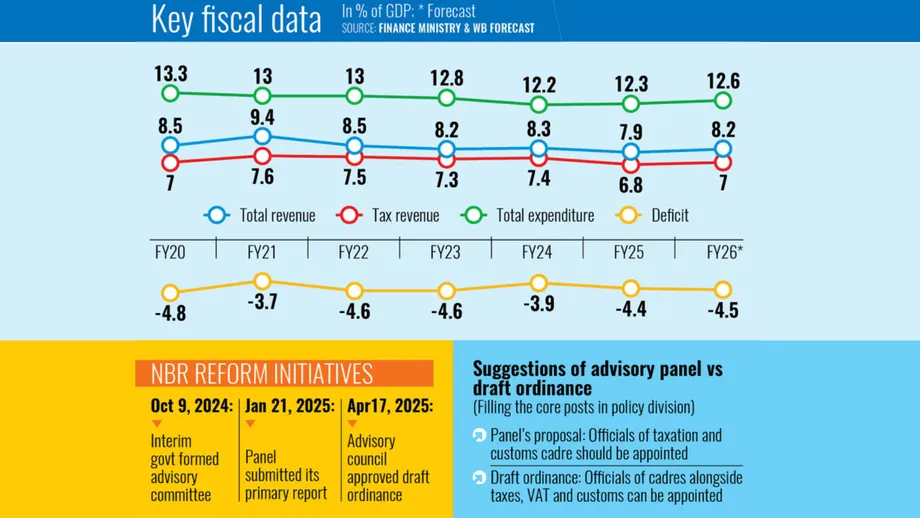
The government has set an NBR collection target of Tk604,000 crore for the full fiscal year, about 45% above actual receipts in the previous year, when revenue grew by 12%. The first quarter therefore presents two connected problems: the economy is generating tax receipts slowly, while the budget assumes a sharp acceleration.
For households and businesses, the consequences extend beyond the tax office. Less revenue leaves the government with less money to spend unless it borrows more, while businesses already facing weak sales could encounter tighter access to credit.
VAT Accounts for Nearly Half the Gap
VAT collection reached Tk29,348 crore against a quarterly target of Tk49,405 crore, leaving a Tk20,057 crore deficit. That amounts to almost 48% of the total revenue shortfall and makes VAT the largest source of the missed target.
VAT is a tax collected through sales of goods and services. Businesses submit returns showing their taxable transactions and the tax payable. Receipts therefore depend on economic activity, compliance and the timing of returns and payments. A change in any of those can affect how much money reaches the treasury during a particular period.
The other major tax categories also missed their targets, even though their collections increased from a year earlier:
- Income tax and travel tax brought in Tk33,040 crore against a Tk42,726 crore target, leaving a Tk9,686 crore shortfall. Collections rose about 16.75%.
- Taxes and duties on imports and exports generated Tk30,129 crore, with a reported shortfall of Tk12,135 crore. Collections increased about 7.5%.
- VAT receipts fell 16% from a year earlier, offsetting the increases elsewhere.
The annual VAT target is Tk223,480 crore, or about 37% of the NBR collection goal. Recovering momentum in this category is therefore central to the budget, even if income tax and customs receipts continue growing.
A Filing Change Complicates the Picture
NBR officials attribute part of the VAT decline to an experimental shift from monthly returns to returns submitted every three months. They said many businesses did not file in July and August under the new arrangement, disrupting the collection pattern during the quarter.
The government subsequently restored monthly filing early in the month following the quarter. NBR Chairman Ahsan Habib also convened a meeting with field officials to review the revenue deficit. Officials said payments from large corporate taxpayers had fallen below expectations.
Zahid Hussain, former lead economist at the World Bank's Dhaka office, challenged the view that filing schedules could fully explain the quarterly gap. He said payment deadlines for the July to September period had already passed, putting the weakness of economic activity at the centre of his assessment.
Towfiqul Islam Khan, additional research director at the Centre for Policy Dialogue (CPD), said October figures would provide a clearer picture of the effect of quarterly filing. An unnamed senior NBR official expressed hope that the shortfall could be recovered by December. That expectation sets a near term benchmark for judging whether the return to monthly submissions restores receipts.
Weak Sales and Investment Reduce the Tax Base
Bangladesh's businesses are confronting subdued demand alongside stagnant private investment. Zahid Hussain said persistent inflation above 8% had reduced household purchasing power, while some importers were delaying shipments because they feared goods would remain unsold.
A family spending more on food and other necessities has less money available for other purchases. For businesses, weaker sales can mean smaller orders, less production and fewer reasons to invest. Those changes reduce the transactions and earnings from which the government collects taxes.
Fazlul Hoque, administrator of the Federation of Bangladesh Chambers of Commerce and Industry, described falling sales, stagnant investment, tight money circulation and imports that had failed to gain momentum. He also identified the VAT filing change as a disruption to collection.
Mustafizur Rahman, a distinguished fellow at CPD, connected the revenue weakness to stagnant investment, reduced bank lending and slow execution of government development projects. His assessment places the tax problem within a wider shortage of economic activity and financing.
Fahmida Khatun, also a distinguished fellow at CPD, said investment remained static and employment generation had stalled. She argued that a substantial recovery in revenue would be difficult without major changes to tax administration.
Development Spending Falls to a New Low
Planning Ministry data put implementation of the Annual Development Programme (ADP) at just 3.89% during July to September, the lowest first quarter rate on record. The ADP is the government's programme for development projects, including public infrastructure and other investments.
The current implementation rate compares with 5.09% in FY2026, 4.75% in FY2025, 7.50% in FY2024 and 8.55% in FY2023. At 3.89%, the latest rate is less than half the FY2023 level, showing how far the pace of execution has fallen.
Slow project spending affects revenue through a direct channel. Tax and VAT are often withheld when payments are made for government funded work. Withholding means part of a payment is deducted and sent to the tax authority rather than paid to the contractor or supplier.
When projects move slowly, fewer such payments occur. Suppliers also receive fewer orders and contractors undertake less work, weakening related business activity. The government then collects less tax both from the project payments themselves and from the businesses connected to them.
Rahman's assessment links these mechanisms: weak project execution reduces the economic transactions that would otherwise produce VAT and other receipts. Raising collection therefore depends partly on decisions and spending outside the NBR.
The Annual Target Requires a Steep Acceleration
The Tk604,000 crore annual target leaves Tk511,483 crore to collect during the remaining nine months. That requires an average of about Tk56,831 crore a month, compared with approximately Tk30,839 crore a month in the first quarter.
On that arithmetic, average monthly receipts would need to rise by about 84% from the opening quarter's pace. Collections can vary during the year, but the calculation shows the scale of the task facing the tax authority.
Zahid Hussain said the original targets had been considered unachievable under prevailing conditions. The budget seeks growth of about 45% over the previous year's actual receipts, against growth of less than 2% at the start of the current year.
Towfiqul Islam Khan estimated that the annual shortfall could reach about Tk130,000 crore unless collection growth improved sufficiently. He urged the government to consider revising the budget around actual conditions rather than retaining its original targets without a plan to address the gap.
A revised budget would give spending departments and lenders a more realistic picture of the resources available. The immediate choice is how to match commitments with revenue while the economy is already struggling to generate investment and jobs.
More Government Borrowing Could Tighten Business Credit
Md Deen Islam, research director at Research and Policy Integration for Development (RAPID), warned that slow revenue collection could restrict public spending at a time when investment is needed to support growth and employment.
Deen Islam explained the connection between production and tax receipts in comments translated from Bengali:
When production falls, revenue collection falls. When economic growth fails to meet expectations, the government cannot collect revenue according to its target.
He said the government might borrow more to cover operating expenses. If it draws more heavily on bank financing, private businesses could find less credit available, making investment and production harder.
Deen Islam said companies were already dealing with credit shortages and high interest rates. More pressure on financing could hit productive businesses particularly hard and could also affect inflation.
Towfiqul Islam Khan added that banking sector reforms could influence tax receipts. His broader assessment connected the deficit to economic weakness, the filing change and administrative shortcomings, placing several pressures on collection at the same time.
Income Tax Gains Face Tests of Their Own
The increase in income tax receipts offers some support to the revenue total, but early filing incentives may have brought some payments forward. Government measures encouraged taxpayers to submit returns before September, helping collections during the opening quarter.
Later figures will show how much of that increase continues after the incentive period. If payments have moved from later months into the first quarter, the opening gain could be followed by slower growth.
Within the NBR, officials also cited weak management and insufficient activity by field staff. Those concerns sit alongside the economic slowdown: improving administration could help collect taxes owed even while weak sales and investment constrain the amount of taxable activity.
Fahmida Khatun's call for major administrative reform addresses that part of the problem. Restoring monthly VAT returns changes the collection schedule, while the management concerns involve how consistently the authority administers and collects taxes.
The Next Figures Will Test Recovery Hopes
Bangladesh's wider economic outlook adds pressure to the collection effort. The International Monetary Fund's World Economic Outlook published on 13 October projected FY2027 growth at 3.2% and inflation at 10.9%. The Asian Development Bank has also lowered its growth forecast.
High inflation reduces what households can buy, while weak growth limits the expansion of business income and employment. Zahid Hussain also expressed concern about softening remittance inflows, which had previously averaged around $3 billion a month, and the risk that tensions in the Middle East could further affect them. Remittances are money sent home by people working abroad and help support household spending.
The sequence of policy changes and upcoming collection figures provides several points for assessing progress:
- July to September: Revenue reached Tk92,517 crore, leaving a Tk41,879 crore gap against the first quarter target.
- Early in the following month: The government restored monthly VAT returns after the experiment with quarterly filing.
- October collection figures: Towfiqul Islam Khan identified these as useful for assessing the effect of the filing change.
- December: An unnamed senior NBR official hoped the accumulated shortfall could be recovered by then.
For the government, the immediate task is to improve collection while bringing spending plans into line with receipts. For businesses and households, the stakes are practical: access to credit, the pace of public projects, employment and the purchasing power needed to keep sales moving.
Key Points
- NBR collected Tk92,517 crore against a Tk134,396 crore first quarter target, a shortfall of Tk41,879 crore.
- VAT receipts fell 16%, and the VAT deficit accounted for nearly half the total gap.
- Income tax and customs receipts increased, but all major categories missed their targets.
- Development programme implementation fell to 3.89%, reducing spending linked to tax collection.
- Monthly VAT filing has been restored, with October figures and December performance providing the next tests.
- Meeting the Tk604,000 crore annual goal requires average monthly receipts of about Tk56,831 crore over the remaining nine months.