More than 63,000 communities face a wider audience
Discord plans to give every Discoverable Server a public web page from November 16, 2026, then begin publishing selected new messages from participating public channels in mid December. The change covers more than 63,000 communities and could make their conversations accessible through Google and other search engines without visitors joining Discord or even having an account.
Contents
- More than 63,000 communities face a wider audience
- Which servers and conversations are included?
- The rollout has three distinct stages
- Why Discord wants answers on the open web
- Administrators control summaries and messages separately
- Members can opt out, but earlier posts need attention
- Regional defaults and age rules change who must act
- Removing names leaves privacy concerns
- AI summaries and outside collection are separate concerns
- Key Points
The company announced the changes on October 27, presenting them as a way to uncover useful answers buried in chat: a technique for beating a game boss, advice on fixing a technical problem or an explanation shared by a language learning community. Server pages will arrive first, potentially carrying summaries generated by artificial intelligence. Individual messages will follow through a gradual rollout.
For members, the most consequential detail is how permission works. In most regions, including Japan, eligible adults' messages will be included by default unless they change a setting. Turning that setting off protects subsequent messages, while earlier eligible posts sent with sharing enabled can still appear later.
Discord will leave usernames and avatars off the published messages. Members also have a personal control over message publication, but that control does not stop their conversations from contributing to channel summaries. Those summaries are controlled by server administrators. Usernames and avatars will not appear in summaries either.
Which servers and conversations are included?
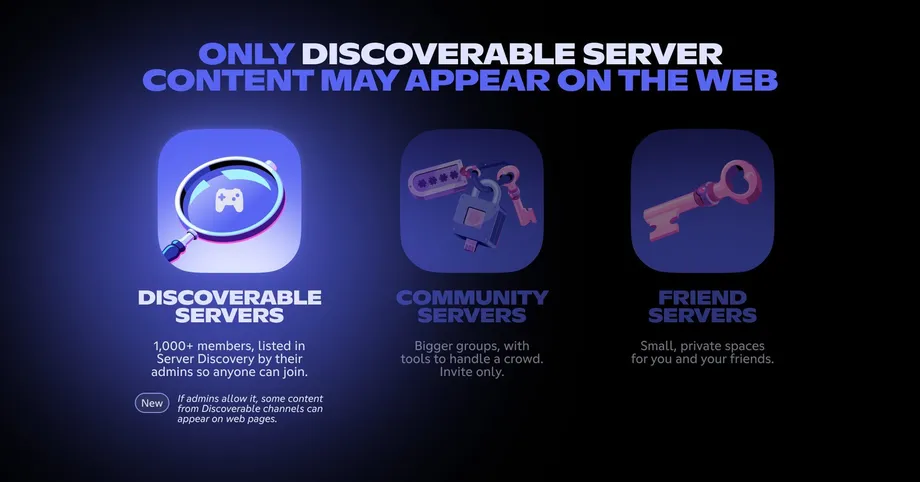
Discoverable Servers are communities whose administrators have registered them for Discord's Server Discovery directory, allowing people to find and join without an invitation. Eligibility requires at least 1,000 members, a server age of at least eight weeks, and compliance with activity and safety requirements. Having 1,000 members alone is not enough. Discord's official announcement sets out these requirements and says there are more than 63,000 Discoverable Servers.
Discord organises each server into channels, which are spaces for particular topics. The new publishing features concern public channels visible to everyone in an eligible server. Private channels and channels restricted to members with particular roles are excluded. Private threads and private forums are also excluded, even when their parent channel is public.
Private servers, direct messages and group direct messages are also outside the change. A conversation between friends in a private community will therefore stay outside this publishing programme, even if its participants also belong to a large Discoverable Server.
For an eligible public channel, the audience can expand substantially. A person who previously needed to enter Discord and join the community could instead read a published answer on an ordinary web page. Participating channels will display an icon and a notice near the header to indicate that their content may reach the web. A pop-up appears before members post and reappears whenever a channel newly enables the feature.
The rollout has three distinct stages
Discord began making settings available before the publishing features arrive, giving administrators and members time to review their choices. The schedule separates the creation of community pages from the later appearance of individual messages.
- October 27, 2026: Discord announced the changes and began rolling out administrator and member controls.
- November 16, 2026: Every Discoverable Server is scheduled to receive a Server Web Page. Channel summaries may draw on conversations from this date onward.
- Mid December 2026: Discord plans to begin gradually publishing selected new messages from participating public channels. The rollout may take several weeks before the first eligible messages appear online.
The announcement says: "If you don't change anything, public channels stay on, your Server Web Page goes live on November 16, 2026 (if it's not already published), and Channel Summaries can start the same day. Channel Messages start rolling out in mid-December 2026."
Discord will create a default page from a server's profile when administrators have not already made one. Some communities, including those for Rust and Dead by Daylight, already have server pages that introduce visitors to the group before they join.
Discord says its Channel Messages pilot included NBA 2K, Rust and Dead by Daylight communities. All posts in that pilot came from administrators and moderators, not members. Channel Messages currently show text only, although a small number of partner communities have images and videos on their pages through an earlier pilot.
Individual messages sent before the December rollout are excluded from message publication. Summaries have their own starting point in November. Discord has given no exact December launch day, and the gradual schedule means communities will not necessarily see messages appear at the same time.
Why Discord wants answers on the open web
Discord's explanation centres on a change in where people share knowledge. Discussions that once appeared on forums have moved into chat communities, leaving helpful answers harder to locate from outside those communities. A search engine can direct someone to a public forum page, but an answer inside a Discord conversation has often required more searching within the service.
The company sees public pages as a route for independent game developers, fandoms and content creators to reach new members. A developer's explanation of a technical fault, for example, could help someone searching for that problem and introduce them to the game's community at the same time.
Discord's announcement describes questions about game strategies, items and speedrun techniques as examples. A speedrun is an attempt to finish a game as quickly as possible, often using specialised techniques that players discuss in detail. Making those explanations searchable could save another player from asking a question that has already been answered.
Server pages can also link back to the original Discord conversations. The planned route is therefore from a web search to an answer, with an opportunity to enter the community for more discussion. For administrators, that creates a new reason to decide which channels best represent their server to strangers.
Administrators control summaries and messages separately
Server owners and members with Administrator permission can manage publication on desktop or in a browser. The controls sit under Server Settings, Community, Web Presence, where Channel Summaries and Channel Messages have separate settings and separate channel selections. Discord's announcement describes the location as "Server Settings > Web Presence" and says: "You can choose which channels take part, or turn them all off."
Both features are enabled by default for eligible public channels. Administrators can disable either feature across the server or choose particular channels for each. A community could, for example, allow individual answers from a technical help channel while keeping its general discussion channel out of message publication.
Administrators can also remove a specific summary generated by AI without excluding that entire channel. This gives moderators a narrower option when they want to withdraw one recap while keeping future summaries available. Discord says administrators can curate the summaries shown or turn them off entirely.
Switching a publishing feature off stops new content from being added, but previously published material may remain visible and require removal. The basic Server Web Page also stays online while the server remains Discoverable. To remove that page, administrators must disable Discoverability, returning the community to a model that requires invitations and removing it from the public directory.
Members can opt out, but earlier posts need attention
Members can open User Settings, then Data & Privacy, and disable the setting labelled "Show my message content from Discoverable channels on web pages." The choice applies across all Discoverable Servers they belong to, rather than requiring a separate change in each community.
The setting is applied when a message is sent. If a member posts an eligible message while sharing is enabled, then switches sharing off, that earlier message can still be published later. The member's action changes the treatment of subsequent posts.
To remove an eligible earlier message from Discord's public pages, the member must delete the original message in Discord. This matters even when the message has not yet appeared on a server page: switching off sharing alone leaves posts sent under the previous setting eligible.
Search engines add another step. They maintain their own indexes, which are lists of pages and content used to produce search results, and may retain stored copies after Discord removes a message. A deleted post can therefore take longer to disappear from search, and a separate removal request to a search engine may be needed.
Regional defaults and age rules change who must act
Discord says individual message sharing is off by default in the European Union and European Economic Area, the United Kingdom, Canada, Brazil, Australia and South Korea because of legal restrictions. Eligible adult members in those places must enable the setting before their messages can appear through this feature.
Most other regions, including Japan, use the opposite starting position: eligible adult members must turn sharing off to keep subsequent messages out of public pages. The practical difference is whether publication begins with a member's action or with the platform's default.
Teen accounts are excluded from individual message sharing and cannot enable it until adulthood. The regional and age rules sit alongside administrators' channel choices, so publication depends on both the server's settings and the member's eligibility and preferences.
The personal message setting does not control Channel Summaries. A member who switches off individual publication can still participate in a public channel whose discussions are summarised according to the administrator's settings. Members seeking to keep both forms of publication off need to know how their server handles summaries as well as messages.
Removing names leaves privacy concerns
Kelsey Duncombe-Smith, Discord's group product manager, described one safeguard for messages published on the web:
Usernames and avatars will not be shown alongside these messages.
Discord's approach removes the account label and profile image normally attached to a post. The content itself may still contain identifying details, such as a workplace, a location, a personal experience or a distinctive description that someone else recognises.
Members using communities to discuss sensitive problems or protect their personal safety may be especially affected by that wider reach. A channel can be open to everyone inside a large server while still feeling different to its participants from a page accessible through a general internet search.
The announcement follows criticism of Discord's age verification policies, adding another debate about how the service handles personal information and user choice. Here, the immediate decision for members is concrete: whether their future eligible messages should be published, and whether administrators should allow summaries of the channels where they talk.
The earlier backlash centred on plans announced in February: adults incorrectly classified by Discord's age-estimation system could have been required to submit a facial scan or government ID to prove their age. Privacy and security concerns were heightened by hackers stealing government IDs belonging to more than 70,000 users in the UK and Australia in 2025. Discord delayed the initial rollout and promised changes.
Discord CTO and co-founder Stanislav Vishnevskiy said user feedback led the company to add age-confirmation options beyond facial age estimation and ID scans. Alternatives now include credit card checks, the Apple App Store, Google Play Store, Google Wallet and AgeKey. Discord says verification vendors may retain related data only as long as needed to confirm age, while facial age estimation must run on the user's device. Vishnevskiy said expanding age-assurance laws had prompted launches in Brazil and Texas, with policymakers also pressing for stronger teen protections in the European Union and Indonesia.
AI summaries and outside collection are separate concerns
Discord will use AI to create Channel Summaries, turning public discussions into shorter recaps for visitors. Members' individual message controls do not switch off that process. Administrators decide which channels contribute and can remove particular summaries.
Discord also says in its help guidance that it does not sell users' messages to AI companies. Its policy prohibits AI companies from training models on user messages. Users have nevertheless raised concerns that making text openly accessible could make it easier for outside companies to collect it.
In its help document, Discord asks specifically, "Are you selling my messages to AI companies?" Its answer is: "No. Nothing has changed. We are making Discord content easier to find if admins and users choose to make their content available on the web." The denial addresses sales of messages to AI companies; it is not a broader statement about every possible use of publicly accessible content.
Training an AI model means using large amounts of material to teach software patterns in language or other information. The concern here is about third parties copying public pages and using the text without members' permission or payment, an issue that has also prompted disputes over discussions on other online platforms.
For communities preparing for November and December, the available choices operate at different levels. Administrators choose the channels and types of content that can be published. Members choose whether subsequent individual messages can appear. Removing earlier eligible messages requires deletion, while withdrawing a server's basic web page requires ending Discoverability.
Key Points
- More than 63,000 Discoverable Servers are covered by Discord's planned expansion of public web pages.
- Server pages and AI summaries are scheduled from November 16, 2026; selected new messages follow gradually from mid December.
- Private servers, private and role restricted channels, private threads and private forums, direct messages and group direct messages are excluded.
- Administrators control summaries and individual messages separately. Members' personal controls cover individual messages only.
- Turning sharing off protects subsequent messages. Earlier eligible posts require deletion to remove them from Discord's pages.
- Individual message sharing defaults off in several regions, including South Korea and the EU, and on in most others, including Japan. Teen accounts cannot enable it.