A small basement, a large claim on Seoul's future
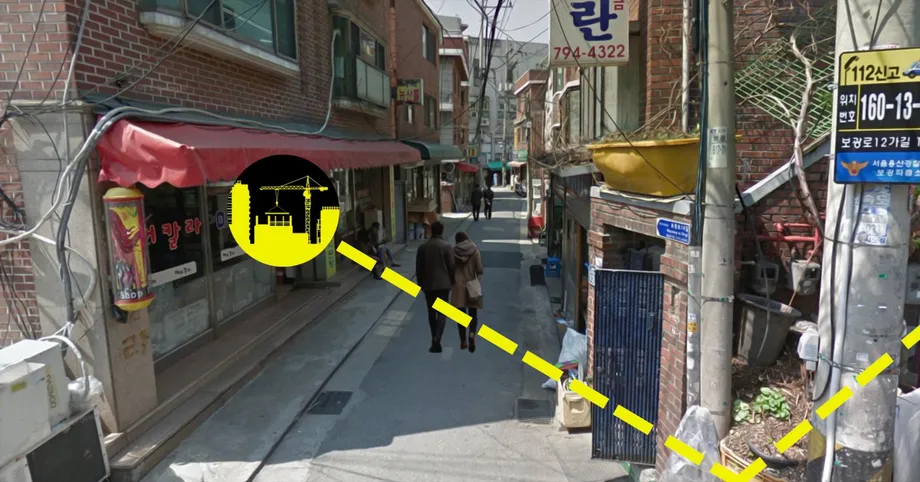
A 26 square meter basement home in Seoul's Hannam 3 redevelopment district changed hands nine times between its first registration in 2003 and 2019. Its price rose from 275 million won in 2006 to 850 million won in 2019. Buyers came from across South Korea, including Gongju, Yeongju and Chungju, while the small dwelling remained part of a neighborhood awaiting demolition.
Contents
- A small basement, a large claim on Seoul's future
- Why the cheapest property could be the preferred investment
- Small homes commanded a premium per square meter
- Trading accelerated when restrictions eased
- Ownership moved away from the neighborhood
- Tenants faced uncertainty before they moved
- More apartments did not mean more room for everyone
- Trillions of won financed the move
- An auction offered another route to an apartment right
- The official milestones and changing timetable
- Key Points
Across 1,671 apartment and villa units examined through property records, semibasement homes changed owners an average of 2.6 times over two decades, compared with 2.1 times for homes above ground. That made their turnover about 24% higher. By the period beginning in August 2020, the median transaction price for a semibasement had reached 1.3 billion won.
The attraction was a future apartment. A qualifying owner of a modest basement could obtain an allocation right through the redevelopment association, much like someone who owned a larger home above ground. Investors were buying a route into a new complex between the Han River and Namsan, rather than simply buying somewhere to live.
For tenants, the same process meant changing landlords, uncertainty over rental deposits and eventual relocation. Only 9.5% of semibasement owners had registered addresses inside Hannam 3 in July 2022.
Yongsan District's June 2023 approval notice shows what lay behind those purchases: a redevelopment area of 386,395.5 square meters and an approved plan for 5,816 apartments, including 876 rental homes. The project illustrates how replacing aging housing can create valuable assets while leaving the people renting the old homes searching for somewhere else.
Why the cheapest property could be the preferred investment
Hannam 3 spans parts of Hannam-dong and Bogwang-dong in Yongsan District. Its older buildings included small villas, houses divided among several households and semibasements, known in Korean as banjiha. These homes sit partly below street level and have often provided relatively cheap accommodation.
Redevelopment changes the way such properties are valued. In principle, a qualifying association member who joined before approval of the management and disposition plan in June 2023 could receive one new apartment allocation right, whether the existing property was a semibasement or a home above ground.
The management and disposition plan sets out how the project's new properties and financial obligations are allocated. Members pay an additional contribution based on the price of their allocated apartment minus the assessed value of their existing property.
A semibasement's lower assessed value can mean a larger contribution later. Its lower purchase price, however, reduces the money needed at the beginning. Buyers able to wait for redevelopment could therefore enter with less cash and meet the additional bill as the project advanced.
Local property agents described investors buying relatively inexpensive semibasement villas and selling when prices rose. Transactions were active among villas priced between 500 million and 900 million won. Some buyers reportedly purchased without inspecting the home.
Small homes commanded a premium per square meter
Semibasements in the records were generally about 10 square meters smaller than homes above ground. Their total purchase prices could be lower even when buyers paid more for each square meter.
From August 2020 through 2023, semibasement transactions averaged 43.84 million won per square meter, compared with 34.86 million won above ground. The basement premium was about 26%, calculated from those two figures.
Between 2010 and 2022, prices per square meter rose to 4.5 times their earlier level for semibasements and 4.1 times for homes above ground. The median semibasement transaction price rose from 320 million won in 2011 through 2014 to 1.3 billion won in the period beginning in August 2020, roughly four times as much.
The pattern also appeared within individual buildings. Among 181 buildings containing both semibasements and homes above ground, semibasements traded more frequently in 112, or about 62%. Buyers repeatedly sought the smaller properties that offered access to the same redevelopment process.
Trading accelerated when restrictions eased
Semibasement transactions were particularly frequent around the early New Town planning period in 2003, when land transaction permit restrictions had limited reach. Ownership changed 32.9 times per 100 semibasement units, compared with 21.5 times per 100 units above ground.
President Lee Myung-bak's government removed speculation zone restrictions across much of the Seoul metropolitan area outside Gangnam, Seocho and Songpa in late 2008. In 2009, it temporarily removed additional capital gains taxation on owners of multiple homes and relaxed permit requirements for purchases of small plots in redevelopment areas.
That year, semibasements recorded 15.1 ownership changes per 100 units, against 11.4 above ground. In 2014, when additional capital gains taxation on multiple homeowners was abolished and taxes on quick resales were eased, the corresponding figures were 12.7 and 9.5.
During periods of stronger restrictions, the trading gap between the two types of home was smaller. The records show that the cheaper route into redevelopment attracted more transactions during periods when buying and reselling became easier.
Ownership moved away from the neighborhood
Across Hannam 3, owners with registered addresses inside the district fell from 2,189 ownership equivalents in 2002 to 738 in 2022, a decline of about 66%. Their share of the development area's land fell from more than 55% to about 19%.
Over the same period, owners registered in Gangnam, Seocho, Songpa and Bundang increased from 163 to 799 ownership equivalents. By 2022, that group was larger than the group registered inside Hannam 3. Outside owners held about 62% of the development area's land.
The registry analysis counted ownership shares proportionally. Two people each owning half a property were counted as half an ownership unit apiece. Its definition of a local owner depended on the registered address at each point in time, rather than continuous residence dating from before redevelopment.
Property also passed between generations. Among 323 recipients of land gifts from 2018 through 2021, 93 were in their twenties, 75 were in their thirties and 22 were minors. Together, those aged under 40 accounted for 190 recipients, about 59% of the total.
The wider price changes were substantial. Average official benchmark land prices for the examined plots in Hannam-dong and Bogwang-dong rose by more than 1,100% after 2003. Those rising values created opportunities both for resale and for transferring property to younger family members.
Tenants faced uncertainty before they moved
A former Hannam 3 semibasement tenant learned through a neighbor that the landlord had sold the home. Without the new owner's contact details, the tenant worried about recovering the rental deposit.
South Korea's jeonse system makes that concern especially serious. Instead of paying ordinary monthly rent, a tenant provides a large deposit that the landlord must return when the tenancy ends. Knowing who holds that obligation matters when a home changes hands.
The tenants' rights group Minsnail Union identified the absence of a legal obligation to notify tenants when ownership changes as a source of problems. Another tenant described a broken water supply and leaking water that the landlord failed to repair.
Campaigners linked poor maintenance to the economics of redevelopment: when the expected new apartment drives the purchase price, repairing the existing home becomes less attractive to an owner focused on resale.
Relocation creates further difficulties for older residents who depend on nearby friends, welfare services and people familiar with their medical needs. Lee Kang-hoon, a lawyer who heads the tenant support organization Tenants 114, described those local relationships as part of the practical support residents lose when they move somewhere unfamiliar.
An account published in October 2024 described compensation and relocation assistance as limited to tenants who had lived in their homes before 2009. It also described residents struggling with the documentation needed to obtain support.
More apartments did not mean more room for everyone
Yongsan District approved 5,816 apartments in 197 buildings in June 2023, with 4,940 for sale and 876 for rent. Subsequent descriptions put the total at 5,970, while an auction account described 5,988 apartments in 127 buildings. The district later reopened consultation on a revised plan; the notices cited here do not give a final updated apartment total.
The approved rental allocation represented about 15% of the 2023 total. Of the 4,940 apartments for sale, 4,069 were allocated to existing property owners, 831 to general sale and 40 held in reserve.
A later relocation count recorded 7,182 tenant households and nine local households choosing cash settlement, totaling 7,191 departures. An earlier financing estimate anticipated about 8,300 households moving, including approximately 6,300 tenant households.
Compared with the later figure of 5,970 planned apartments, the 7,191 recorded departing households outnumbered the new homes by 1,221. The earlier estimate of 8,300 departures and the approved 5,816 apartments produced a gap of about 2,500.
Those comparisons explain the pressure on renters. Buildings containing numerous small, inexpensive homes are being replaced by a smaller number of larger apartments, most allocated for ownership. During demolition and construction, departing households need accommodation elsewhere, adding demand to surrounding rental markets.
Trillions of won financed the move
The redevelopment association secured 2.1 trillion won in relocation loans from a consortium of four major commercial banks, followed by another 400 billion won through financing arranged by KB Securities. Together, the packages totaled 2.5 trillion won.
For the second package, a special purpose company issued securities to investors and lent the proceeds to the association. Hyundai Engineering & Construction, the project's builder, provided a joint guarantee, while KB Securities supplied a purchase commitment supporting the financing.
Both loan packages carried interest rates in the low 6% range. Principal and interest were scheduled for repayment by November 2028. The financing account anticipated further borrowing worth several trillion won to fund construction.
The project also includes public infrastructure. The 2023 approval lists 51,849.3 square meters of roads, 27,263.6 square meters of parks, a primary school site of 10,755.4 square meters, welfare facilities and public offices.
The association defended redevelopment in an emailed response, saying members had pursued better housing conditions legally and transparently after two decades of difficulty. It argued that delays increase members' financial burdens and that faster approvals help deliver improved housing sooner.
An auction offered another route to an apartment right
A property offered for lender initiated auction comprised 105 square meters of land and a 99 square meter building, with an appraisal of 3.43 billion won. Demolition was underway, leaving most of the appraised value in the land.
A Hannam 3 association member described the rights attached to the property at the time of the 2023 approval:
As of the time of approval of the management and disposal plan in 2023, the item had the right to receive a refund of about 100 million won along with the exclusive 84㎡ occupancy right.
Ordinary purchases after approval face restrictions on transferring association membership in designated speculation zones, subject to exceptions. The auction description presented a lender initiated sale as another route through which a successful bidder could obtain membership, without a land transaction permit or funding plan. It scheduled the sale for the third day of the following month, without an identifiable calendar month.
The attraction is consistent with the basement transactions: the property carries a claim on a future apartment. At the other end of the market, a detached house with 126 square meters of land in Bogwang-dong reportedly sold for 4.5 billion won.
Hyun Bang Shin, a professor of geography and urban studies at the London School of Economics, described the financial appeal of apartment ownership:
The increase in housing price in the condominium sector throughout the years, kind of created this conviction that this is the most desirable type of housing that can safeguard the asset that many families were trying to accumulate.
The official milestones and changing timetable
Yongsan District's approval notice records a planning process lasting two decades before the allocation plan was approved. Its January 2025 consultation notice records further revisions after a city committee reviewed the proposal.
- November 18, 2003: Hannam was designated a New Town district.
- October 1, 2009: Seoul approved changes to the redevelopment district and its promotion plan.
- September 4, 2012: The redevelopment association received approval to form.
- March 29, 2019: Yongsan District approved the project implementation plan.
- June 23, 2023: The district approved the management and disposition plan under Article 78 of the Act on the Improvement of Urban Areas and Residential Environments.
- December 23, 2024: Seoul's urban redevelopment committee approved a revised proposal with modifications.
- January 31 to February 14, 2025: Yongsan District reopened the revised proposal for public inspection and comments.
Construction schedules have shifted. The financing plan anticipated construction beginning in 2025 and completion in 2028; later descriptions put construction in 2026 and occupancy in 2029. November 2028 remained the repayment date stated for the relocation loans.
The ownership findings draw on 5,021 public records covering 3,244 land parcels, identifying 12,616 owners and 9,459 ownership changes during 2002 through 2022. Some records may have been unavailable because registers had closed. The findings capture a long transfer of property interests while the neighborhood waited for redevelopment.
Key Points
- Hannam 3 semibasements changed owners about 24% more often than homes above ground over the period examined.
- From August 2020 through 2023, semibasements sold for about 26% more per square meter than homes above ground.
- Only 9.5% of semibasement owners had registered addresses inside the district in July 2022.
- The June 2023 approval provided for 5,816 apartments, including 876 rental homes; later project descriptions gave higher totals.
- A later count recorded 7,191 departing households, exceeding the 5,970 apartments described in that account.
- The association secured 2.5 trillion won in relocation financing, with repayment scheduled for November 2028.
- Later project descriptions targeted completion or occupancy in 2029.