A Proposed Group With More Than 14 Trillion Yen in Assets
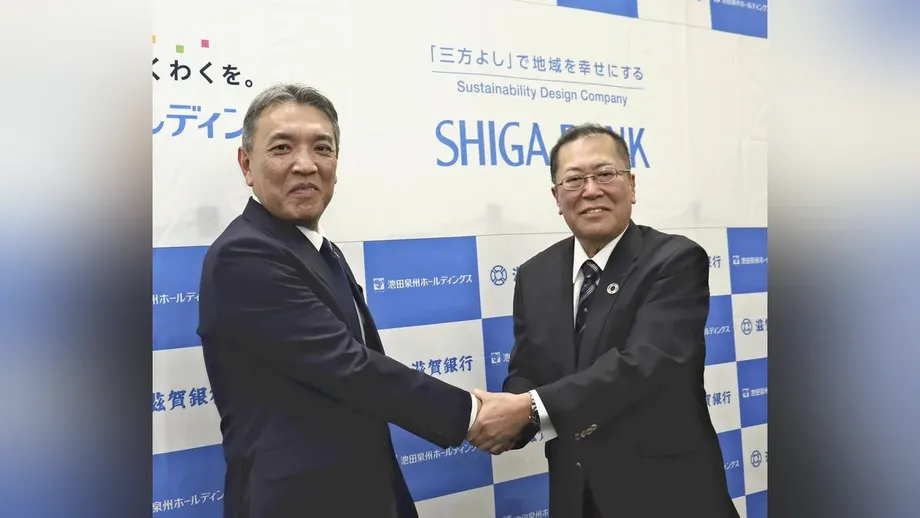
Shiga Bank and Osaka's Ikeda Senshu Holdings confirmed on October 23 that they were considering a management integration that would bring together businesses with combined assets of 14.2649 trillion yen. If completed, the transaction would create the largest regional banking group in Japan's Kansai region by assets, overtaking Kyoto Financial Group.
Contents
- A Proposed Group With More Than 14 Trillion Yen in Assets
- How the Relationship Reached This Point
- What the April Agreement Actually Set Out
- How Large Would the Combined Business Be?
- Nearly 20,000 Companies Use the Two Banks as Their Main Bank
- Why Deposits and Operating Costs Matter
- What Business Customers Could Gain
- What the Plan Means for Individual Customers
- Regional Finance Beyond Loans
- Key Points
The companies are considering establishing a holding company, with no plan to merge the banks themselves. That structure would put the banking businesses under common ownership while keeping them as separate banks. The aim is to expand their customer base and strengthen their ability to compete across Shiga, Kyoto, Osaka and Hyogo.
A formal announcement could come as early as October 29. Both companies said on October 23 that integration was under consideration, that no specific decision had been made and that they would promptly announce any matter requiring disclosure. The possible announcement date is therefore a date to watch, rather than a confirmed completion timetable.
The talks follow a capital and business alliance agreed on April 17, 2026. That agreement already set out cooperation on corporate services, personal wealth management, regional development, staff training and digital technology. The integration discussions would take the relationship beyond cooperation between separate groups toward common management.
How the Relationship Reached This Point
Shiga Bank and Ikeda Senshu have worked together on customer convenience since 2017, when they introduced mutual ATM fee waivers. Their April agreement broadened that relationship into a plan covering both ownership stakes and banking services.
The main developments are:
- 2017: The banks introduced mutual ATM fee waivers.
- April 17, 2026: Both boards approved a capital and business alliance, including plans for each company to acquire approximately 0.5% to 1% of the other's shares.
- October 23: Both companies confirmed that they were considering management integration.
- October 29: A formal announcement could take place as early as this date.
At the April announcement, Shiga Bank President Shinya Kubota and the president of Ikeda Senshu Holdings said future integration was not ruled out, but was not then being considered. Their immediate priority was to produce benefits from the alliance. The October statements mark a change from that position.
What the April Agreement Actually Set Out
Shiga Bank's April alliance notice said the companies would acquire shares in each other to support a lasting cooperative relationship. Each acquisition was expected to represent approximately 0.5% to 1%, based on share prices at the time. The precise number of shares and the acquisition method were to be decided with market conditions in mind.
A capital alliance means companies support their business relationship by owning shares in each other. At the percentages announced in April, each company would hold a small stake in its partner. A holding company arrangement would go further by placing the banking businesses within one corporate group.
Ikeda Senshu Holdings' alliance disclosure also said a joint consultative body would develop and carry out specific measures. Both companies expected the immediate effect on their consolidated financial results to be minor.
The April documents therefore described a programme of cooperation whose financial benefits would take time to develop. They did not set out the terms of a management integration. No integration completion date, ownership allocation or leadership structure was given in the October statements.
How Large Would the Combined Business Be?
Shiga Bank had consolidated assets of 7.669 trillion yen at March 31, while Ikeda Senshu Holdings had 6.5959 trillion yen. Their simple combined total is 14.2649 trillion yen, compared with Kyoto Financial Group's 11.8256 trillion yen.
That puts the proposed combination about 2.4393 trillion yen, or approximately 20.6%, above Kyoto Financial Group on those figures. The combined group would rank first among regional banking groups in Kansai, also known as Kinki, and eighth among regional banking groups nationally.
Assets are the things a bank owns or has a claim on, including loans that borrowers must repay and securities held as investments. The asset total measures the size of the business. Earnings depend on what the banks receive from lending, investments and services, and what they spend on deposits, staff and operations.
The 14.2649 trillion yen figure is a simple addition of the two existing totals. It gives readers a measure of the proposed group's scale while the companies work through the structure of any transaction.
Nearly 20,000 Companies Use the Two Banks as Their Main Bank
The proposed combination also has a substantial business customer base. A 2026 main bank survey counted 10,799 companies for Shiga Bank and 9,085 for Ikeda Senshu Bank, producing a combined total of 19,884.
A main bank is a company's principal banking relationship. Businesses often rely on that bank for regular financing and advice as well as everyday transactions. Bringing those relationships into one group would give the proposed organisation a wider base for corporate services.
Shiga Bank ranked 27th and Ikeda Senshu 37th among financial groups by the survey's customer count. Together, they would rank 17th, ahead of Yamaguchi Financial Group. Among financial groups based in Kansai, they would be second to Resona Holdings.
Resona's count was 86,095 companies, compared with the proposed combination's 19,884, or about 23.1% of Resona's total. The comparison shows the scale of the competition: even after integration, the two banks would face a much larger rival by this measure.
The survey analysed a database of 1,624,517 companies using information at the end of March. Where a company listed several main banks, it counted the highest ranked bank. Its customer figures measure business banking relationships, while the regional asset ranking measures the size of banking balance sheets.
Why Deposits and Operating Costs Matter
Population decline, changing industries, digital technology and the response to decarbonisation were all identified in the April disclosures as pressures on regional banks. The companies said customers increasingly needed help solving business and financial problems alongside conventional lending services.
Competition for deposits is another factor behind the integration discussions. Deposits provide banks with money they can use to support lending. As interest rates rise, banks can earn more from loans, but may also need to offer customers better deposit rates to attract and retain their savings.
Shiga Bank faces competition within its home prefecture, including from Kansai Mirai Bank. Osaka is contested by major banking groups and Resona as well as regional lenders. A larger customer base would give the proposed group more opportunities to gather deposits and provide loans across neighbouring markets.
Staff expenses and the cost of running core banking systems are also increasing. Those systems handle essential records and transactions, such as balances, payments and deposits. The April alliance included sharing knowledge and studying more efficient services, giving the companies an existing framework for examining some of those costs.
What Business Customers Could Gain
Shiga Bank identifies Shiga and Kyoto as its main operating areas, while Ikeda Senshu focuses on Osaka and Hyogo. Their neighbouring territories are central to the plan: the companies want to use each other's branches, business contacts, employees and specialist services.
The April agreement included support for corporate growth, business succession and mergers and acquisitions. Business succession means arranging for a company to pass from its current owner to a new leader or owner, whether within a family, to employees or through a sale.
For a company seeking a buyer or a partner, access to a wider network could provide more potential matches. A business expanding beyond its home prefecture could also benefit from services and contacts available elsewhere in the group. These are practical ways the stated plan to broaden the customer base could translate into services.
The agreement also covered cooperation in growing industries and the use of services supplied by group companies. The commercial aim is to offer existing customers a broader range of support, rather than relying solely on increasing the volume of loans.
What the Plan Means for Individual Customers
Individual customers were part of the April alliance from the outset. The companies agreed to cooperate on services for building savings and investments, passing assets to the next generation and providing financial advice.
They also planned joint development of staff working in wealth management. That term covers advice and services for managing a person's money and investments, including planning how assets will be inherited.
The mutual ATM fee waivers introduced in 2017 are an existing example of cooperation that customers can use. The October integration discussions concern the ownership and management structure above the banks, while the reported approach would retain the banks as separate businesses.
The wider alliance also includes staff exchanges, digital technology and the use of data. Those measures could support changes in how services are delivered, but the companies have not announced a package of new retail products as part of the integration discussions.
Regional Finance Beyond Loans
The April agreement included sustainable finance and cooperation on regional industrial development. Sustainable finance means providing funding that helps businesses address environmental or social goals, including changes associated with reducing carbon emissions.
Shiga Bank and Ikeda Senshu linked this work to changes in the industries and communities they serve. Their plan combines financing with advice, employee development and shared knowledge, reflecting a broader role for banks in helping local businesses adapt.
The immediate development to watch is the possible formal announcement on October 29. A detailed integration proposal would give customers, employees and shareholders a clearer picture of how the companies intend to turn the April alliance into a single group.
Key Points
- Shiga Bank and Ikeda Senshu Holdings confirmed on October 23 that management integration was under consideration.
- The proposed approach involves a holding company while retaining the banks as separate businesses.
- Combined March 31 assets totalled 14.2649 trillion yen, about 20.6% more than Kyoto Financial Group.
- The two banks had 19,884 main bank business customers in a 2026 survey.
- The April 17 alliance covered mutual shareholdings, corporate services, personal finance, regional support, staff and digital technology.
- A formal announcement could come as early as October 29, but no specific integration decision had been announced.