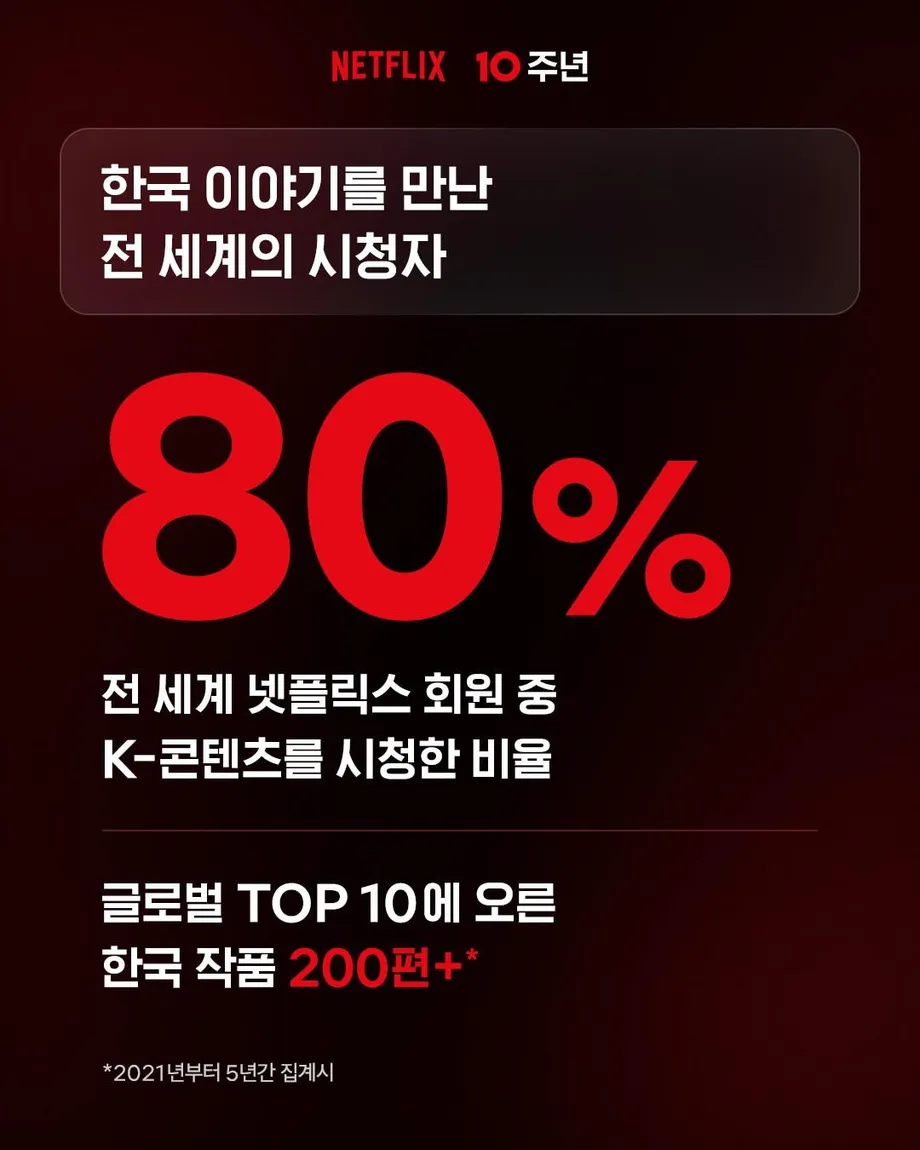
A global audience built on a decade of Korean production
About 80% of Netflix members worldwide have watched Korean content, the company says, as it marks a decade of working with an industry that has supplied more than 200 titles to its global Top 10 rankings. Behind that audience is a production network involving more than 80 Korean companies, filming in more than 100 cities and villages.
Contents
- A global audience built on a decade of Korean production
- How Korea became central to Netflix
- New directors gain support for their first major projects
- More time before release changes what reaches the screen
- Visual effects become part of planning, not just finishing
- Training reaches thousands, with experience carried into new jobs
- Translation and accessibility carry stories further
- Small films find audiences, while popular shows affect daily life
- Higher costs and ownership shape who benefits
- Key Points
Netflix presented the figures through its anniversary website, Netflix and Korea: 10 Years, unveiled on October 23, 2026. Its production totals cover 2016 through 2025, when the company produced or jointly produced more than 200 Korean works. More than 25,000 cast and crew members participated, alongside more than 70,000 extras and workers hired by the day.
The anniversary account also describes how those productions were made and distributed: more than 6,500 people received training opportunities between 2021 and 2025, while 122 partners worked on dubbing and subtitles. More than a third of Korean Netflix originals released over the latest three years involved emerging directors or writers.
Korean producers now have access to audiences far beyond their home market, including viewers who discover smaller films alongside major series. At the same time, rising production costs and ownership arrangements have left questions about how much of that success returns to the companies making the work.
Netflix's figures describe both audience reach and production activity. The 80% measure concerns members who have watched Korean content at some point. The Top 10 figures track titles reaching popularity rankings, while the production totals count works Netflix helped make.
How Korea became central to Netflix
Netflix began operating in South Korea in January 2016. Its first Korean original series, Kingdom, arrived in 2019, combining a historical setting with a zombie outbreak. Squid Game followed in 2021 and became the company's biggest series in a language other than English.
The company's anniversary figures place more than 200 Korean titles in its global Top 10 since the ranking system began in 2021. A count covering June 2021 through 2025 put the number at 210.
Netflix's Tudum rankings list Squid Game season one first among its most popular series in languages other than English, followed by seasons two and three. True Education also appears in that chart, in tenth place.
The milestones show how the relationship developed from a service launch into a substantial production commitment:
- January 2016: Netflix began its Korean service.
- 2019: Kingdom became its first Korean original series.
- 2021: Squid Game became a global hit, and Netflix began publishing its global Top 10 rankings.
- 2023: Netflix announced plans to invest $2.5 billion in Korean content over four years.
- 2021 to 2025: More than 6,500 people received production education opportunities.
- October 23, 2026: Netflix unveiled its anniversary website covering content, production, localization and wider effects.
New directors gain support for their first major projects
More than one in three Korean Netflix originals released over the past three years involved an emerging director or writer, according to the company. Those opportunities extend beyond receiving permission to make a film or series: new creators also need experienced colleagues to help turn scripts into finished productions.
Park Yoon-seo worked as an assistant director on Kingdom season two before making a directing debut with Girigo. Park described how receiving an opportunity also made it possible to cast emerging performers.
Park, the director of Girigo, explained the thinking behind that first project:
It was a challenge made possible because Netflix actively believes in new attempts rather than relying on familiar names.
Kim Hee-jin, who directed a first feature with My Name Is Loh Kiwan, described assistance from experienced staff and support coordinating postproduction. That stage includes editing, sound, visual effects and other work completed after filming.
Writers and producers also described a wider choice of subjects. Choi Kyung-sook, the planning producer of the drama about Eun-jung and Sang-yeon, said the range of stories had expanded beyond those designed to attract the broadest possible audience. Kim Min-seok, the writer of Juvenile Justice, described being encouraged to tell the story rather than beginning with concerns about international performance.
More time before release changes what reaches the screen
Netflix's practice of completing production before release has changed a familiar pressure in Korean television: filming and rewriting while a series is already being broadcast. Finishing earlier gives teams more time to plan effects, edit episodes and check sound and picture quality.
Lee Seong-min, an associate professor in the Department of Media Arts and Sciences at Korea National Open University, said the spread of advance production had reduced the practice of delivering scripts at the last minute. He also described more time for postproduction on projects outside Netflix.
Series formats have become more flexible. Alongside traditional dramas built around roughly 16 episodes, Korean creators have made productions running for six, eight or ten episodes, as well as stories continuing across seasons.
Entertainment producers described another benefit: deciding where a show should end. Kim Su-ah, chief executive of Sijak Company, which makes Single's Inferno, said an agreed ending allowed producers to build a complete narrative rather than keep extending a successful programme.
Yoon Hyeon-jun, chief executive of Studio Slam, which makes Culinary Class Wars, described sustained investment in ideas as central to developing entertainment formats. Physical: 100 became the first Korean entertainment programme to lead Netflix's global television ranking for shows in languages other than English. Culinary Class Wars season one also reached the top.
Visual effects become part of planning, not just finishing
Korean technical teams describe a shift in when they enter a production. Visual effects specialists increasingly help design scenes before filming begins, deciding with directors which elements to shoot physically and which to create digitally.
Ahn Jae-gon, an executive at Madman Post who worked on Kingdom and Mask Girl, said the role had expanded into planning the visual appearance of a production across its entire schedule. Lead studios coordinate with specialist companies in Korea and overseas to manage quality and delivery.
Sweet Home provides a concrete example of what preparation time can change. Son Seung-hyun, chief executive of visual effects company Westworld, said the production received eight months of preparation, allowing the team to create its principal creatures before filming.
Colorist Park Jin-young described high dynamic range, or HDR, as expanding the tools available for shaping an image. HDR allows a wider range of brightness and colour, giving artists more room to preserve detail in dark areas and bright highlights.
Sound supervisor Kim Seok-won said meeting higher technical standards helped Korean teams understand international production expectations and build confidence. Squid Game editor Nam Na-young described receiving greater recognition as the series became a worldwide success, including an Emmy nomination for editing.
Training reaches thousands, with experience carried into new jobs
Netflix says it provided education opportunities to more than 6,500 people through Korean production training and skills programmes between 2021 and 2025. The anniversary website connects those programmes with examples of workers moving into more demanding roles.
Baek Seung-min worked on the lighting team for Kingdom before taking responsibility for lighting on the second filming unit of All of Us Are Dead season two. Baek described larger productions as opportunities to use equipment and filming techniques that staff had previously had fewer chances to encounter.
Gu Sang-mo moved from a production internship into work as a line producer, a role concerned with the practical organization of a shoot. After learning about the production process from working professionals, Gu participated in filming in Korea and Italy for Can This Love Be Translated?
Gu said overseas filming experience was unusual at that career stage and helped broaden a working perspective. Such experience gives the training figures a practical meaning: staff learn how to coordinate locations, schedules and teams, then bring that knowledge to later productions.
Translation and accessibility carry stories further
Netflix works with 119 dubbing studios and three specialist subtitle partners, a total of 122 localization partners. Localization means adapting language and presentation so viewers elsewhere can follow both the story and its cultural meaning. Korean works can receive dubbing in as many as 36 languages and subtitles in as many as 33.
Culinary Class Wars illustrates why a title may need more than a literal translation. Its Korean name refers to black and white cooking classes. The international title instead communicates competition and hierarchy while avoiding a possible racial reading.
The anniversary website also describes translating the emotional meaning of titles such as When Life Gives You Tangerines and using colours in subtitles to distinguish teams in Physical: Asia. These choices help viewers identify relationships and speakers as well as understand individual words.
Accessibility work serves viewers who need information delivered differently. Audio description explains visual action for people who are blind or have limited vision. Subtitles for deaf viewers and those with hearing loss can identify speakers and meaningful sounds alongside dialogue.
Kang Nae-young, an audio description writer, recalled that Kingdom launched with audio description available at the same time as the series. Choi Ha-neul, a sign language instructor and accessibility monitor, described the value of sharing trending shows and common conversation topics with friends.
Small films find audiences, while popular shows affect daily life
Directors of smaller Korean films described international distribution as a way to gather an audience that might be scattered across many countries. Nam Gung-sun, director of The History of Confession, compared fans exchanging reactions online across borders to a festival.
Kim Da-min, director of Honey Part-time Job, described the value of simultaneous international access:
The fact itself that we can show our work to people around the world in real time is very meaningful.
Wi Eun-kyung and Son Gwang-min, directors of Aunt Sun-hee, said their film generated thousands of times more feedback than their previous work, alongside opportunities for screenings at overseas festivals. Kim Geun-ho, director of Vietnam Bodhisattva, described developing an ambition to make a Netflix series or feature.
Research by Synthesio also tracked activity outside the viewing service. Following the release of D.P. season one, Korean search interest in posttraumatic stress disorder, or PTSD, reached 1.8 times the preceding eight week average on Google and 4.1 times that average on Naver. PTSD is a condition that can develop after someone experiences or witnesses a traumatic event.
The same research described an approximately 303% increase in restaurant reservations and waiting list registrations for establishments featured in Culinary Class Wars season two during the five weeks after release. Sales of Choi Kang-rok's cooking notebook rose to about 14 times the previous month's level following season one.
Higher costs and ownership shape who benefits
Korean production companies face a harder financial calculation as the scale of projects grows. An industry estimate put drama production costs at around 500 million won per episode in an earlier period, compared with roughly 2.5 billion to 3 billion won more recently. The figures describe an increase of about five to six times.
Squid Game season one reportedly cost about 25 billion won to produce. Seasons two and three together reportedly received more than 100 billion won. These budgets show how much larger major productions can become after a successful opening season.
Park Ki-soo, a professor of cultural content at Hanyang University's ERICA campus, warned that rising costs and limited distribution choices could make producers more dependent on global platforms. A company may gain experience making a hit while still facing difficulty financing its next project.
Ownership is central to that concern. Intellectual property, often shortened to IP, includes rights that can generate income from sequels, games, merchandise and other uses of a story or its characters. When a platform finances production and holds those rights, the production company's later income depends on its contract rather than simply on how popular the title becomes.
Netflix's anniversary figures give a measure of production activity and audience reach. The company did not provide a breakdown of producer earnings or ownership terms across the more than 200 works. For Korean companies, the financial benefit of a global success therefore turns on both the production fee and the rights negotiated before filming begins.
Key Points
- Netflix says about 80% of its members worldwide have watched Korean content.
- From 2016 through 2025, it worked with more than 80 Korean production companies on more than 200 works.
- Productions involved more than 25,000 cast and crew members and more than 70,000 extras and workers hired by the day.
- More than a third of Korean originals released over the latest three years involved emerging directors or writers.
- More than 6,500 people received training opportunities between 2021 and 2025.
- A network of 122 localization partners helps deliver dubbing and subtitles, alongside accessibility services.
- Rising budgets and the ownership of rights remain central concerns for Korean producers seeking lasting income from international success.