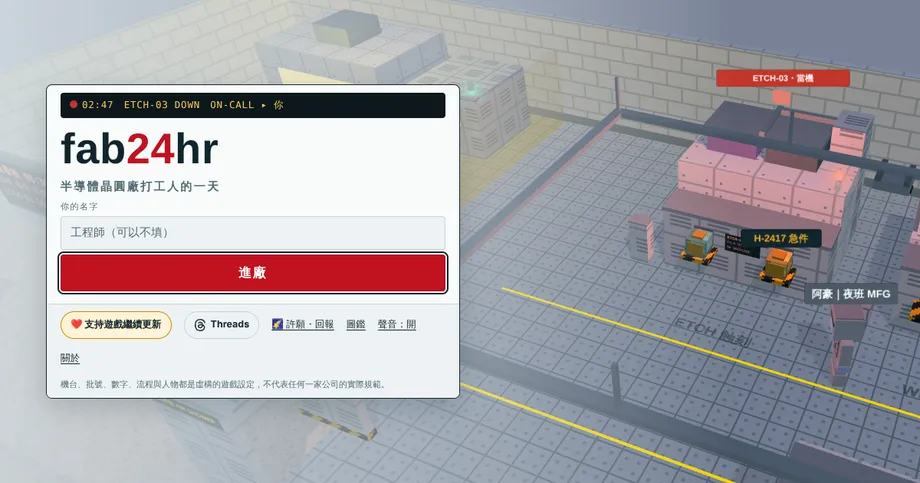
A 02:47 phone call starts the shift
At 02:47, a semiconductor tool stops working, an urgent batch of wafers is stuck inside, and an engineer must explain when production can resume. That is the opening predicament in fab24hr, a free browser game whose fictional factory has struck an uncomfortable chord with semiconductor workers in Taiwan.
Contents
- A 02:47 phone call starts the shift
- What players actually do
- A clock that follows the player
- Glowmere connects the factory to a person
- How the game expanded
- Thirty one roles, different kinds of pressure
- One breakdown, several versions of the day
- Why workers find it unsettling
- An accessible introduction with fictional rules
- The Bottom Line
Created by Taiwanese independent developer mrclty, the game turns repair calls, production bottlenecks and tense conversations with managers into short, playable shifts. Its blocky, isometric 3D factory looks approachable. The pressure comes from being the person everyone expects to have an answer.
The developer's official game guide dates its launch to October 4, 2026, and describes a personal project made by one author working with AI. The documented version offers 31 playable roles across a research and development line, a production factory and a testing and assembly facility.
Players can follow a hearing aid chip called Glowmere from its first experimental wafers to the person who uses it, or choose a job and handle a shift matched to their device's clock. Traditional Chinese, English and Japanese versions are available, with no installation or account required to play.
Fab workers have responded with recognition, jokes and groans. Discussions on Dcard and Threads have compared the experience to confinement at work and the tension of a horror game. For newcomers, the same situations offer a view of the people and decisions behind a finished chip.
What players actually do
Fab24hr puts the player inside a workplace rather than above it. Instead of building a factory or running a semiconductor company, the player investigates faults, reads handover notes, moves production forward and answers colleagues whose priorities may conflict.
The process engineer's initial assignment centres on ETCH-03, an etching machine. Etching removes selected material from a wafer, helping create the tiny structures that form a chip. A wafer is the thin disc on which many chips are manufactured together.
An equipment engineer repairs the machinery, while a process engineer decides whether the manufacturing step is operating properly and whether batches can proceed. Manufacturing staff schedule and move those batches. A machine failure therefore creates several connected problems: fixing the equipment, protecting the product and finding a workable production schedule.
Characters make those responsibilities easier to follow. Kai handles equipment, Ya-Ting owns the batch as the process integration engineer, Yun coordinates manufacturing, and Chief Chen is the boss. Hao, working in manufacturing at night, is the person who calls when something goes wrong.
A clock that follows the player
A Day in the Fab assigns one of four shifts according to the time on the player's device: late night from midnight to 05:59, morning from 06:00 to 11:59, afternoon from noon to 17:59, and evening from 18:00 to 23:59. Each role has a different story for each period.
The developer describes the process engineer's late night situation in terms that explain the game's central tension:
You are at home and can't see the tool. You ask the night shift to be your eyes, then give instructions over the phone.
Morning brings the handover sheet, a meeting about the repair deadline, an investigation and checks before restarting the tool. Afternoon interrupts lunch with a wafer that needs work repeated by hand, followed by an incident report and review meeting. Evening offers repeated chances to leave, followed by another person or warning light demanding attention.
The official guide puts each shift at about five to 15 minutes. Its four periods are a storytelling structure: the guide explains that workers on real factory floors mostly rotate through two shifts lasting 12 hours, while engineers generally work days and share duties answering calls outside normal hours.
Glowmere connects the factory to a person
The longer mode, The Life of a Chip, follows Glowmere, the first hearing aid chip designed independently by a fictional small company. Players take fixed roles as the product moves through research, manufacturing, testing, packaging and shipping, before reaching its user.
The official guide lists a prologue and 13 chapters, while earlier descriptions put the story at 12 chapters. It identifies the finale as chapter 13, played as Mr. Shen, the person at the end of the chip's journey. Each chapter takes about ten minutes, and players can return over several sessions or start from a chosen chapter.
The research section begins roughly six months before the production factory's day. Engineers work out how to make the new chip reliably before transferring it to production. One batch from that product later becomes H-2417, the urgent lot at the centre of the factory's problems. A lot is a group of wafers managed together through manufacturing.
Three endings connect earlier choices to later consequences: delivery on time, delivery a little late with no returns, or a batch coming back three months later. The story carries a decision beyond the engineer's desk and into the experience of a customer and user.
How the game expanded
The official site's dated details show how quickly the project grew after launch. Its current role list reaches beyond the process, equipment and manufacturing jobs featured in early descriptions, adding work before and after the main wafer factory.
- October 4, 2026: fab24hr launched as a free browser game.
- October 18, 2026: 21 additional roles were added, according to the official fact sheet, bringing the total to 31.
- The official guide lists those 21 added roles and the main story as beta content, indicating that they are still being developed.
The distribution is eight roles in research and development, 20 in the production factory, and three at the testing and assembly facility. With four shifts per role, the documented version provides 124 role and shift combinations. That breadth lets players revisit a shared manufacturing problem from several positions.
The developer also invites suggestions for characters and stories, and the project continues to add roles, shifts and events. The game remains a single player experience; players have suggested a cooperative mode resembling Overcooked, where people must coordinate under pressure.
Thirty one roles, different kinds of pressure
Research engineers begin with questions that come before mass production: how to divide an initial batch of 12 wafers, interpret electrical results and find settings that work consistently. The research line has only one tool of each kind, making its choices different from those in the production factory.
Process and equipment roles each cover seven areas: etching, lithography, thin films, chemical mechanical polishing, furnaces, ion implantation and wet cleaning. Lithography transfers a circuit pattern onto a wafer. Chemical mechanical polishing, commonly shortened to CMP, makes a surface flat by combining chemical action and polishing.
Other jobs reveal dependencies outside the machine itself. Facilities engineers supply gases and chemicals. Mask engineers inspect the patterned templates used during exposure. Quality engineers decide whether a lot can leave the factory, while production control staff revise schedules and shipping expectations when equipment loses capacity.
Testing and assembly continue the story after wafer production. A test engineer examines failures and sets testing limits. An assembly process engineer handles steps such as cutting wafers into individual chips and attaching fine wires. A customer liaison answers questions about packaging, returned samples and discrepancies in chip counts.
One breakdown, several versions of the day
ETCH-03 is the meeting point for several stories. The handover sheet written by manufacturing during the night becomes the document a process engineer reads in the morning. Quality staff review the response to the same incident, while production control plans around the same damaged capacity.
A suspected helium problem reaches the facilities control room. An evening warning light seen by the process engineer connects to a threshold an equipment engineer might loosen. Wafers already processed in lithography begin queuing when etching stops. Switching roles changes what the player knows and what they can do.
Handover notes therefore serve as more than background text. They carry clues from one worker to another, making documentation part of the action. A person asked for a repair estimate may first need someone else's observations, photographs or test results.
The connected structure explains the appeal more precisely than the technical setting alone. Each job has a reasonable immediate goal: restore the tool, protect the batch, meet the shipping date or finish the shift. The tension emerges when achieving one goal puts pressure on another team.
Why workers find it unsettling
Taiwanese workplace discussions have focused on the familiarity of interrupted rest, urgent calls and managers asking for a completion time before the cause of a fault is known. Some Dcard commenters described the game as another way to feel trapped at work after hours.
A Threads user recounted a particularly fitting interruption: a supervisor asked staff to try the game during an afternoon handover, then a real machine alarm sounded. The workers closed the simulator and returned to the equipment. The anecdote captures why an entertaining premise for an outsider can feel like an unwanted second shift to someone doing the job.
Players have also praised the relationships between departments. The proposed Overcooked style multiplayer mode reflects that interest: much of the challenge comes from passing information and coordinating tasks, rather than operating a machine in isolation.
Overseas interest has followed the Taiwanese discussion. Journalist Mark Tyson tried the game in a browser and found it ran smoothly, while understanding why experienced factory workers found it stressful. His reaction was that this particular workplace was not the escape he wanted during leisure time. No player total or usage figures were given, so the scale of the game's reach remains unquantified.
An accessible introduction with fictional rules
Fab24hr lowers the entry barrier with explanations attached to technical terms. Players can tap underlined jargon for plain language definitions, including concepts related to wafer maps, gas cabinets, alignment errors, wire bonding and quality reviews. Instructions point toward the next person or tool, and an automatic movement option helps players reach them.
Exploration adds smaller diversions. Objects left in aisles can be collected, and some affect later events. Players can decline certain calls, with different results depending on their response. An illustrated reference collection and a daily results card that can be saved or shared give players ways to review their shift.
The developer says the tools, lot numbers, figures, procedures, people, products and companies are fictional. Technical explanations draw on public material. The game introduces how responsibilities connect; university courses and textbooks provide the deeper technical study recommended by its creator.
Progress is stored in the browser, with an optional Google account connection for continuing on another device. The game itself is free and carries no advertising. It supports phones held upright, tablets and computers, and the official guide says play can continue even in some browsers that cannot display the 3D view.
The Bottom Line
- Fab24hr is a free browser game by Taiwanese developer mrclty, made as a personal project with AI.
- The official guide dates its launch to October 4, 2026, and lists 31 roles with four shifts each.
- The main story follows the fictional hearing aid chip Glowmere through a prologue and 13 chapters to three possible endings.
- Shared incidents connect manufacturing, engineering, facilities, quality and scheduling work.
- Taiwanese workers have responded to its familiar workplace pressures with both praise and discomfort.
- The game supports Traditional Chinese, English and Japanese, requires no installation, and explains technical jargon for beginners.