A signal from neurons helps preserve their insulation
Researchers at the Korea Brain Research Institute have identified a molecular signaling pathway that helps nerve cells maintain myelin, the insulating material around their fibers, in the adult brain. The work connects three proteins, CDK14, FAM19A1 and DIP2A, and traces how a signal sent by a neuron can influence the cells responsible for making myelin.
Contents
- A signal from neurons helps preserve their insulation
- Why an adult brain still needs myelin maintenance
- What the mice revealed about FAM19A1
- DIP2A provides the receiving end
- CDK14 controls a precise molecular step
- Neurons take an active role in their surroundings
- What comes next for aging and brain disease research
- Key Points
The institute announced the findings on October 22, 2026. The team, led by principal researcher Choi Young-sik in its Brain Disease Research Division, found that mice lacking FAM19A1 showed no clear myelin difference during early brain development but developed thinner myelin as adults. That change directed attention toward the ongoing maintenance of insulation after the brain has developed.
The researchers also identified a receiving protein on oligodendrocytes, the cells that produce myelin in the brain. Reducing that protein, DIP2A, specifically in adult mouse oligodendrocytes led to less myelin in the corpus callosum, the bundle of nerve fibers connecting the brain's two hemispheres.
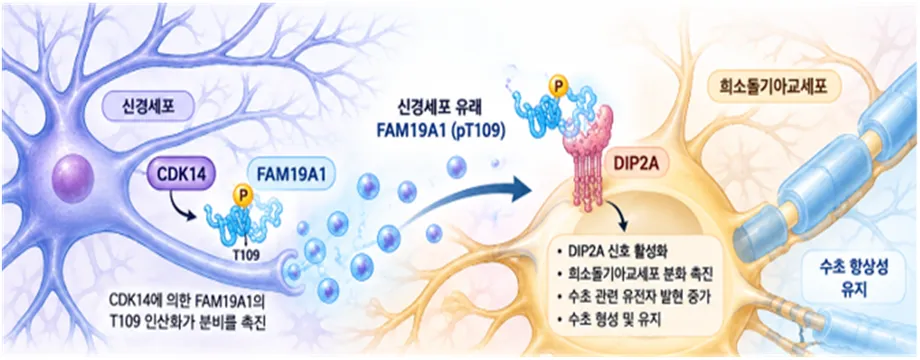
Published in Cell Communication and Signaling, the study describes a chain of communication: CDK14 modifies FAM19A1 inside neurons, helping it leave those cells and bind to DIP2A on oligodendrocytes. This interaction promotes oligodendrocyte maturation and supports myelin maintenance.
The paper, titled "CDK14-dependent phosphorylation of neuronal FAM19A1 activates DIP2A signaling in oligodendrocytes to maintain myelin homeostasis in the adult brain," was written by Soonbong Baek, Seungeun Yeo, Hyun Jin Jung, Jaemyung Jang, Jae Young Seong and Youngshik Choe. It was published on October 6, 2026, in Cell Communication and Signaling, after being received on April 10, 2026, and accepted on September 5, 2026. Its DOI is 10.1186/s12964-026-03221-3.
Why an adult brain still needs myelin maintenance
Myelin wraps around axons, the long fibers through which neurons send electrical signals. Like insulation around a wire, it helps signals travel quickly and reliably. Oligodendrocytes make this wrapping in the central nervous system, which includes the brain and spinal cord.
Adult myelin continues to change in response to nerve activity and the surrounding environment. The biological task therefore extends beyond producing insulation during development. The brain also needs ways to keep that insulation in working condition as its circuits remain active.
Choi's team investigated how neurons participate in that task. Its findings place the neuron at the start of a communication process: a neuron releases a protein signal, and a neighboring cell receives it through a protein on its surface. The receiving cell then changes its state of maturation, helping sustain the myelin surrounding nerve fibers.
What the mice revealed about FAM19A1
FAM19A1 was the team's starting point because it is a protein secreted by neurons in the central nervous system. A secreted protein leaves the cell that produces it and can carry a message to another cell. Here, the researchers examined whether that message helped regulate the cells responsible for myelin.
Mice deficient in FAM19A1 showed no obvious difference in myelin during early brain development. Once the animals reached adulthood, however, their myelin was thinner. The contrast between these life stages was central to the finding: the effect became apparent after the early period when the brain was building its initial myelin structures.
The result links FAM19A1 to the continued stability of myelin in adulthood. It also helps explain why examining an early developmental stage alone would have missed an important part of this protein's role.
Myelin thickness was a concrete measure of the change. A thinner sheath means there is less insulating material around the axon. The study then pursued the mechanism behind that change, asking which protein on an oligodendrocyte receives FAM19A1 and how neurons control the signal they send.
DIP2A provides the receiving end
The team used proteomic analysis to identify DIP2A as a receptor for FAM19A1 on the surface of oligodendrocytes. Proteomics examines proteins and their interactions. A receptor is a protein that recognizes a molecular signal and provides a way for a cell to respond to it.
Finding the receptor gave the researchers a specific link between the neuron releasing FAM19A1 and the oligodendrocyte receiving it. They then selectively reduced Dip2a expression in oligodendrocytes in adult mouse brains. Reducing expression means lowering the cell's production of the protein encoded by that gene.
Myelin decreased in the corpus callosum after that intervention. This region carries connections between the left and right sides of the brain, making it a relevant location for studying the insulation around nerve fibers.
The FAM19A1 deficiency and Dip2a suppression experiments approached the same communication pathway from opposite ends. One removed the signal sent by neurons; the other reduced the receiving machinery in oligodendrocytes. Together, their results connected communication between these cells with the maintenance of adult myelin.
CDK14 controls a precise molecular step
CDK14 supplied another piece of the mechanism. This protein is a kinase, an enzyme that adds a phosphate group to another protein. That chemical modification, called phosphorylation, can change how a protein behaves, including how it interacts with other molecules.
The researchers identified a specific target on FAM19A1: threonine at position 109, written as T109. Proteins are chains of amino acids, and threonine is one of those building blocks. The number identifies its position in the chain, allowing the team to pinpoint where CDK14 acts.
When CDK14 phosphorylated FAM19A1 at T109, FAM19A1 secretion increased and its binding to DIP2A became stronger. The modification therefore affected both the release of the message from the neuron and its interaction with the receiving cell.
Blocking that process reduced FAM19A1 secretion and its binding to DIP2A. It also weakened FAM19A1's ability to promote oligodendrocyte maturation. These linked changes explain why the team describes CDK14, FAM19A1 and DIP2A as a signaling pathway rather than three separate proteins associated with myelin.
The sequence can be understood in three steps. CDK14 modifies the signal protein inside a neuron. FAM19A1 is released and binds to DIP2A on an oligodendrocyte. That interaction supports the cell's maturation and the maintenance of myelin.
Neurons take an active role in their surroundings
Choi, the study's corresponding author, said the findings show that neurons actively influence the cells maintaining their insulation. Describing the result, he said in remarks translated from Korean:
We confirmed that neurons are not simply objects protected by myelin, but actively regulate oligodendrocyte maturation and the state of myelin using a molecular signal called FAM19A1.
The institute's October 22 announcement gave his remarks in Korean as follows:
교신저자인 최영식 박사는 "신경세포는 단순히 수초로 보호받는 대상이 아니라, FAM19A1이라는 분자 신호를 이용해 희소돌기아교세포의 성숙과 수초 상태를 능동적으로 조절한다는 사실을 확인"했다며, "향후 CDK14–FAM19A1–DIP2A 신호축이 노화와 퇴행성 뇌질환에서 발생하는 수초 손상과 어떠한 관련이 있는지를 규명한다면, 성체 수초의 안정성을 보존하거나 손상된 수초의 회복을 촉진하는 새로운 치료전략 연구로 확장할 수 있을 것"이라고 밝혔다.
The finding connects two functions that can seem separate: sending nerve signals and maintaining the material that helps those signals travel. Neurons carry electrical messages, while oligodendrocytes produce myelin. The identified pathway shows how a neuron can also help regulate the condition of those supporting cells.
Oligodendrocyte maturation matters because cells must reach a functional state to carry out their role in myelin production and maintenance. By tracing a signal that promotes that process, the researchers have provided a molecular explanation for one way neurons help maintain their immediate environment.
What comes next for aging and brain disease research
The next research question is how the CDK14, FAM19A1 and DIP2A pathway relates to myelin damage during aging and degenerative brain disease. That relationship has yet to be established. The work described here concerns molecular mechanisms and experiments in mice, with treatment development presented as a future research direction.
Choi said that establishing such a relationship could allow the work to expand into research on strategies to preserve adult myelin stability or promote the recovery of damaged myelin. Those are two related goals: keeping existing insulation intact and helping restore it after injury.
The pathway gives researchers specific steps to investigate, including FAM19A1 release, its binding to DIP2A and the maturation response in oligodendrocytes. Understanding which of these steps changes during aging or disease would help define where further experiments should focus.
The study was supported by South Korea's Ministry of Science and ICT and Ministry of Trade, Industry and Energy. The Korea Brain Research Institute, headed by President Lee Seung-bok, announced the work as a finding from its Brain Disease Research Division.
Key Points
- The Korea Brain Research Institute announced the findings on October 22, 2026, following publication in Cell Communication and Signaling on October 6, 2026.
- Mice lacking FAM19A1 developed thinner myelin in adulthood despite showing no clear difference during early development.
- DIP2A was identified as a receptor for FAM19A1 on oligodendrocytes. Reducing Dip2a expression in these cells decreased myelin in the adult mouse corpus callosum.
- CDK14 modifies FAM19A1 at T109, promoting its secretion, binding to DIP2A and ability to support oligodendrocyte maturation.
- The team plans to investigate the pathway's relationship with myelin damage in aging and degenerative brain disease.