New rules cover a growing pool of overseas assets
China will introduce annual reporting on overseas investment and require early reports on projects involving at least $100 million in Chinese investment or affecting diplomatic relations under revised rules published on October 22, 2026. The changes come as Chinese investment held abroad has grown from $1.8 trillion in 2017 to nearly $3.4 trillion at the end of 2025.
Contents
- New rules cover a growing pool of overseas assets
- Why China is replacing the 2017 framework
- Resident individuals are explicitly included
- Protection extends to pressure over technology and ownership
- Some major projects must be reported earlier
- Reinvestment and project completion remain part of oversight
- Approval and filing thresholds
- Commerce figures show where investment is growing
- Investment support reaches beyond the new measures
- What happens before December 1
- Key Points
The National Development and Reform Commission (NDRC), China's top economic planner, issued the Administrative Measures for Outbound Investment through Order No. 49 of 2026. The measures take effect on December 1, 2026, when they will replace the enterprise overseas investment rules issued in 2017.
The revised framework explicitly includes resident individuals alongside domestic enterprises and other organizations. It also strengthens reporting arrangements intended to help authorities respond when Chinese investors face demands abroad to hand over technology or data, or dispose of shares and assets.
The measures contain 76 articles across six chapters: general provisions, investment guidance and services, supervision, investment protection, legal responsibility, and supplementary provisions. Their central purpose is to support overseas investment while giving authorities more information about risks before, during and after projects.
Why China is replacing the 2017 framework
The NDRC says overseas investment has expanded substantially under the previous rules, helping Chinese products, services, brands and standards reach foreign markets. It also points to investment income, employment, major infrastructure projects and smaller projects serving local communities as benefits for China and investment destinations.
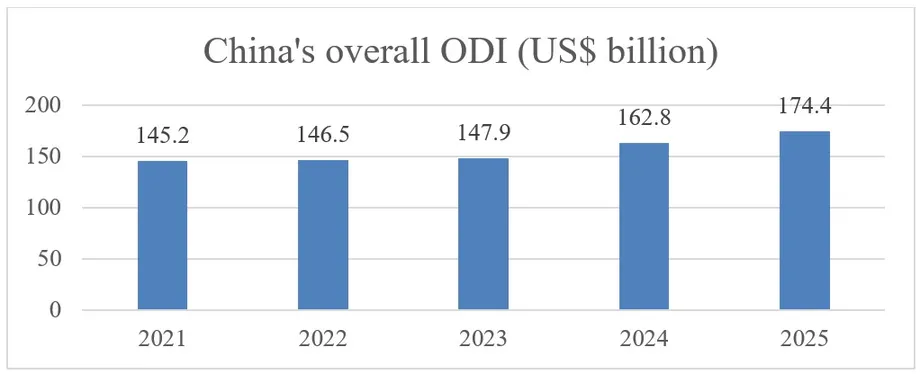
Annual outward investment rose from $158.3 billion in 2017 to $213.6 billion in 2025, according to the commission. That is an increase of $55.3 billion, or about 35%. The accumulated investment held overseas grew by roughly 89% over the same period, using the rounded totals of $1.8 trillion and $3.4 trillion.
These figures measure different things. Annual investment, often called a flow, records investment during a particular year. Investment stock measures the accumulated position held abroad at a particular date. The much larger stock shows the scale of the overseas interests that the revised protection and monitoring arrangements will cover.
The commission says the external environment has also become more difficult, citing rising unilateralism and protectionism, local conflicts and political instability. Its explanation places the revision within policy decisions made at the third and fourth plenary sessions of the 20th Communist Party Central Committee and the State Council's June 2026 Regulations on Outbound Investment.
Resident individuals are explicitly included
The 2017 measures mainly addressed overseas investment by domestic enterprises and organizations other than enterprises. The NDRC says investors and investment methods have since become more varied, requiring rules that better reflect who is investing abroad.
The State Council's regulations identify domestic enterprises, other organizations and resident individuals as investors. The new NDRC measures repeat that scope and extend their service and protection arrangements accordingly. The commission says the framework supports investment conducted according to market principles.
For individuals, the practical message is continuity alongside broader recognition. Investors can continue using established routes into overseas financial markets, including the Qualified Domestic Institutional Investor scheme, the Hong Kong Stock Connect channels and Cross Boundary Wealth Management Connect.
Those channels provide different ways to access eligible investments. The Qualified Domestic Institutional Investor scheme operates through approved domestic institutions, while the connect programs link specified financial markets or wealth management services. The commission presents their continued operation as part of aligning the revised measures with existing investment arrangements.
Protection extends to pressure over technology and ownership
The NDRC identifies a specific concern behind the stronger protection provisions: measures taken by some countries or regions that it describes as discriminatory. These include demands that Chinese investors provide technology or data, or dispose of equity holdings and other assets.
A demand to dispose of equity means an investor may have to sell or otherwise give up an ownership stake. For a company operating abroad, such a requirement can affect control of its business as well as the value of its investment. Demands for technology or data concern resources that may be central to its operations.
The previous rules already required reports about major adverse circumstances, with a focus on protecting people and assets connected to overseas investment. The revision improves that reporting system and establishes an annual overseas investment information report covering the kinds of pressure described by the commission.
Major adverse circumstances must be reported immediately. Investors must submit their annual overseas investment information reports by June 30 each year.
The NDRC says informing the authorities should help investors and government departments work together to protect legitimate rights and interests. The annual report adds a regular reporting channel alongside the mechanism for serious adverse events, giving the framework both periodic updates and reports prompted by particular problems.
Some major projects must be reported earlier
The revised measures also address risks that arise before an overseas project is fully under way. They establish reporting on preliminary work for projects involving at least $100 million in Chinese investment or affecting China's diplomatic relations with the countries concerned.
Investors must submit a preliminary work report through the national online system at least 10 working days before undertaking important preliminary work. This includes making investment commitments to a foreign government, signing an investment agreement or similar document, and other preliminary work that could affect China's diplomatic relations with the countries concerned.
Early reporting brings those projects to the attention of authorities while preparations are still taking place. That changes the timing of oversight: officials can receive information about a project before the later stages covered by investment and completion reports.
The NDRC says some investors have suffered losses after underestimating overseas risks or responding poorly to them. It cites political instability, changing policies and rising security risks in some destinations as reasons to improve monitoring, warnings and prevention.
The commission's explanation does not set out the monetary threshold or annual reporting deadline, but the measures specify the $100 million threshold and June 30 deadline. The NDRC will publish standard reporting forms and lists of supporting documents; the supplied materials do not include updated forms or detailed submission guides.
Reinvestment and project completion remain part of oversight
The 2017 framework already included reports on large projects outside the sensitive category, described in the NDRC explanation as overseas reinvestment, as well as reports on project completion. The revision builds on those arrangements rather than replacing every existing procedure.
Overseas reinvestment broadly concerns further investment made through an existing overseas business. Monitoring it helps authorities follow investment activity beyond the initial movement of capital from China. A project completion report serves a different purpose by recording the position when a project reaches that stage.
Under Article 14, investors making non-sensitive investments through overseas enterprises or other organizations they control must submit an overseas reinvestment report through the online system at least 10 working days before implementation. The article specifies no monetary threshold. Investments back into China through those controlled overseas entities must also be reported under the same arrangements.
For investments subject to approval, filing or overseas reinvestment reporting, investors must report completion or termination through the online system within 10 working days. Completion includes the end of construction, the transfer of the target equity or assets, or full expenditure of the Chinese investment amount. Termination includes abandoning an investment or ceasing to hold the overseas ownership, control, management rights or other related interests it created.
Development and reform departments may also require written reports on major matters, with investors required to respond on the issues and within the deadline specified in the inquiry. Information reports must be truthful, accurate, complete and timely, and investors must promptly submit missing information or correct errors and omissions. Investors can print confirmation of completed submissions through the online system.
The revised reinvestment arrangements, annual information reports and preliminary project reports therefore operate at different points in an investment's life. Together, they expand the information available to departments responsible for investment protection and risk management.
For investors, the practical change is a wider set of reporting responsibilities alongside continued access to guidance and services. The commission links that exchange of information to coordinated action on overseas risks, particularly where a project has financial, security and diplomatic dimensions.
Approval and filing thresholds
Sensitive overseas investments, whether made directly or through controlled overseas entities, require NDRC approval before implementation. Direct non-sensitive investments require filing before implementation. For centrally managed enterprises, filing is handled by the NDRC. For local enterprises, projects involving Chinese investment of $300 million or more are filed with the NDRC, while those below $300 million are filed with the provincial development and reform department where the investor is registered. Other organizations follow the enterprise arrangements, while resident individuals file with the provincial department where they have household registration or usually reside. Information reports follow the same allocation of responsibilities.
The Chinese investment amount includes assets and rights invested directly or through controlled overseas entities, together with financing and guarantees provided. Covered contributions include money, securities, physical assets, technology, data, intellectual property, equity and debt claims.
Investors must apply for and complete changes to an existing approval or filing before specified changes occur. These include adding or removing investors, major changes to the investment location, content or scale, and a change in the Chinese investment amount reaching at least 20% of the originally approved or filed amount, or at least $100 million.
Commerce figures show where investment is growing
Zhao Chunfeng, director of the Ministry of Commerce's Department of Outward Investment and Economic Cooperation, said on October 22 that China's overseas investment stock had reached nearly $3.4 trillion by the end of 2025. Ministry figures placed China among the world's three largest outward investors for nine consecutive years.
Zhao made the remarks at an October 22 State Council Information Office press conference in its series on the start of the 15th Five Year Plan period.
Zhao also put outward direct investment across all industries at $128.62 billion during the first nine months of 2026. That figure covers nine months, while the NDRC's $213.6 billion figure covers the whole of 2025, so the periods need to match before calculating an annual growth rate.
Investment in green and low carbon activities and in digital industries each grew by more than 20% from a year earlier during the first three quarters of 2026, according to the ministry. Both categories expanded faster than outward investment as a whole.
Those figures help explain why the policy discussion reaches beyond traditional overseas construction projects. The ministry is also developing cooperation arrangements for the digital economy, green minerals and green energy, sectors where investment can involve technology, information and strategic resources as well as physical assets.
Investment support reaches beyond the new measures
The Ministry of Commerce says China has established more than 90 investment cooperation working groups with key partner countries. It has also signed nearly 100 cooperation documents covering areas such as industrial and supply chains and green development.
For the 15th Five Year Plan period, Zhao outlined an approach combining investment management, services, development and security. The ministry plans further work on investment rules and implementation provisions, along with revisions to regulations governing overseas contracted projects and overseas labor cooperation.
The ministry also intends to implement guidance on integrity, compliance and social responsibility for overseas enterprises. Work with other authorities will cover compliance guidance and industry initiatives for sectors including automobiles and mineral resources.
These steps sit alongside the NDRC's reporting changes. Government cooperation mechanisms address relations with investment destinations, while company guidance addresses how businesses operate there. The revised measures add more structured information about investment activity and the pressures investors encounter.
What happens before December 1
The NDRC says it will work with provincial development and reform departments and other bodies to put the measures into operation. Its immediate tasks include revising standard forms and explaining the documents required for approval, filing and reporting.
Approval involves a decision by the responsible authority; filing records the required investment information with that authority. Reporting supplies information at specified stages or when particular circumstances arise. Updated forms and instructions will help investors identify what to submit for each process.
The measures require an approval application to describe the investor, the investment plan, its effects on China's national interests and national security, and the investor's declaration concerning authenticity and compliance. The plan must include the project name, destination, main content and scale, and Chinese investment amount. Approval applications and filing forms must be accompanied by supporting documents, with the NDRC responsible for publishing the standard forms and attachment lists.
Approval, filing and information reporting must generally be handled through the national online system. Paper submissions are permitted for matters involving state secrets or otherwise unsuitable for the system. The NDRC will publish system operating instructions.
The commission also plans to update its answers to frequently asked questions and improve the national online system for outbound investment management and services. Investors will use that system for consultations and administrative procedures.
The main dates and policy steps are:
- 2017: The enterprise overseas investment measures that are now being replaced were issued.
- June 2026: The State Council published its Regulations on Outbound Investment.
- October 22, 2026: The NDRC published the revised measures and explained their main changes.
- December 1, 2026: The new measures take effect and the 2017 measures are repealed.
The transition combines continued investment channels with more reporting and a broader protection framework. Companies, organizations and resident individuals will need the updated implementation instructions to understand how the requirements apply to their activities.
Key Points
- China's revised overseas investment measures take effect on December 1, 2026, replacing the rules issued in 2017.
- The framework contains 76 articles and explicitly includes resident individuals, enterprises and other organizations.
- Annual information reports are due by June 30 each year, while major adverse circumstances must be reported immediately; the reporting framework addresses risks including demands involving technology, data, shares and assets.
- Projects involving at least $100 million in Chinese investment or affecting diplomatic relations require reports at least 10 working days before important preliminary work.
- Non-sensitive overseas reinvestment through controlled overseas entities must be reported at least 10 working days before implementation, with no monetary threshold specified; investments subject to approval, filing or reinvestment reporting must be reported within 10 working days of completion or termination.
- Local enterprises file direct non-sensitive investments of $300 million or more with the NDRC and smaller investments with the relevant provincial department; investment amount changes of at least 20% or $100 million require advance changes to approval or filing.
- China's overseas investment stock rose from $1.8 trillion in 2017 to nearly $3.4 trillion at the end of 2025.
- The NDRC plans updated forms, filing instructions, policy answers and online services to support implementation, but the supplied materials do not include the updated forms or guides.