Dushanbe hub to connect AI training with industrial testing
Tajikistan plans to establish an artificial intelligence hub supported by NVIDIA, linking Area AI in Dushanbe with a robotics laboratory in Khujand and preparing trials of automated ore sorting for early 2027. The initiative brings together education, computing infrastructure and industrial testing, with mining chosen as its first practical application.
Contents
- Dushanbe hub to connect AI training with industrial testing
- Who will build and manage the hub?
- Khujand will host the physical AI laboratory
- Why ore sorting comes first
- Virtual factories and robots for hazardous inspections
- Training extends from universities to schools
- Computing infrastructure is already part of the relationship
- Local companies and national policy provide the foundation
- The Bottom Line
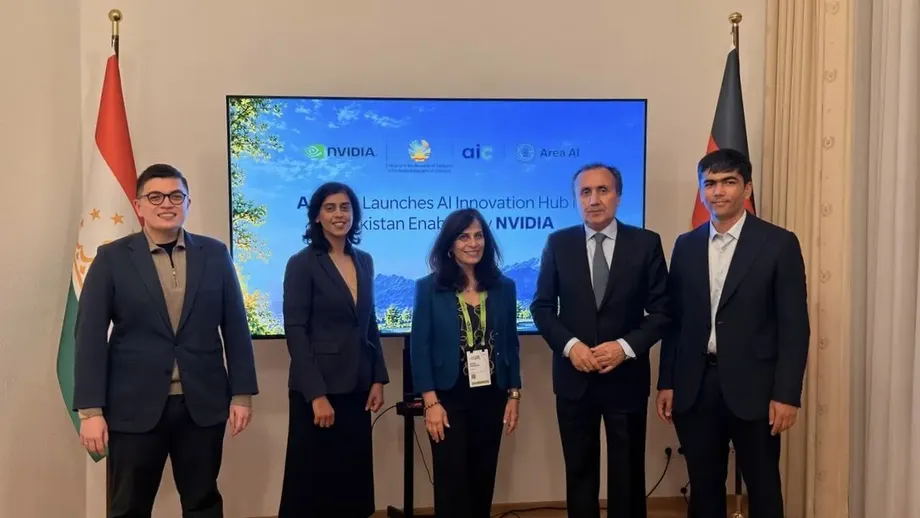
The launch announcement came on October 21, 2026, at NVIDIA GTC Berlin. The initiative was also presented at an event at Tajikistan's embassy in Berlin attended by Shilpa Kolhatkar, director of NVIDIA's Global AI Nations program, and representatives of Armada, VEON, DataVolt, Perplexity and Supermicro.
Area AI, established in January 2026, will provide the hub's base in the capital. Universities, developers, startups and industrial companies are expected to work together on training, research and the development of products for commercial use in Tajikistan and across Central Asia.
The first industrial task is specific: train AI to distinguish rock containing useful minerals from waste rock, test the models on samples and then move toward a trial at a mining enterprise. That gives the project a practical sequence, from learning and laboratory work to testing under operating conditions.
Who will build and manage the hub?
zehnlab.ai, a founding member of the Area AI consortium and a participant in the NVIDIA Inception program for startups, will create and manage the hub. The company is developing its technical program, while the Artificial Intelligence Council under the Ministry of Industry and New Technologies provides institutional support.
Azizjon Azimi, chairman of the council, presented the planned cooperation with NVIDIA. Its main areas include training AI specialists and introducing physical AI into industry. Physical AI means systems that use information from cameras, sensors and other equipment to understand their surroundings and guide actions in the real world.
Industry and New Technologies Minister Sherali Kabir said the laboratory could help local engineers introduce advanced technologies at mines and factories, supporting industrial development and exports. The proposed work puts engineers close to industrial problems: researchers and startups would build prototypes with companies, test them through pilots and prepare successful designs for commercial use.
The project's budget, the size of NVIDIA's financial or equipment contribution, the participating mining enterprise and a firm opening date for the hub have not been announced. The next stated operational milestone is the start of mining pilot trials in early 2027.
Khujand will host the physical AI laboratory
The planned Physical AI Lab will occupy converted workshops at an industrial site in Khujand. It is part of a future industrial AI park and is intended to become Central Asia's first physical AI laboratory based on NVIDIA technologies.
Robotic work cells, computer simulation stations and equipment for remote control and data collection are planned for the facility. A robotic work cell is a defined area where a robot, its tools and its sensors perform a task together. This arrangement lets engineers examine how a complete process works, rather than testing a software model alone.
Dushanbe and Khujand would serve connected roles. Area AI would bring together education, developers and research, while the laboratory would provide equipment and space for practical experiments. The planned link gives teams a route from developing an idea to testing how it behaves around real materials and machinery.
Why ore sorting comes first
The first industrial project will use images and sensor readings to train and test locally developed models on ore samples. The aim is to distinguish material containing valuable minerals from waste rock before moving toward deployment at a mine.
AI sorting works by finding patterns in examples. Engineers show a model images or measurements associated with different materials, then test whether it can classify new samples accurately. In this project, industrial images and sensor data would provide the information needed to make those decisions.
Laboratory testing and a mining pilot have different jobs. Tests on samples allow developers to check their models and adjust them. A pilot at a mining enterprise would examine performance within an operating process, where the system must work alongside the site's equipment and material flows.
The planned sequence makes the early 2027 trials an important checkpoint. The immediate task is to move from models tested on samples to a system that can be assessed in an industrial setting.
Virtual factories and robots for hazardous inspections
The Khujand laboratory also plans to research digital twins, three dimensional mapping and robotic inspections of hazardous or difficult to reach facilities. A digital twin is a computer representation of a physical object or process that engineers can use to study its behaviour.
For industrial teams, a simulated environment provides a place to test how a robot might move or respond before trying the same task with physical equipment. Three dimensional maps can give machines a representation of the spaces they must navigate, while inspection robots can collect information from locations that are difficult for people to enter.
The proposed technology includes NVIDIA Isaac tools for robotics and NVIDIA Omniverse libraries for simulation and digital environments. Researchers also plan to assess NVIDIA Cosmos models for generating synthetic data, meaning artificial examples created to help train or test AI systems.
NVIDIA Jetson technology is planned for running AI directly on devices. In practical terms, a robot or sensor system could process information close to where it is collected, rather than sending every decision to a remote computer. Together, these tools would connect simulated testing, model development and operation on physical equipment.
Training extends from universities to schools
The hub's education program will draw on NVIDIA Deep Learning Institute resources. Planned activities include practical courses, instructor training, university seminars and hackathons, where participants work together to build and test ideas within a limited period.
Researchers also intend to explore simulations in teaching and run robotics pilots. These activities connect the education program with the laboratory's work: students and instructors could learn methods that are also being examined for industrial applications.
Schools with limited internet access are expected to receive materials that work offline. That provision addresses a concrete barrier to participation, allowing lessons to be used without a continuous connection.
The education effort builds on Soro, a project implemented with the Ministry of Education and Science. Its AI program has been rolling out in more than 4,000 schools since September 2026, combining curriculum development, teacher training and SoroLLM, a model for the Tajik language developed by zehnlab.ai.
A language model learns patterns in text so that it can process and generate language. Developing tools for Tajik gives the school program a local language component alongside the wider technical training planned through the hub.
Computing infrastructure is already part of the relationship
Cooperation discussions between Tajikistan and NVIDIA preceded the Berlin announcement. At a June 12 meeting at NVIDIA's headquarters in Santa Clara, California, Azimi met the company's head of AI ecosystems and strategic partnerships and members of the AI Nations team.
The Artificial Intelligence Council said Tajikistan's first GPU cluster, using NVIDIA H200 processors, had already been commissioned and was serving customers in the country and the wider region. A GPU cluster is a group of computers equipped with processors suited to performing many calculations at once, a capability used to train and run AI models.
The talks covered expanding computing infrastructure using Tajikistan's hydropower resources. Area AI participants also plan further computing capacity using NVIDIA GPUs powered by hydroelectricity. The operating H200 cluster provides an existing starting point, while expansion remains part of the development plans.
Azimi expressed readiness to introduce NVIDIA's AI ecosystem development program at Area AI. The discussions also covered possible adaptation of NVIDIA Nemotron models for SoroLLM and improvements to the quality, efficiency and security of AI services in Tajik.
NVIDIA's Vera Rubin architecture was another subject of the meeting, alongside future computing platforms. The discussion places the hub within a wider relationship covering hardware, language models and developer support.
Local companies and national policy provide the foundation
Area AI brings together several strands of Tajikistan's technology sector. Alongside zehnlab.ai's language models, zypl.ai develops synthetic data technology and AI tools that help organisations make decisions. Its banking products are used in more than 20 countries, and the company has attracted investment from Prosus and Carbide Ventures.
That existing commercial activity gives the consortium experience beyond research and teaching. The proposed hub would add a more direct route into industrial applications, with companies and researchers developing prototypes around the needs of participating enterprises.
Tajikistan adopted a national AI development strategy in 2022, becoming the first country in Central Asia to do so. At the Berlin embassy event, Ambassador to Germany Imomuddin Sattorov linked the hub initiative to a UN General Assembly resolution on AI and sustainable development in Central Asia, adopted in July 2025 at President Emomali Rahmon's initiative.
UN General Assembly resolution 79/322, titled "Role of artificial intelligence in creating new opportunities for sustainable development in Central Asia", was adopted on 25 July 2025 and issued on 31 July 2025. Paragraph 3 notes the initiative to establish a regional AI centre in Dushanbe. It also encourages international AI capacity-building partnerships to develop education and training programmes, increase access to open AI models and systems, open training data and compute, facilitate model training and development, and promote the participation of micro-, small and medium-sized enterprises in the digital economy.
The dates show how the industrial proposal connects with policy, education and an existing platform:
- 2022: Tajikistan adopted its national AI development strategy.
- 25 July 2025: The UN General Assembly adopted resolution 79/322 on AI and sustainable development in Central Asia, noting the initiative to establish a regional AI centre in Dushanbe.
- January 2026: Area AI was established in Dushanbe.
- September 2026: The Soro school program began its rollout across more than 4,000 schools.
- October 21, 2026: The hub announcement was made at NVIDIA GTC Berlin.
- Early 2027: Mining pilot trials are planned.
The Bottom Line
- NVIDIA will support a planned AI hub based at Area AI in Dushanbe.
- zehnlab.ai will create and manage the hub, with institutional support from Tajikistan's Artificial Intelligence Council.
- A connected laboratory in Khujand will focus on robotics, simulation and industrial testing.
- AI ore sorting is the first planned industrial project, with mining pilots scheduled for early 2027.
- Training plans include university activities, instructor preparation and offline materials for schools.
- Tajikistan already has an operating NVIDIA H200 GPU cluster, while further computing capacity is planned.