A plan covering an entire ward meets resistance
A redevelopment proposal covering all 447 hectares of Hà Nội's Vĩnh Hưng Ward would affect about 7,250 households, or 20,000 people, according to the draft planning summary. Yet residents say many first discovered their homes were inside the project boundary when the groundbreaking was announced on Aug. 28, 2026, roughly six weeks before formal consultation began.
Contents
- A plan covering an entire ward meets resistance
- What would change across Vĩnh Hưng?
- How consultation followed the groundbreaking
- Residents are examining the maps in large numbers
- Why public works and commercial housing draw different responses
- Replacement housing must also accommodate families and livelihoods
- Đầm Ấu families fear having to start again
- Police warnings accompany the protests
- A dispute over whose views reach the public
- Key Points
The project, backed by nearly 186 trillion đồng, about $7.1 billion, promises wider roads, parks, public services and replacement housing within the ward. Its investor is Công ty TNHH Đầu tư Tập đoàn Mặt trời, a Sun Group member company that also organized preparation of the plan.
Residents challenging the proposal draw a firm line between public infrastructure and commercial property. Many say they would surrender land for roads, schools or clinics, but oppose losing legally held homes so a company can build apartments and villas for sale.
The dispute has spread beyond compensation. Residents describe unanswered petitions, neighborhood meetings without the developer, police warnings against demonstrations and television coverage that they say removed their objections. Formal consultation on the detailed plan runs from Oct. 12 to Nov. 1, 2026.
The draft now provides more detail than residents had in August, including proposed land uses and replacement housing. The central dispute is whether those proposals answer the needs of families who could lose homes, businesses and established communities.
What would change across Vĩnh Hưng?
The project divides the ward into 206.1 hectares for redevelopment and new construction, and 240.9 hectares for renovation and coordinated improvements. Those areas represent approximately 46% and 54% of the total, respectively.
Vĩnh Hưng lies about four kilometers from Hoàn Kiếm Lake. Launch descriptions put its population at nearly 80,000, while another account gives more than 67,500 residents following an administrative merger. The draft planning summary identifies about 20,000 affected people within this wider planning area.
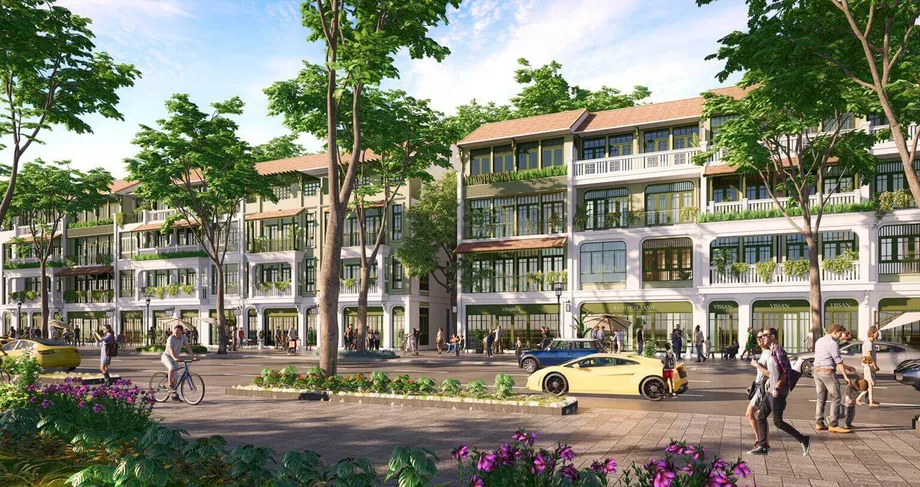
Sun Group proposes 225.4 hectares of residential land, about half the project area. Nearly 152 hectares would consist of existing residential neighborhoods slated for improvement. Mixed apartment and commercial developments would be concentrated along major roads and the Red River.
The draft also proposes about 83.6 hectares for social infrastructure, described as 3.5 times the existing provision. Approximately 42.5 hectares would go to parks, greenery, water and sports facilities, described as 22 times the current area. Main neighborhood roads and alleys would be at least seven meters wide.
Launch descriptions identify metro lines 4, 8 and 15, while the later draft also includes line 10. The proposed approach places homes, shops and services around stations, allowing more journeys by public transport or on foot. A separate aim is to put everyday services within a 15 minute walk.
Plans for connected parks and water retention lakes follow a Sponge City approach, using land and water features to absorb rainfall and improve drainage. These are proposed changes to a ward the developer describes as lacking sufficient transport infrastructure and public green space.
How consultation followed the groundbreaking
Residents of Lane 467 Lĩnh Nam Street petitioned the city in early September, saying they were worried by circulating clearance information but could not obtain official details. Hà Nội's Center for Communications, Data and Digital Technology directed them to the ward People's Committee or the city Department of Construction.
Before the August announcement, a project proposal had appeared on the Department of Finance website, but its area and investment figures differed from the current project description. Residents say meetings held from late August through early October brought officials who recorded their concerns, without anyone from Sun Group attending.
The sequence of announcements, protests and consultation helps explain their frustration:
- Aug. 28, 2026: The principal project announcements date the groundbreaking to this day. A later description accompanying the draft gives Aug. 22.
- Sept. 20: Đầm Ấu residents submitted a petition opposing another relocation and requesting legal, planning and compensation details.
- Oct. 8 to 10: Hundreds of residents gathered outside government offices and marched through streets.
- Oct. 11: Residents described the detailed planning map as becoming available.
- Oct. 12: Formal public display and consultation began, about 45 days after the Aug. 28 groundbreaking.
- Nov. 1: The scheduled deadline for comments on the draft plan.
A plan at a scale of 1:500 shows considerable local detail: one centimeter on the map represents five meters on the ground. For residents, it offers a way to locate their homes against proposed buildings, roads and other land uses.
Residents are examining the maps in large numbers
The ward displayed draft drawings, supporting documents and feedback forms at 20 locations. Residents could inspect maps, use QR codes to access project information, submit forms or contribute at meetings organized by the authorities. Forms were accepted daily from 8 a.m. to 11 a.m. and from 2 p.m. to 5 p.m.
Lương Văn Đóa, a member of the ward working group, said more than 700 visits to review the plan and participate in consultation were recorded on the first morning at residential group 16 in Xép neighborhood, which has 1,112 households.
Nguyễn Xuân Hợp, a resident of group 14, said the map placed his family's land and other homes with land use certificates inside areas proposed for clearance for tall buildings, townhouses and villas. He questioned how that matched information residents understood they had received during earlier discussions.
The comment form offers three choices: agree, disagree or other opinion. Residents have asked how any approval percentage would be calculated and whose responses would form the total. Local authorities say the collected views will inform further study and revision of the plan.
Detailed household compensation terms, relocation dates, replacement apartment entitlements and the method for calculating consultation results remain unresolved in the public information described by residents. Those details determine what each family would actually receive and when it would have to move.
Why public works and commercial housing draw different responses
Protest banners across affected neighborhoods oppose taking residential land for commercial apartments. Residents say improvements to transport and public services have a different purpose from transferring their homes into a development whose properties will be sold.
A middle aged Vĩnh Hưng resident explained that distinction while discussing the proposed apartments and villas:
If the project were [to open] a road, there would be nothing to say, but they're taking it to build apartments and villas and then sell them.
Residents also express different concerns within the ward. Some oppose commercial redevelopment of their particular streets. Families connected to the Thanh Trì bánh cuốn village want to preserve the neighborhood, its traditional rice roll trade and the community supporting it. Đầm Ấu households fear being relocated for a second time.
The legal argument centers on land recovery, the process through which the state takes back land use rights. Chapter 6 of the Land Law permits recovery for socioeconomic development in the national and public interest. Residents challenging commercial projects question how those purposes are applied to their homes.
A National Assembly resolution passed on Dec. 11, 2025, concerning special mechanisms for major development projects in Hà Nội allows additional recovery beyond cases listed in the Land Law for projects serving national or public interests, as directed by competent authorities.
Commercial development under that rationale has a history elsewhere, including land recovery for the Ecopark urban area in Văn Giang, Hưng Yên. In Vĩnh Hưng, residents want authorities to explain the legal basis for including their neighborhoods and the public purpose served by replacing their homes.
Replacement housing must also accommodate families and livelihoods
The draft sets aside approximately 14.39 hectares for resettlement and social housing. It proposes accommodating the affected households in apartment complexes within Vĩnh Hưng, keeping them in the ward rather than moving them to a distant district.
Residents say location is only part of the calculation. Existing houses can accommodate several generations across multiple floors. A single apartment may offer much less usable space, even when its floor area resembles the size of the original plot.
One resident described apartments of 50 to 60 square meters valued at roughly 3 billion to 3.5 billion đồng. The resident contrasted that with a house built over four or five floors on a plot of 50 square meters, giving two or three generations room to live together.
Nguyễn Thanh Huyền, of alley 670 Nguyễn Khoái Street, raised another practical concern: families whose homes also serve as shops depend on their location for daily income. Moving into an apartment changes both their housing and their ability to earn a living.
The developer proposes giving former street frontage businesses priority to rent or own commercial space at preferential costs in the lower levels of new apartment buildings. For those households, the eventual cost and conditions of that space will matter alongside the value of the replacement home.
Đầm Ấu families fear having to start again
About 100 households live in Đầm Ấu, according to a resident's account accompanying the neighborhood's objections. Many families previously moved there through resettlement and then invested in filling land, building homes and establishing a stable community.
Their Sept. 20 petition described a neighborhood with legally documented land, solid houses, roads wide enough for two cars to pass and no flooding. Residents supported road improvements and urban renovation while opposing land recovery for commercial apartments.
Residents say the city Department of Construction had earlier responded that Đầm Ấu, having already undergone resettlement, should not be subjected to another redevelopment designation. They subsequently believed their homes still appeared within the draft planning boundary released in early October.
The ward's response to the September petition acknowledged the residents' views. Families continued seeking publication of the legal basis, compensation arrangements and housing guarantees, together with a direct inspection before decisions affecting their homes.
Their concern has a parallel in Hồng Hà Ward, where residents opposing the Red River Scenic Boulevard project say they had already relocated there in 1997. For these communities, another move would mean rebuilding arrangements made after an earlier displacement.
Police warnings accompany the protests
Vĩnh Hưng police issued an online warning on Oct. 10 after several days of demonstrations. The message appeared in the police administered Facebook group Tôi Yêu Phường Vĩnh Hưng 2 Thủ Đô Hà Nội and warned against illegal gatherings, marches, public disorder and obstruction of agencies.
The ward police described how they intended to respond to violations:
proactively verify, gather evidence, and resolutely and strictly punish
Police directed residents to obtain information from state agencies, avoid sharing false or unverified claims and send petitions to the competent authorities. The message also asked residents to stand with local authorities and help the project proceed.
A police summons dated Oct. 9 called a resident to discuss the Sun Group project. Residents gathering outside the ward People's Committee were also ordered to disperse, according to an account of the protests.
From Oct. 15, at least one resident identified as H faced repeated police contact and summons concerning information posted online. She said she was protesting the loss of her home and had done nothing wrong.
The warnings followed a June 30 message from Hà Nội police concerning gatherings around major capital projects. Police also broke up meetings organized by residents opposing the Red River Scenic Boulevard project in late September. Vĩnh Hưng residents have continued sharing photographs and videos through Facebook and Threads.
A dispute over whose views reach the public
Residents of residential group 22 in Lane 467 Lĩnh Nam accused Hà Nội Television of removing most objections from its Oct. 13 evening broadcast. In a statement posted the next day, they said the remaining interviews showed support for infrastructure work while omitting opposition to commercial redevelopment.
A video recorded by residents showed a woman telling an interviewer that she opposed taking legally occupied residential land for a company to build commercial apartments. Her objection did not appear in the broadcast, according to the comparison circulated by residents.
Nguyễn Đình Chiến, of residential group 21, expressed support for land recovery for roads, schools and bridges. Ward Vice Chairman Ngô Mạnh Cường described residents as mostly supportive of the project, while the broadcast presented concerns as coming from some households.
The difference concerns what residents were agreeing to. Supporting a wider road leaves a different set of choices from accepting the replacement of an existing neighborhood with commercial housing. Residents want that distinction reflected in both consultation results and public statements.
The Red River project has added to their concern. Its consultation closed on Sept. 26, and residents were still awaiting detailed results in mid October, despite a publicly cited support figure of 71.8%. Separately, residents opposing Sun Group's Ba Vì Safari development have sought clearer boundaries, compensation and relocation information, with checkpoints organized locally on Oct. 16.
Sun Group executive Trần Minh Sơn, a founding council member and standing vice chairman of the board, pledged at the Vĩnh Hưng launch to commit maximum resources to selected Hà Nội projects and deliver them on schedule and to high quality. Residents are seeking an equally concrete explanation of how the project will preserve their housing security, income and communities before consultation closes on Nov. 1.
Key Points
- The proposed Vĩnh Hưng project covers 447 hectares and carries investment of nearly 186 trillion đồng.
- The draft identifies about 7,250 affected households, or 20,000 people.
- Consultation runs from Oct. 12 to Nov. 1, 2026, following the August groundbreaking.
- About 14.39 hectares are proposed for resettlement and social housing within the ward.
- Residents support public infrastructure but oppose taking their homes for commercial property development.
- Police warnings, summons and disputed television editing have deepened conflict over participation and public consent.
- Families are seeking household compensation details, adequate replacement housing and protection for businesses and established neighborhoods.