A spider from 1892 reveals a hidden life
A pale tarantula first described in 1892 has been confirmed as Asia's first known tarantula that lives exclusively in caves, after researchers returned to a limestone cave system in Camarines Sur, in the Philippines. The investigation also uncovered two new tarantula species in the forest above, bringing the country's recognized total to 16, all found naturally only in the Philippines.
Contents
- A spider from 1892 reveals a hidden life
- What changed after Simon's first description?
- What makes it a true cave dweller?
- How did the spiders handle low oxygen?
- Detecting meals and danger in darkness
- DNA connects three caves and a much older history
- Two discoveries on the forest floor
- Three relatives divide the same landscape
- Why the park matters for conservation
- Key Points
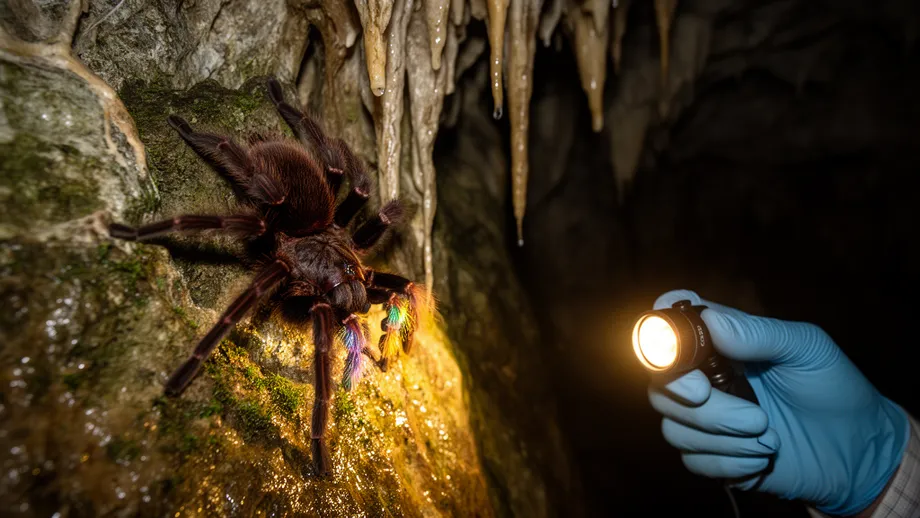
The cave species, Orphnaecus pellitus, was collected in the completely dark zones of Alinsanay, Kalangkawan and Laya, three connected caves within Libmanan Caves Natural Park. Its unusually small eyes, pale coloring and elongated legs helped researchers resolve a question left open for 133 years: whether this spider was a permanent underground resident.
Laboratory tests added evidence beyond its appearance. Under conditions with little oxygen, the cave tarantulas took five to 12 minutes to lose consciousness, compared with less than two minutes for the surface and cave tolerant species used for comparison. The cave spiders recovered without any recorded deaths.
The findings appeared in a study published June 5, 2025, in Subterranean Biology, Volume 52, pages 143 to 186. The research team included Darrell C. Acuña, Myla R. Santiago-Bautista, Volker von Wirth and Leonardo A. Guevarra Jr.
The University of Santo Tomas, whose researchers participated in the work, described the discoveries in its June 26 announcement. Together, the findings reveal three related spiders occupying different parts of the same protected landscape, from dark cave chambers to shelters beneath forest logs and stones.
What changed after Simon's first description?
French naturalist Eugène Simon described Orphnaecus pellitus from the Culapnitan Caves in 1892. He noted its tiny, widely separated eyes and suggested that their unusual appearance might be connected to life underground. His brief examination left later researchers with a species name and an intriguing possibility, but little knowledge of how the animal lived.
The new investigation returned to that original collection area, now part of Libmanan Caves Natural Park. Researchers examined body structures, compared DNA and studied behavior and habitat. Combining those approaches allowed them to assess the spider's way of life as well as its identity.
The major dates trace a long gap between the original description and the modern investigation:
- 1892: Simon described Orphnaecus pellitus from the Culapnitan Caves and suggested a connection between its unusual eyes and underground life.
- June 5, 2025: The new study appeared in Subterranean Biology, confirming its cave specialization and describing two new forest species.
- June 26, 2025: The University of Santo Tomas announced the findings and outlined its researchers' involvement.
The 133 years measure the interval between the original description and the publication of this detailed reassessment. The central discovery is a much fuller understanding of a named species that had gone unstudied for more than a century.
What makes it a true cave dweller?
Orphnaecus pellitus is classified as troglobitic, meaning it lives entirely in the dark parts of caves. A spider that sometimes enters a cave can still depend on the world outside. A troglobitic species has become specialized for an underground habitat.
Researchers collected the tarantulas at locations 30 to 300 meters inside the three connected caves, in areas without natural light. Their bodies showed several features associated with permanent cave life: reduced eyes, lighter pigmentation, elongated legs and shortened tactile setae, the small sensory hairs on the body.
The eye differences extended beyond simple size. The relative sizes of the different eye pairs also differed from those of Orphnaecus species living at the surface. In an environment without daylight, researchers examined these changes alongside the spider's other features and its behavior.
Before this finding, recognized tarantulas restricted to caves were known from Mexico, the Dominican Republic and Brazil. Orphnaecus pellitus brought the worldwide total to 19 and extended that known distribution to Asia.
How did the spiders handle low oxygen?
The laboratory comparison tested how long spiders remained responsive under hypoxia, the scientific term for a shortage of oxygen. Oxygen helps animals release the energy they need to keep their bodies functioning. Tolerance of reduced oxygen can be useful in underground environments.
Orphnaecus pellitus took between five and 12 minutes to lose consciousness during the tests. The surface and cave tolerant species used for comparison became unresponsive in less than two minutes. Even the shortest time recorded for the cave specialist was more than twice that comparison threshold.
The cave tarantulas recovered quickly, and researchers recorded no fatalities among them. The result added a physiological finding, concerning how the body works, to the visible differences in eyes, legs and coloring.
The University of Santo Tomas highlighted the research team's findings about both oxygen tolerance and behavior. Its announcement quoted the study's description of the additional adaptations:
tolerance to hypoxia and heightened sensitivity to ground movements are the other subterranean adaptations observed.
Detecting meals and danger in darkness
Inside the caves, the tarantulas reacted to approaching movement from more than a meter away, retreating into their burrows. Ground vibrations provide a way to detect nearby activity where daylight offers no help.
Laboratory observations also showed rapid prey detection and capture. The observed spiders seized live insects without pausing to survey their surroundings. Juveniles captured insects as large as three times their own body size, showing that effective hunting began while the spiders were still young.
Cave crickets were among the prey associated with Orphnaecus pellitus in its underground habitat. For an animal living in darkness, locating such prey depends on sensory information other than a clear visual image.
Researchers suggested that organs on the spiders' feet that detect vibrations could help explain their sensitivity. They found no corresponding structural changes in those organs, however, so the precise mechanism behind the heightened response remains unresolved.
DNA connects three caves and a much older history
Genetic analysis placed Orphnaecus pellitus within the Orphnaecus group while distinguishing it from related species. The specimens collected in different caves showed very small genetic differences, supporting their identification as the same species across the connected system.
Researchers estimated that the cave species may have diverged from its relatives between 33.5 million and 50 million years ago. This is an estimate of when evolutionary lineages separated. The timing of its transition to permanent cave life remains uncertain.
Orphnaecus pellitus also has a special place in the naming of its genus. The study's genus treatment, archived on Zenodo, identifies it as the type species of Orphnaecus. A type species is the reference species to which a genus name is attached.
The record says it received that status by monotypy, meaning it was the sole species included when the genus was established. The same treatment lists five species in the genus: O. adamsoni, O. kwebaburdeos, O. pellitus, O. libmanan and O. tangcongvaca.
Two discoveries on the forest floor
The expedition's findings extended beyond the caves. Researchers identified Orphnaecus libmanan and Orphnaecus tangcongvaca as new species in the park's forest grounds, using physical characteristics, genetic relationships and ecological observations.
Orphnaecus libmanan occupies larger sheltered spaces, including places beneath logs and rocks. The smaller Orphnaecus tangcongvaca burrows beneath branches and stones. Both live on the forest floor, but the differences in their shelters indicate that they use that shared environment in different ways.
Orphnaecus tangcongvaca also attracted attention because of its dramatically reduced stridulatory organ. This is a structure used to produce sound through friction, rather like rubbing two textured surfaces together.
Genetic analysis nevertheless placed the species within Orphnaecus. Its reduced organ challenges classifications that rely on this feature alone. The researchers' combined approach allowed DNA evidence to be considered alongside body structures when deciding where the new species belonged.
Three relatives divide the same landscape
Libmanan Caves Natural Park contains three related tarantulas with different ecological niches. A niche describes how an animal uses its surroundings, including where it shelters and what it eats. Here, the most pronounced division separates the permanent cave resident from the two species living in the forest.
Orphnaecus pellitus occupies the dark underground system and feeds on cave prey, including crickets. Above ground, O. libmanan and O. tangcongvaca use shelters of different sizes and appear to target different prey.
Researchers suggested that competition for space and food may have contributed to these differences. The cave species followed a separate route into an underground habitat, while the forest species share the surface through different patterns of shelter and feeding.
The comparison gives the discoveries a connection beyond their names. Within one park, the study documents how related animals can occupy neighboring environments yet develop different bodies, behaviors and ways of obtaining food.
Why the park matters for conservation
The two newly described forest species bring the recognized Philippine tarantula total to 16. All 16 are endemic, meaning their natural distribution is restricted to the Philippines. Their conservation therefore depends on conditions within the country.
The findings also show why a survey limited to one habitat would have produced an incomplete picture. Work in the dark cave zones revealed the specialization of Orphnaecus pellitus. Examination of the surrounding forest uncovered two species that had not previously been formally described.
Researchers called for further surveys and conservation in Libmanan Caves Natural Park, including exploration of caves that remain unexamined. Their findings place both the underground system and the forest above it within the same conservation picture.
The next scientific task is to build on that close examination of habitat, anatomy, behavior and DNA. A spider known mainly through an 1892 description now has a documented place among the world's few tarantulas restricted to caves, while its forest relatives show how much remained to be identified nearby.
Key Points
- Orphnaecus pellitus, described in 1892, has been confirmed as Asia's first known tarantula restricted to caves.
- Researchers collected it in three connected caves in Libmanan Caves Natural Park, Camarines Sur.
- Its adaptations include tiny eyes, pale coloring, elongated legs, tolerance of low oxygen and sensitivity to ground vibrations.
- Two new forest species, O. libmanan and O. tangcongvaca, bring the recognized Philippine tarantula total to 16, all endemic.
- The study brings the worldwide count of recognized cave obligate tarantulas to 19 and calls for further surveys and conservation.