A No. 3 hit with an artificial voice
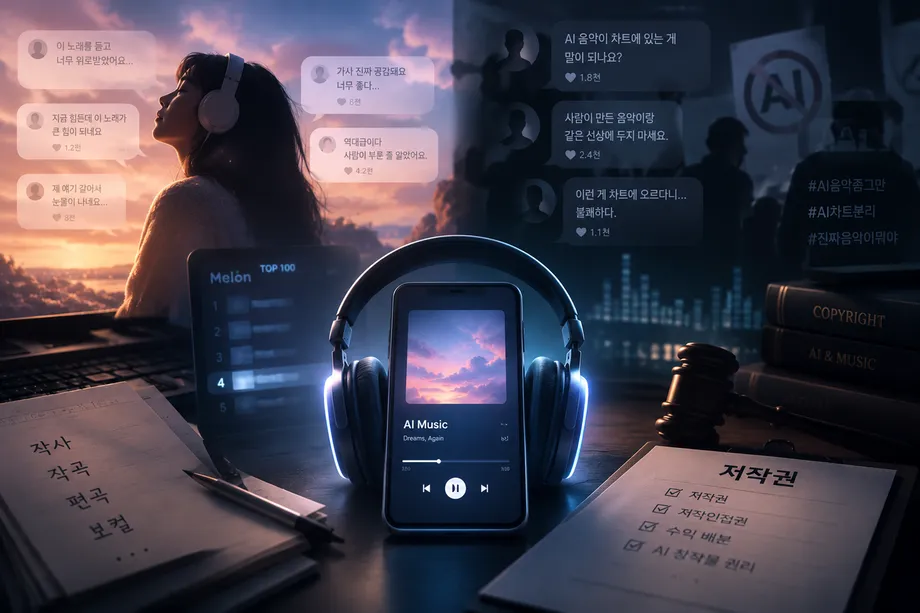
Meomuru's Have You Become the Adult You Dreamed Of? reached No. 3 on South Korea's Melon Top 100 in October 2026, turning a song made with artificial intelligence into a commercial success and a practical test of the country's copyright rules. Its lyrics came from people. Its basic composition and singing came from Suno, an AI music service.
Contents
- A No. 3 hit with an artificial voice
- The people behind Meomuru
- Why listeners are responding
- What the production process involves
- The registration rule that lasted 22 days
- Why one recording has different payment streams
- Registration figures expose the administrative strain
- Growing supply, unresolved training disputes
- What clearer rules would need to cover
- Key Points
Released on June 2, the rock ballad spread through short videos before reaching No. 3 on October 13 and holding that position on October 14. Its subject is familiar: the distance between childhood hopes and the pressures of being an adult. Listeners have shared personal stories and described finding comfort in a voice that belongs to no human singer.
The success has arrived while rules for collecting and distributing some of the money remain unsettled. Glorywave, the songwriting team behind Meomuru, says it receives distribution income through its distributor but has not registered the song for royalty management with the Korea Music Copyright Association, known as KOMCA. It therefore receives none of the usual songwriting royalties through that arrangement.
Another project, Joseon Hiphop, has reached No. 89 on Melon's Top 100 with Forest of the Heart, combining human lyrics and creative direction with AI composition and vocals. Together, the tracks put a concrete question before the industry: when a person writes the words and a machine supplies the tune and voice, which contributions earn which payments?
The people behind Meomuru
Glorywave consists of Lee Yong-seok and Choi Seong-hyeok, who say they have spent about a decade working with singers including Gilgu Bonggu and Hwang Chi-yeul. Meomuru gave them a project they could direct themselves, from its initial idea through production, instead of shaping songs around a singer's or agency's requirements.
The team wrote the lyrics for Have You Become the Adult You Dreamed Of? from personal experience of questioning their dreams as composers. Suno supplied the basic musical composition and vocals, while the creators used repeated instructions, revisions and added material to develop the finished recording.
Meomuru's YouTube channel description presents AI as an instrument within a creative process directed by people. The project describes its relationship with the technology this way:
To me, AI is a modern instrument and a partner that helps bring my imagination into reality.
Glorywave's account also describes unease. The pair initially regarded Suno as something close to a toy, then found its improved output unsettling enough to make them question the value of years spent studying and producing music. They eventually decided to learn the technology and use it themselves.
Why listeners are responding
Have You Become the Adult You Dreamed Of? places worries about adulthood at the centre of a rock ballad. Its appeal rests on a recognisable experience: growing older brings responsibilities and doubts that a child imagining the future may never consider.
Short videos helped carry that feeling beyond the song's initial audience. People used it as background music, giving brief clips a soundtrack that other viewers could discover and share. A September 28 account placed it at the top of YouTube's daily popular music video chart on September 2, before its October rise on Melon.
Some listeners respond to the words and melody regardless of how the recording was produced. Others object to AI recordings competing beside human performances, or want clearer labels explaining how much AI was involved. Concerns also extend to the work available for singers, composers and other people involved in production.
The song's route to popularity contains a useful tension. Its emotional subject offers something different from music built around idol fandom or dance challenges, yet short video circulation helped it reach listeners. Familiar feelings and a powerful distribution channel worked together.
What the production process involves
Glorywave says AI allows it to try melodies and arrangements quickly, including ideas it did not initially imagine. Earlier production methods could require arranging instruments, finding musicians and recording a guide vocal before an idea could be heard in a developed form.
Suno introduces different difficulties. Asking it to change one passage can also alter parts the creators wanted to keep. Glorywave describes moving material into conventional music software, singing a melody again or changing the structure, then sometimes feeding the revised material back into AI.
That repeated movement matters for copyright administration. A simple division between human lyrics and machine music becomes harder to document when people and software repeatedly revise the same passage. Assessing a contribution requires knowing what the person actually created, rather than counting instructions or minutes spent working.
Glorywave plans to continue using AI while also collaborating with human singers and instrumentalists. Its workflow points toward a range of production choices, with different combinations of human writing, performance, editing and generated sound.
The registration rule that lasted 22 days
KOMCA tried to draw a boundary through its registration criteria, announced under chairman Lee Si-ha and effective from August 3, 2026. The association said music could be registered when a human participated substantially and actively in writing lyrics, composing or arranging, even if AI served as an assisting tool.
The official announcement excluded results generated entirely by AI from simple prompts. The proposed system also required creators to disclose the tools they used, how extensively they used them and the nature of their own contribution.
After 22 days, KOMCA withdrew the criteria. The Ministry of Culture, Sports and Tourism called for their withdrawal amid concerns about insufficient consultation. The ministry and National Assembly sought broader discussion, while the absence of an agreed method for measuring human contributions remained a central obstacle.
The sequence places the song's rise alongside the interrupted attempt to manage AI music:
- June 2, 2026: Meomuru released Have You Become the Adult You Dreamed Of?
- August 3: KOMCA's new registration criteria took effect.
- Later in August: The association withdrew the criteria after 22 days.
- September 2: The song topped YouTube's daily popular music video chart.
- October 13 and 14: The song stood at No. 3 on Melon's Top 100.
Of 648 AI music applications received during the 22 days, 583 were suspended and 65 were deleted, according to figures cited in the policy debate. That left about nine in every 10 applications suspended. No replacement timetable was specified.
Why one recording has different payment streams
South Korea's copyright framework protects human creative contributions. Material generated solely by AI falls outside that protection. A song combining both therefore requires closer attention to the lyrics, melody, arrangement and other creative work.
Songwriting rights and rights associated with a recording are separate. A lyricist can have rights in words they wrote, while a producer may hold related rights, also called neighboring rights, in the recording. Distribution income can reach a producer through a different route from royalties collected for a musical composition.
Glorywave's position illustrates the practical result. The team says it receives income through its distributor while leaving the Meomuru song outside KOMCA's management. Melon has said the copyright royalty portion of revenue from AI music remains unsettled.
Shin Ji-young, an executive at Melon operator Kakao Entertainment, told a National Assembly discussion that music services lacked a way to resolve copyright payments themselves and called for settlement standards. A service needs rules identifying the eligible rights and recipients before it can distribute that portion of the money.
For a song with human lyrics, AI composition and a mixture of human and machine editing, the central task is to identify each person's creative work. A single label saying AI was used gives listeners useful information, but administrators also need a more detailed account of production.
Registration figures expose the administrative strain
Data obtained by People Power Party lawmaker Cho Eun-hee's office from the Korea Copyright Commission show AI related registrations across music, video and publishing rising from one in 2023 to 18 in 2024, 367 in 2025 and 1,054 in the first eight months of 2026.
The 2026 figure was already nearly three times the total for all of 2025. The commission did not break the figures down by medium or track rejected applications in the account of the data. It said it planned to require applicants to disclose AI use on registration forms.
Copyright registration with the commission and registration for royalty management with KOMCA serve different purposes. The first records a claim concerning a work; the second allows the association to administer rights and payments. Both systems need usable information about human authorship, but their figures measure different activities.
Cho's office also identified 802 cases in KOMCA data involving works registered as human compositions and later identified as AI generated. It cited royalties of 15.307 billion won across 643 cases and 5.26 billion won across 159 cases, a combined 20.567 billion won.
KOMCA suspended payments but was reported to lack the authority needed to investigate AI use and recover earlier earnings. Its withdrawn August rules included recovery measures and penalties set at three times the relevant amount for false registrations. The dispute therefore concerns both new applications and money already paid.
Growing supply, unresolved training disputes
Deezer's figures illustrate how quickly AI music can enter distribution systems. Its reported daily intake rose from 10,000 AI generated tracks, representing 10% of uploads, in an earlier January count to 60,000, about 39%, in the following January, then roughly 90,000 and more than half of uploads by June.
Those figures amount to a ninefold increase in daily AI uploads between the first and last counts. For music services, that expansion increases the amount of material requiring decisions about identification, distribution and payment, alongside the smaller number of tracks that attract substantial audiences.
In South Korea, a March audit analysis of a sample of works managed by KOMCA suggested that 60% might involve AI assisted composition. The finding was expressed as a possibility within the sample. Identifying AI use more reliably is part of the administrative problem facing the industry.
Music companies including Universal Music Group and Sony Music have also pursued lawsuits against AI music developers over recordings used to train their systems. Training means using existing material to teach software patterns from which it can generate new output. The disputes concern permission and payment for that earlier material, a separate stage from deciding who contributed to a newly released song.
What clearer rules would need to cover
KOMCA's withdrawn criteria already identified three useful pieces of information: the AI tool, the extent of its use and the creator's contribution. Meomuru's production process shows why documenting revisions and edits may also matter when a work moves repeatedly between generation software and conventional production tools.
Listeners seeking transparency need an understandable account of what they are hearing. Rights administrators need enough detail to identify protected human work. Creators need a workable route for registering that work and receiving payment without claiming authorship over material generated entirely by a machine.
Foreign collecting organisations offer examples of conditional acceptance. ASCAP and BMI in the United States and SOCAN in Canada have been described as allowing registration of works containing both human and AI elements since October 2025. Their treatment of mixed works offers a comparison as South Korea debates its own requirements.
Meomuru's chart position makes the issue immediate. A commercially successful song can already reach listeners while its makers receive one kind of income and leave another uncollected. The next administrative decisions will affect whether human lyrics, human revisions and recording production can each be recognised and paid through clear procedures.
Key Points
- Meomuru's Have You Become the Adult You Dreamed Of? reached No. 3 on Melon in October 2026.
- Glorywave wrote the lyrics and directed production; Suno supplied the basic composition and vocals.
- Joseon Hiphop's Forest of the Heart also entered Melon's Top 100, reaching No. 89.
- KOMCA introduced criteria for music made with AI on August 3, then withdrew them after 22 days.
- Glorywave receives distribution income but says it is not collecting the usual songwriting royalties through KOMCA for the song.
- The debate centres on documenting human contributions, distributing royalties and addressing rights in music used to train AI systems.