Three agencies step in after three vehicles suffer fractures
China's Ministry of Industry and Information Technology announced on October 15, 2026, that three national agencies had formed a joint investigation team to examine reported brake pedal bracket fractures in the Maextro V800, a luxury vehicle developed by Huawei and JAC Motors.
Contents
- Three agencies step in after three vehicles suffer fractures
- What happened during the braking tests?
- A week of tests, statements and intervention
- What Maextro has promised owners
- What the laboratory results actually measured
- Why the speed and direction of a push matter
- Understanding the competing force figures
- Materials and suppliers face closer scrutiny
- A costly dispute for JAC's luxury push
- Key Points
The ministry, the Cyberspace Administration of China and the State Administration for Market Regulation will carry out checks building on preliminary investigative work, according to the announcement published through the ministry's Gongxin Weibao account. Authorities said they would handle the matter according to laws and regulations and publish further information promptly.
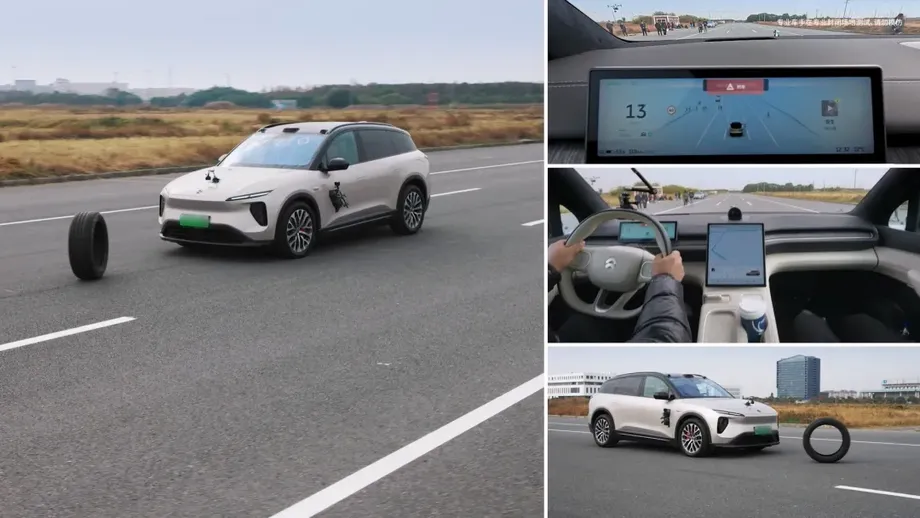
The intervention follows tests released by automotive platform Dongchedi on October 8. Its testing team said brackets fractured in all three V800 vehicles subjected to repeated braking from 100 kilometers per hour to a standstill. The failures occurred on the third, fourth and second attempts, respectively.
Maextro, known in China as Zunjie, said on October 15 that it would cooperate fully with the joint investigation. The company had already promised to redesign the component and offer existing owners a free upgrade, while saying it had received no reports of bracket base fractures during customer use since deliveries began.
The dispute now brings together two sets of results that need a technical explanation: repeated failures during driving tests and laboratory findings published by Maextro showing inspected pedal assemblies surviving loads of up to 3,000 newtons. How force was applied, which parts were tested and how the assemblies were supported have become central issues.
What happened during the braking tests?
Dongchedi conducted the stops on a closed course. After brackets failed in the first two vehicles, the team bought a third V800 to repeat the exercise. That vehicle reportedly had just 3 kilometers on its odometer when delivered.
The third vehicle stopped in 38.44 meters on its first attempt, with a recorded peak pedal force of 1,596 newtons. During the next attempt, its support fractured at a reported 1,612 newtons. A newton is a unit of force, measuring how hard something is pushed or pulled.
The testers said normal operation of the foot brake became unavailable after the fractures. They used the emergency braking function activated through the Park control to stop the vehicles. In the third vehicle's test, the team reported a stopping distance of about 140 meters after the failure.
That was roughly 3.6 times the 38.44 meters recorded during the same vehicle's first stop. The comparison shows the practical consequence described by the testing team: the alternative stopping method required substantially more road after the driver lost normal pedal operation.
Dongchedi said the fracture locations were similar across all three vehicles, around the plastic reinforcement surrounding the pedal's pivot. The bracket supports the point around which the pedal rotates, so damage there can prevent the driver's foot movement from operating the brake normally.
A week of tests, statements and intervention
The controversy developed over seven days, moving from a test video to company statements, laboratory checks and a joint government investigation.
- August 5: The V800 launched with announced prices ranging from 766,000 yuan to 1,016,000 yuan.
- October 8: Dongchedi released its braking test video. Maextro promised design improvements and free upgrades for owners.
- October 11: A third party laboratory tested pedal samples, according to Maextro's subsequent statement.
- October 13: Maextro published its brake pedal testing statement, citing compliance with QC/T 788-2018 and additional checks at higher loads.
- October 15: The industry ministry announced the joint investigation with the cyberspace administration and market regulator. Maextro pledged full cooperation.
The October 15 announcement said preliminary investigation work had already taken place. It gave no deadline for findings and did not announce a recall, a penalty or a technical conclusion about the fractures.
What Maextro has promised owners
Maextro's initial response on October 8 combined a defense of its development standards with a commitment to change the component. The company said its braking system had undergone development and validation against requirements exceeding national and industry standards.
Maextro described its reasoning for the proposed improvement in its statement:
Even under nonstandard, extreme test conditions, we still want to provide users with a greater margin of safety.
The company said it would refine the bracket base design and offer a free upgrade option to customers who had already received their vehicles. It also promised a review of design validation, testing parameters and production quality management.
Maextro's customer service hotline reportedly indicated that an upgrade plan was expected by the end of October, with implementation beginning in November. That timetable came from customer service, while the October 15 corporate statement focused on cooperation with investigators.
Owners therefore have a promised component improvement alongside the government inquiry. Maextro's statement that it knew of no fractures during customer use describes its reported experience since deliveries began; the investigation concerns the failures observed during the testing program.
What the laboratory results actually measured
Maextro's October 13 statement said a nationally accredited laboratory had tested the V800 brake pedal on October 11. The work was carried out by the testing center of China Automotive Engineering Research Institute Co., Ltd., commonly known as CAERI.
The cited report, numbered 26-WT-DGJ-N10440, was issued to JAC Motors. Maextro said the tested strength requirements complied with QC/T 788-2018, an industry standard covering automotive pedal performance and bench testing. A bench test examines a component in a controlled laboratory setup rather than during a complete vehicle's movement on a road.
Four samples tested at a longitudinal force of 1,500 newtons recorded permanent deformation of 2.04, 4.07, 2.05 and 2.28 millimeters. Their average was 2.61 millimeters, below the stated limit of 5 millimeters. Permanent deformation means the change in shape left after the force is removed.
Maextro also disclosed checks on 14 pedal assemblies at forces ranging from 2,000 to 3,000 newtons. Two samples underwent the maximum 3,000 newton load. Visual inspections found no cracks or damage in the tested assemblies.
Staff at the testing center confirmed the existence of the report. A member of its archives staff explained the laboratory's responsibility in comments translated from Chinese:
Our report is only responsible for the samples or sample vehicles submitted by the enterprise. We make no guarantee regarding the enterprise's subsequent mass production products.
The laboratory's statement places the results within the normal scope of sample testing: the findings concern the items submitted for examination. The joint inquiry now adds a government examination of the vehicle issue beyond the company's published testing statement.
Why the speed and direction of a push matter
Dongmen Jiannan, Dongchedi's head of automotive safety content and one of the test participants, challenged whether the published laboratory work reproduced the sudden force of emergency braking. He also questioned the absence of sample photographs, video and comparisons showing the parts before and after testing.
His central concern was the difference between applying force gradually and applying it suddenly. A laboratory machine can increase pressure smoothly, while a driver reacting to danger may strike the pedal hard within a fraction of a second. The part must carry force in both situations, but the loading process is different.
Meng Wei, a deputy chief engineer responsible for vehicle products at an automaker, explained that slowly reaching 2,000 newtons over one or two seconds differs from applying that force almost instantly in an emergency. Structural design engineer An Xin also said vehicle movement and the speed at which force is applied affect the loads experienced by a pedal.
Direction matters too. A force applied straight along the intended operating path places a different demand on the bracket from a push that includes sideways movement. Bethel chairman Yuan Yongbin questioned whether the test driver had applied lateral force, describing that as an abuse condition. Dongchedi defended its procedure as normal heavy braking.
Dongchedi explained its position in a statement about the test:
Braking from 100 km/h is among the most basic vehicle performance tests and reflects situations drivers may encounter on highways.
The engineering issue connects the two competing accounts: investigators need to establish the force, direction, timing and support conditions in the driving tests and laboratory checks, then examine how the component behaved under each.
Understanding the competing force figures
The controversy has circulated several force values: 500, 1,500, 1,612, 2,000, 3,000 and 4,589 newtons. They refer to different tests, claims or readings.
The 500 newton figure concerns pedal effort during specified braking performance checks, meaning how much force is used to achieve the required braking response. The QC/T 788-2018 strength procedure described during the dispute applies approximately 1,500 newtons, held for five seconds and repeated five times, with limits on permanent deformation and cracking.
Some test participants cited a requirement of 2,000 newtons for five seconds. Maextro's published compliance findings specifically cited QC/T 788-2018 and a 1,500 newton check, followed by additional testing up to 3,000 newtons. Maextro also named GB 21670-2025 and GB 7258-2026 among the national standards its development program exceeded.
For the driving test, Dongchedi said the actual peak force in the disputed footage was 1,612 newtons. Earlier descriptions included a displayed reading of 4,589 newtons; the platform said that image resulted from a mismatch between the camera's recording rate and the measuring screen's refresh rate.
The practical task is to match each measurement to its procedure: braking performance, component strength, additional laboratory loading or a force recorded during a moving vehicle's emergency stop. The joint investigation will examine the reported fractures within the applicable technical and legal requirements.
Materials and suppliers face closer scrutiny
The China Automotive Technology and Research Center, known as CATARC, reportedly sent automakers a questionnaire about materials used in brake pedal assemblies, with particular attention to nonmetallic materials. This organization is separate from CAERI, whose testing center examined the samples cited by Maextro.
The questionnaire has drawn attention to possible changes in testing requirements. Authorities have not announced a revised standard or a timetable for one.
Industrial plastics can reduce component weight and allow complex shapes, including reinforcing ribs. Their performance depends on material properties, geometry and how loads pass through the finished assembly. Dongchedi's teardown focused on the support around the pivot, including its reinforcement and the areas where force was concentrated.
Supplier speculation also spread. Bethel said Maextro was not its customer and that it did not manufacture brake pedals. Shanghai Carthane declined to confirm details for individual models, citing a confidentiality agreement with JAC. The identity of the supplier responsible for the disputed component had not been publicly confirmed in the accounts of the controversy.
A costly dispute for JAC's luxury push
JAC's shares closed at 24.72 yuan on October 8, down 10.01%, reaching their daily trading limit. At 10 a.m. on October 9, they were trading at 22.25 yuan, down a further 9.99%. The decline accompanied intense public attention to the braking video.
The V800 occupies the premium end of Huawei's Harmony Intelligent Mobility Alliance. With launch prices of 766,000 yuan to 1,016,000 yuan, it competes for business transport customers in a market served by vehicles such as the Toyota Alphard and Lexus LM.
The investigation puts a basic driver control at the center of a vehicle marketed around advanced technology and luxury. For customers, the concrete developments to watch are the government's findings and Maextro's promised upgrade arrangements. For JAC and Huawei's joint brand, the immediate commitments are cooperation, component redesign and closer checks on development and production.
Key Points
- Three Chinese agencies announced a joint investigation on October 15 into reported Maextro V800 brake pedal bracket fractures.
- Dongchedi said all three tested vehicles suffered fractures during repeated stops from 100 kilometers per hour.
- Testers said they used the Park control's emergency braking function after normal pedal operation became unavailable.
- Maextro reported passing laboratory strength checks, including additional loads up to 3,000 newtons on two samples.
- The dispute centers on how laboratory loading compares with sudden forces during driving tests.
- Maextro has promised design improvements and free upgrades, with customer service indicating a plan by late October and rollout from November.
- Authorities have not announced a deadline for their findings.