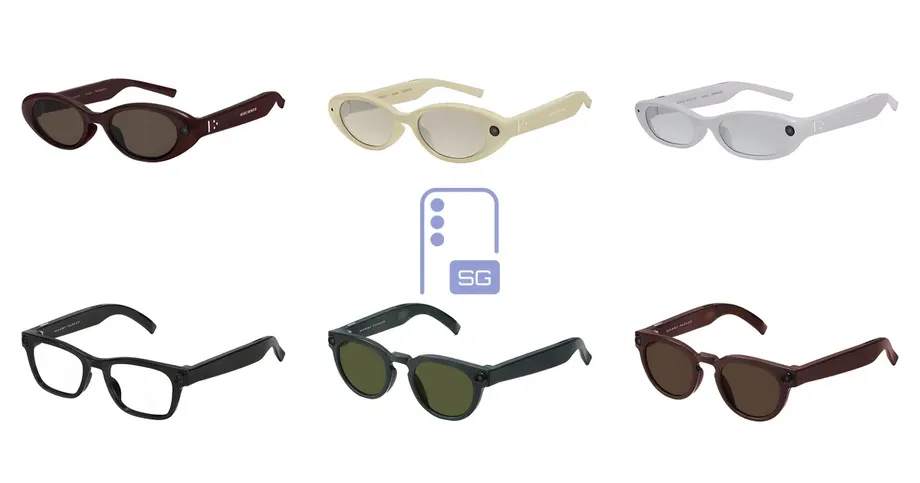
Nine frame designs and a November launch target
Samsung's first smart glasses are expected to reach stores in November 2026, with leaked specifications pointing to nine frame designs, a weight of 41 grams and up to nine hours of battery life. Developed with Gentle Monster and Warby Parker, the glasses combine a camera, microphones and speakers with Google's Gemini assistant, but have no display inside the lenses.
Contents
- Nine frame designs and a November launch target
- How the launch schedule developed
- Gentle Monster and Warby Parker bring different looks
- What the reported hardware would deliver
- Nine hours on the glasses is different from 72 hours with the case
- Gemini turns the camera into an assistant
- Voice, touch and watch controls are not equally settled
- A capture light addresses only part of the privacy concern
- Samsung enters a growing market with a premium price strategy
- Key Points
The November timing is more specific than Samsung's previously announced fall launch window. An October 1 report attributed that timing to a Samsung official, although an exact release date and price have not been announced. The name Galaxy Glasses also remains unconfirmed.
Samsung detailed the product at Galaxy Unpacked in London on July 22, following its first appearance at Google I/O in May. Those presentations established the central features: photographing what the wearer sees, translating text and speech, summarizing messages and providing spoken navigation. The latest leaks add a much broader selection of frames and a fuller hardware specification.
The distinction between announced capabilities and leaked specifications matters. Samsung has described the glasses as a premium product that needs a smartphone connection. Details such as the 41 gram weight, memory, camera resolution, individual frame names and software version requirements come from reports rather than a complete published retail specification.
How the launch schedule developed
The glasses have progressed from an initial design announcement to a more detailed product presentation and then reports of a November release. The sequence helps explain why some accounts give only a season while others identify a month.
- May 2026: Samsung and Google showed Android XR glasses developed with Gentle Monster and Warby Parker at Google I/O.
- July 22, 2026: Samsung detailed camera, audio and AI functions at Galaxy Unpacked in London and showed additional designs.
- October 1, 2026: A report citing a Samsung official identified November as the expected market launch.
- November 2026: The reported release month, with the precise date, prices and complete regional availability still unannounced.
US buyers are expected to be able to purchase the glasses through the Warby Parker and Gentle Monster websites and Samsung Experience Stores. Samsung has also said it will use partner sales channels. That supports the broad distribution strategy, but does not yet establish which designs each outlet will carry or when orders will open.
Gentle Monster and Warby Parker bring different looks
The reported lineup includes six Gentle Monster styles and three Warby Parker styles. Gentle Monster's frames span squared, rounder, bolder square, cat eye, slim oval and regular oval shapes. This is a wider selection than the two initial designs shown during the product's early presentations.
Reported lens colors include clear, light blue, gray, brown, black, light gray, pale lilac, burgundy and cream. These are described as lens options, not necessarily frame finishes, and the reports do not establish that every lens color will be available with every frame.
Warby Parker's reported designs are Alden, Wren and Reid. Alden and Wren are associated with pine, dark green and the reddish brown finish Saddle, while Reid is reported in Jet Black. The July presentations had highlighted a rich brown Warby Parker frame with a subtly upswept brow and a slim black Gentle Monster frame with a straight upper rim and rounded lower edges.
Clear and transition lenses were also shown during the July preview. Transition lenses change their tint with light conditions. Pricing for different lenses, prescription availability and the effect of lens choices on weight have not been established.
The frame selection gives Samsung a way to compete on appearance as well as electronics. Fit remains a separate concern: James Choi, Samsung's executive vice president and head of its XR research and development team, acknowledged that electronics and sensors inside the temples restrict how much they can be adjusted compared with ordinary glasses.
What the reported hardware would deliver
The leaked specification lists Qualcomm's Snapdragon AR1 Gen 1 chip, 2 GB of RAM and 64 GB of storage. Samsung's July presentation also identified the AR1 platform, which is designed for lightweight smart glasses rather than larger immersive headsets.
A reported 12 megapixel camera would record 3K video at 30 frames per second. The glasses are also said to contain two speakers that leave the ears uncovered and four microphones. The camera resolution, video settings and microphone count should still be treated as reported specifications until Samsung publishes the final product details.
At 41 grams with standard lenses, the glasses would be 2 grams lighter than the 43 gram Meta Ray-Ban model used in the reported comparison. That is about a 4.7% reduction, calculated from those two figures. It is a modest difference, and it does not establish that every Samsung frame or prescription configuration will weigh the same.
The hardware is intended to capture pictures and video, make calls, send messages and play music or podcasts. Samsung has also described sharing the wearer's surroundings during video calls. Unlike a phone camera pointed outward by hand, a camera mounted on glasses records roughly from the wearer's viewpoint.
Nine hours on the glasses is different from 72 hours with the case
Battery life is reported at up to nine hours on the glasses, or up to 72 hours when the charging case is included. A separate account of the July announcement describes the case as providing up to seven additional charges.
Those figures are mathematically consistent: one initial nine hour charge plus seven more would total 72 hours. They describe cumulative use between case recharges, not 72 hours of uninterrupted operation while wearing the glasses.
Actual endurance will depend on the mix of camera recording, calls, audio playback and AI requests. The reports do not provide a common test procedure or separate battery figures for each activity, so the nine hour claim cannot yet be translated into a guaranteed day of heavy recording or continuous calls.
The phone connection is another practical limit. Choi said the glasses are not a smartphone replacement because AI processing still relies on the phone. The portable case extends use away from a charger, but it does not remove that dependence on a connected handset.
Gemini turns the camera into an assistant
The glasses run Android XR and use a version of Gemini built for wearables. Android XR is Google's software platform for headsets and smart glasses; it supports devices without displays as well as those with screens. In this product, the main response channel is spoken audio.
Samsung demonstrated a task beyond ordinary photography: capturing a whiteboard or presentation and organizing its key information into notes. Gemini can use the camera image as context, allowing a request to refer to what the wearer is looking at rather than requiring a detailed spoken description.
Other described functions include summarizing long smartphone messages, translating text and audio in real time, giving directions and identifying surroundings. A July preview also described email summaries, recipe guidance and help interpreting signs or menus. Their usefulness will depend on how accurately the assistant understands both the request and the scene.
Won-Joon Choi, chief operating officer of Samsung's Mobile eXperience business, described the intended role of the glasses in the company's announcement:
Intelligent eyewear creates a new point of interaction, bringing more personalized AI assistance naturally into the moments that make up everyday life.
The lack of a display defines how those tasks work. A message can be read aloud or summarized, but it cannot appear as text in the lens. Navigation is delivered through audio rather than a visible arrow over the street. Samsung is developing separate glasses with displays, but has not announced their release date.
Voice, touch and watch controls are not equally settled
Voice commands are a central control method. Reports also describe touch sensitive areas on the temples, a physical power switch and a button that can trigger photo or video capture or summon an assistant. Bixby is described as handling phone apps and eyewear functions such as volume, while Gemini handles broader AI requests.
Accounts differ on the status of watch gestures. One July account says compatible Wear OS watch users will be able to raise a wrist to activate Gemini and use hand gestures for other controls. Another quotes James Choi saying Samsung is testing smartwatch gestures, with Galaxy Ring gestures a possibility rather than a confirmed feature.
A separate preview reported no gesture recognition on the frames for raising or lowering volume. That does not necessarily contradict watch based gestures or the reported touch controls, since these are different input methods. It does mean the complete control scheme should not be assumed from any single description.
The latest reported requirements say Galaxy specific features need a Galaxy S, Z Fold or Z Flip phone running One UI 9 or later. Watch features reportedly require a Galaxy Watch running Wear OS 7 or newer. Earlier accounts refer more broadly to compatible Wear OS watches, leaving support for other brands unresolved.
No health or fitness sensors have been announced for Samsung's glasses. A connection to a watch does not, by itself, mean the frames can measure heart rate, sleep or other body signals. The announced purpose is communication and assistance, rather than replacing a health tracking wearable.
A capture light addresses only part of the privacy concern
The frames shown in July had a visible LED intended to indicate photo or video capture. They also had stereo speakers, microphone openings and a physical capture button. The indicator gives people nearby a signal that recording is taking place, but it does not establish consent or explain what happens to captured information afterward.
Privacy matters particularly for the functions that distinguish these glasses from ordinary eyewear. Reading a presentation, interpreting a whiteboard or showing surroundings during a call can capture information belonging to colleagues, businesses or bystanders as well as the wearer.
James Choi, Samsung's head of XR research and development, discussed public acceptance during the July preview. He pointed to the close proximity of passengers on South Korean public transportation as one setting where concerns can be greater.
Regarding public acceptance, it takes time,
Choi said Samsung was continuing to work on the issue while developing the product. The described features do not establish detailed rules for retention of images, processing of sensitive documents or every recording indicator behavior. Those remain practical details buyers will need to understand before using camera based assistance in shared spaces.
Samsung enters a growing market with a premium price strategy
Samsung is entering a category in which Meta held 69.2% of the smart glasses market in the first quarter of 2026, according to IDC. That is slightly more than two thirds of the market, leaving Samsung to compete against an established product family rather than an empty category.
IDC figures cited in the research put shipments of glasses without displays at 2.25 million in that quarter, up 167% from a year earlier. Its forecast for 2026 is 13.6 million units, rising to 27.3 million in 2030. Those are shipment estimates and projections, not Samsung sales targets.
Other figures measure different periods or categories. Omdia says US smart glasses sales doubled over the past year and global shipments exceeded 4.2 million. The period for that global total is not specified here, so it should not be directly compared with IDC's full year 2026 forecast. Another market analysis projects annual growth above 24% through 2033, but the underlying market definition is not given.
Omdia analyst Qiran Ju described manufacturers' focus as photography and video without holding a device, audio that leaves the ears open and AI assistance built into everyday frames. Samsung's announced functions fit that direction, making price and daily usefulness central points of competition.
Samsung has not disclosed a price. James Choi said the company wanted a reasonable price while positioning the glasses as premium, rather than at the lower end of the market. IDC analyst Francisco Jeronimo suggested $600 to $700 as a possible range, but that is an analyst estimate, not an announced retail price.
The comparison is demanding: Meta introduced an entry level model at $299 in June 2026 and unveiled its $799 Ray-Ban Display glasses in 2025. Samsung's first model lacks a display, so its value case will rest on design, camera and audio performance, Gemini and integration with connected devices rather than a screen inside the lenses.
Choi expects the category to remain a niche market during Samsung's early entry and said sales would not reach 100 million units in those early days. He declined to give Samsung's sales expectations. For prospective buyers, the next concrete milestones are the final launch date, confirmed prices, retail specifications and a clear compatibility list.
Key Points
- Samsung's first smart glasses are expected in November 2026, following an announced fall launch window.
- Reports describe six Gentle Monster styles and three Warby Parker styles, with a weight of 41 grams using standard lenses.
- The glasses use Android XR and Gemini, with camera and audio functions but no lens display.
- Battery claims reach nine hours per charge and 72 hours cumulatively with the charging case.
- A smartphone connection is required; the final scope of watch and ring gesture support is not settled.
- Samsung has not announced prices. The suggested $600 to $700 range is an analyst estimate.
- Final compatibility, regional availability and detailed privacy arrangements still need clarification.